
Lead Editor-Politics
akash.sama[email protected]
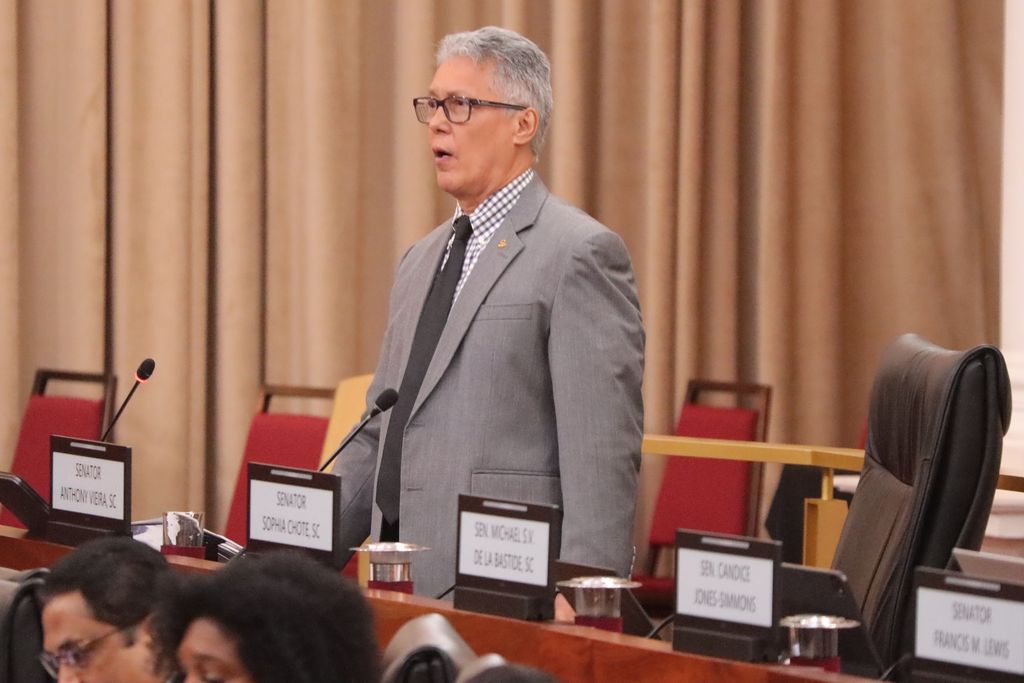
Independent Senator Anthony Vieira says it will take “a lot more than holy water and mantras” to get him to support the Government’s Procurement Bill, as he fired back at Prime Minister Kamla Persad-Bissessar by turning her description of independent senators as “satanic” and “demonic” back on the Government during yesterday’s Senate debate.
Vieira, who raised several concerns about the proposed changes to the country’s procurement framework, also revealed he deliberately decided against preparing amendments to the bill because of Persad-Bissessar’s declaration that her Government would no longer entertain amendments from the independent bench.
Concluding his contribution, Vieira made it clear the bill in its present form would not get his vote.
“Mr President, it is going to take a lot more than holy water and mantras to get me to vote in support of this bill,” he said.
It was not his only reference to the Prime Minister’s recent criticism of independent senators.
Earlier, as he warned about the need for strong safeguards to protect public money from corruption and abuse, Vieira sarcastically embraced the labels directed at the bench.
“Now, Mr President, a benefit of being satanic and demonic is that I have insight into the souls of men,” Vieira said.
“I understand those whose moral compasses and codes are compromised, as I understand the seven deadly sins, in particular, greed.”
His remarks came after Persad-Bissessar strongly criticised all nine independent senators following their decision not to support the Special Operations Bill last week.
The Prime Minister described the senators as “satanic,” “demons” and “scumbags” and accused them of siding with criminals by rejecting the crime-fighting legislation. She subsequently said her Government would no longer accept amendments from the independent bench.
That declaration has now spilled over into the debate on the Public Procurement and Disposal of Public Property (Amendment) Bill.
Vieira said despite his concerns, he believed the Procurement Bill could be improved.
“With all the faults and potential for abuse, with the right amendments, I believe this bill is salvageable,” he said.
However, he said the Prime Minister’s stated position meant he saw little point in spending time drafting amendments.
“I had hoped that the benches would have worked together to avoid a financial ambush dressed up as ease of doing business. But in light of the Prime Minister’s declared refusal to accept amendments from the independent bench, I decided to save my time and energy,” Vieira said.
He said he spent two days working on amendments to the Special Operations legislation in an attempt to improve it, but those proposals were not accepted.
“To no avail. That’s not happening today,” he said.
The Procurement Bill proposes several significant changes to the existing procurement framework, including expanded exemptions covering energy, national security, public-private partnerships for public housing and emergency procurement. It also proposes increasing the simplified procurement threshold to $2 million for certain public bodies, while making changes to the powers and consequences flowing from investigations by the Office of Procurement Regulation (OPR).
Vieira said he was not opposed to making the procurement system more efficient, acknowledging complaints that the existing process can be cumbersome and the current $1 million threshold may be too low for major ministries and State enterprises.
His concern, however, was that the cumulative effect of the amendments would move the country away from independently regulated procurement towards greater administrative discretion, with reporting occurring after transactions have already taken place.
One of his major concerns surrounds the proposed $2 million threshold.
Vieira said increasing the figure from $1 million was not inherently unreasonable. His objection was to removing the simplified procurement framework governing transactions beneath that threshold.
He questioned what would prevent a $10 million requirement from being divided into five procurements of $2 million, warning that legislation had to contemplate the possibility of people attempting to circumvent the rules.
Vieira suggested Government could instead increase the threshold while retaining the simplified procurement regulations, saying this would provide greater efficiency without creating a “regulatory vacuum.”
He also raised concerns about the breadth of the proposed exemptions.
While accepting that energy companies operating in international commodity markets may require greater flexibility, Vieira questioned why that should result in the energy sector as a whole escaping procurement oversight.
He argued that exemptions should apply to specific transactions requiring special treatment rather than entire institutions or sectors.
Vieira took a similar position on national security, acknowledging that some sensitive purchases cannot be subjected to ordinary public tendering but arguing that confidentiality should not mean an absence of accountability. He suggested sensitive information could be supplied confidentially to the Procurement Regulator while retaining an auditing role for the Auditor General.
He also questioned why emergency procurement should be placed outside the act, rather than establishing an expedited emergency procedure within the procurement regime, with requirements for records, reporting and subsequent auditing.
Vieira was also concerned about proposed restrictions surrounding OPR investigations, warning against weakening the regulator to the point where it was effectively left “shouting from the sidelines.”
Towards the end of his contribution, Vieira suggested there was a parallel between what he believed was happening to the regulator and the Government’s treatment of independent senators.
“Sadly, like us on the independent bench, there are those who would like to see her too marginalised, helpless or made useless,” he said.
Vieira said the issue ultimately came down to how much discretion the State should have over public money without independent procedural safeguards.
“We spent years building this system. Let’s improve it. Let’s simplify it and modernise it. Let’s make it work faster. But let’s not dismantle it,” he said.
“I am not willing to sacrifice the guardrails of good governance, ostensibly on the altar of efficiency and ease of doing business.”