
Senior Political Reporter
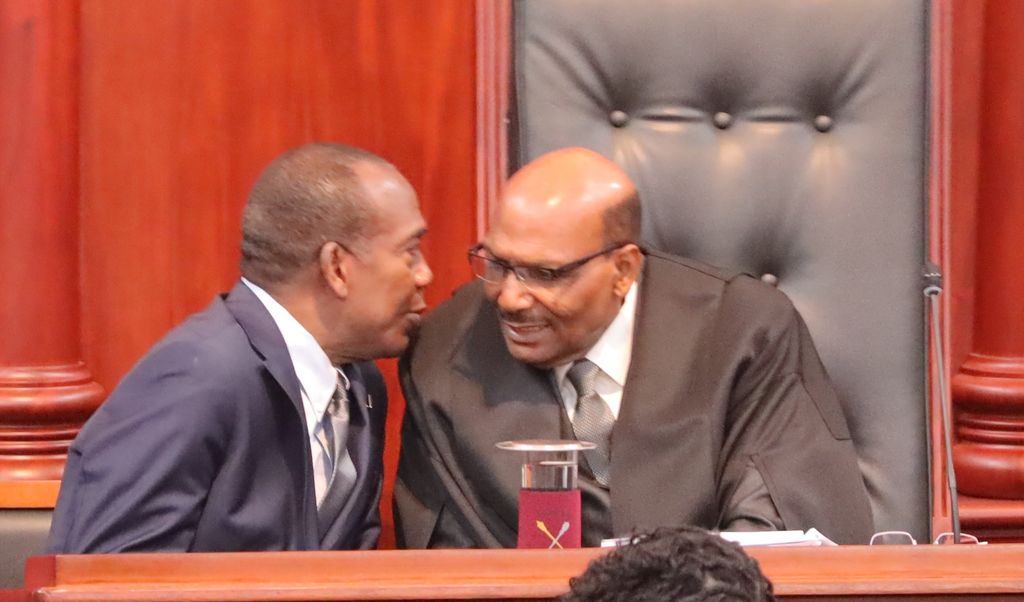
Government Senate Leader Darrell Allahar yesterday defended Senate President Wade Mark’s decision to cast the deciding vote on the Special Operations Bill, arguing the Constitution was never intended to leave an elected government dependent on the support or abstention of an Independent Senator to pass ordinary legislation.
“I do not think that the framers of the Constitution ever intended that an elected government should depend on the vote or abstention of even a single so-called Independent Senator to pass an ordinary bill,” Allahar said.
“If that were so, a democratically elected government would not be able to govern and would be held to ransom by an unelected functionary chosen by the President.”
His comment came even as former deputy house speaker Dr Fuad Khan raised concerns over Mark’s decision to use his casting vote to pass the Government’s Special Operations Bill, noting that Mark invoked the opposite principle during tied votes on the Children’s Life Fund (Amendment) Bill in 2025.
“If the status quo principle was appropriate when Mr Mark invoked it in a previous tied vote in 2025, the public is entitled to know why that principle was not applied on Thursday (yesterday),” Khan said.
All Government senators voted in favour of the legislation, while Opposition People’s National Movement (PNM) senators and Independent senators voted against it, leading to a 15-15 deadlock. The bill was ultimately passed on Mark’s casting vote and would have failed without it.
The legislation required only a simple majority for passage in both the House of Representatives and the Senate. While the Government was able to pass the bill in the House using its majority, the Senate’s composition meant Government senators held 15 votes, equal to the combined total of Opposition and Independent senators.
Mark’s decision has drawn comparisons with his handling of three separate 15-15 votes during the Committee Stage of the Children’s Life Fund (Amendment) Bill on June 23, 2025.
On each occasion, Mark exercised his casting vote on the basis that his duty was to preserve the status quo rather than determine the outcome according to personal preference.
Parliamentary records quote Mark as saying: “I have a casting vote and I cast my vote in favour of the intention of the status quo. I secure and favour the status quo ... so the original provision of the bill remains.”
As a result, the proposed amendments failed and the legislation remained unchanged.
Khan questioned whether Mark’s latest action had brought the Senate into disrepute.
“A casting vote must not become a political instrument. Is Trinidad and Tobago slowly sliding into an undemocratic state?” he asked.
He argued that the Senate President’s casting vote is not an ordinary vote but an exceptional constitutional mechanism intended to resolve equal divisions in the chamber.
“It must therefore be exercised with the greatest possible neutrality, restraint and regard for parliamentary convention,” Khan said.
“President Mark himself demonstrated the appropriate approach in 2025 when confronted with tied votes. He expressly stated his casting vote was being used ‘to secure the status quo’. That makes the present controversy all the more disturbing.”
Khan contended that if parliamentary convention requires a casting vote to preserve the existing position when the Senate is evenly divided, the Senate President cannot use that vote to effect a substantive change in the country’s legislative framework.
“A casting vote should not become a mechanism by which one side of a divided Senate obtains a victory that it could not obtain through its own numerical strength,” he said.
Khan said the Senate’s constitutional role is to provide restraint, deliberation and independent scrutiny of legislation, particularly measures involving extraordinary policing powers, military assistance and special operations.
He said the public was entitled to answers on several questions, including: What precisely was the status quo at the moment the casting vote was exercised? What parliamentary convention was relied upon? Why was the vote exercised in a manner that departed from the principle previously articulated in 2025 by the Senate President, namely to ‘secure the status quo’?
“These questions go to the credibility and impartiality of the Senate itself. The President of the Senate occupies an office that must stand above Government and Opposition. Once the Chair becomes perceived as determining substantive legislative outcomes rather than neutrally applying parliamentary rules, public confidence in the institution is inevitably placed at risk.”
Khan stressed that the issue was not whether individuals supported or opposed the bill, but whether parliamentary rules had been applied consistently.
Also contacted yesterday, Opposition Senate Leader Dr Amery Browne declined to comment directly on Mark’s vote.
Instead, Browne recalled remarks made by late former PNM Senate leader Frankie Khan.
“I only recall the words of the late PNM Senate leader Frankie Khan, who told us that if a government presents a Bill or any other proposal to the Senate and it fails to obtain the support of at least nine Independent Senators, then it is really a sign that the government should re-look the issue and consider returning to the drawing board on it,” Browne said.
“Clearly, this UNC administration has a very different view of democracy and Parliament’s role.”