
Senior Reporter
kaymarie.fletch[email protected]
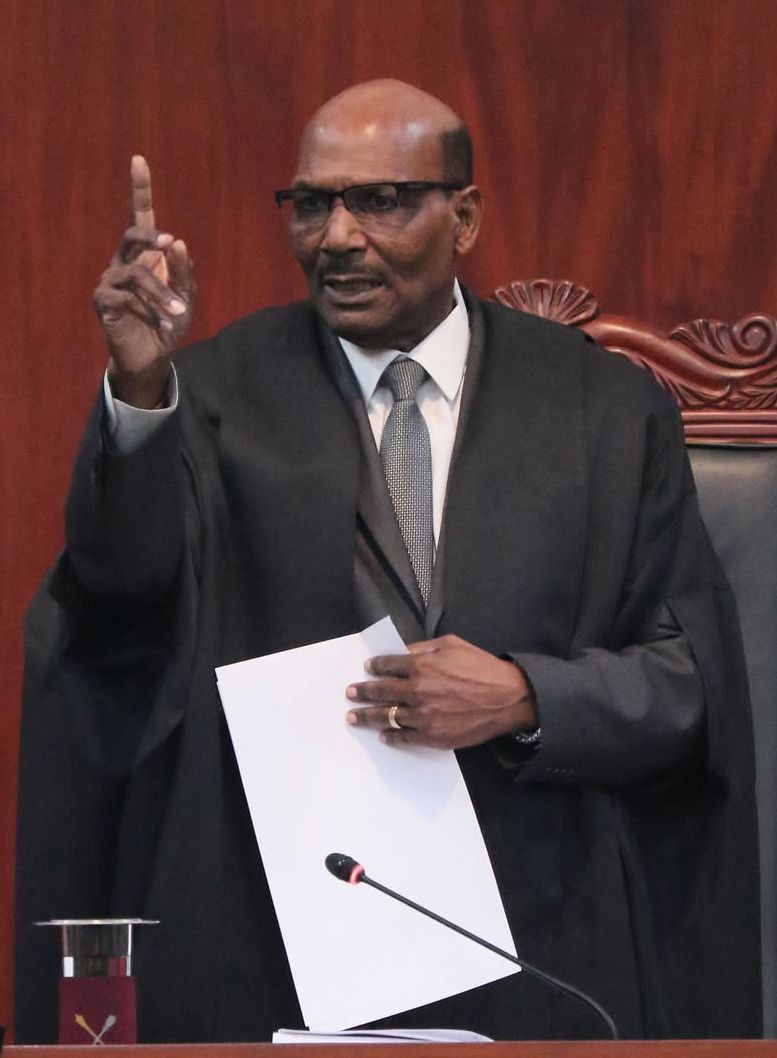
Senate President Wade Mark is refusing to publicly elaborate on his decision to cast the deciding vote in favour of the Government’s Special Operations Bill yesterday, insisting his reasoning belongs on the parliamentary record rather than in public debate.
Mark used his casting vote in the early hours of yesterday to break a 15-15 deadlock and secure passage of the legislation, which has now cleared both Houses of Parliament. The official parliamentary record shows the bill passed its third reading by 16 votes to 15, with no abstentions.
Speaking last night after receiving the Order of the Republic of Trinidad and Tobago at the National Awards ceremony at Queen’s Hall, Mark repeatedly referred questions about his decision to the Hansard, saying he did not want to compromise the office of President of the Senate.
“What I would say is simply this: whatever decision taken by myself, I have placed it in the parliamentary record,” Mark said.
“I do not believe it’s proper for me, as a presiding officer, to engage in a public kind of communication on what may have happened in the Parliament this morning.”
Mark said his position required him to avoid public discussion of Senate proceedings.
“It is not my responsibility, and it’s not my style, to engage in what I call matters of the Parliament, given my role as President of the Senate. That is a very important role and I don’t want to do anything to compromise the office of the President.”
He added that any explanation for his decision was already contained in Hansard and would, in due course, be made available to senators who had requested it.
His comments came hours after he told the Senate that his research had found no settled parliamentary convention requiring a presiding officer to vote to preserve the status quo when exercising a casting vote.
“There is no settled practice in this Parliament based on my research on this issue of the status quo re casting vote,” Mark told senators before siding with the Government.
“I have done the research on this matter. I will make it available at the appropriate time to my colleagues who have requested it. I vote with the ayes, 16.”
The bill subsequently passed 16-15 after all 15 Government senators voted in favour, while the six Opposition senators and nine Independent senators voted against it.
Mark’s intervention followed hours of debate on legislation establishing a framework for special operations in designated areas, including provisions dealing with restrictions on movement, closed areas, detention and oversight. Independent senators sought a series of amendments aimed at strengthening safeguards in the bill, but those proposals were rejected by the Government.
The final vote came after Mark had reportedly exercised a casting vote during the committee stage as well.
The Opposition has since criticised the decision, with Opposition Leader Pennelope Beckles questioning whether the Senate President acted appropriately in casting the deciding vote.
Mark, however, maintained the issue should be assessed through the official parliamentary record.
Pressed on whether he would disclose the research and advice considered before making his decision, Mark said, “As I said, in due course, I will make it available to my colleagues here because it’s in the Hansard, it is in the records.”
He again stressed that no established parliamentary convention governed the exercise of a casting vote.
“As I said, if you go to it, I may simply say that the issue of the casting vote and the status quo have not been settled. It is not a settled practice,” Mark said.
“That is why I placed it on record.”
Mark said it was important for a presiding officer to explain the basis on which a casting vote was exercised when confronted with a tied result.
Drawing a distinction between his political and parliamentary roles, he said: “I always tell journalists, the Speaker, when I was Speaker, does not speak. And the President also does not speak.
“Not because I don’t want to speak, but because the office I hold is a secret office and I have to respect that office.”
He added that, having been elected by Parliament to preside over the Senate, his primary responsibility was to the institution itself.
“I’m responsible to the Parliament,” he said.
Prime Minister Kamla Persad-Bissessar also defended Mark’s decision, arguing there is no established convention requiring a Senate President to vote in favour of preserving the status quo.
Addressing the Independent Senators’ non-support of the bill, she said, “It is very clear they don’t have that interest of the country. They were not elected by anyone, and we are the elected government. We were given a mandate to govern the country.”
Persad-Bissessar said her years in Parliament had brought her to the realisation that the casting vote was a matter of discretion.
“There is no settled practice when it comes to a casting vote,” the Prime Minister said.
“The President of the Senate will exercise his discretion. He could go left, he could go right, or he could just abstain. So he (Mark) has done what is in the law and in the practice.”
The Government’s revised Special Operations Bill required only a simple majority in the Senate, unlike the earlier Zones of Special Operations legislation, which required a three-fifths majority.
With Thursday’s 16-15 vote, it has now cleared both chambers of Parliament and moves to the next stage of the legislative process before implementation.