
Senior Reporter
dareece.po[email protected]
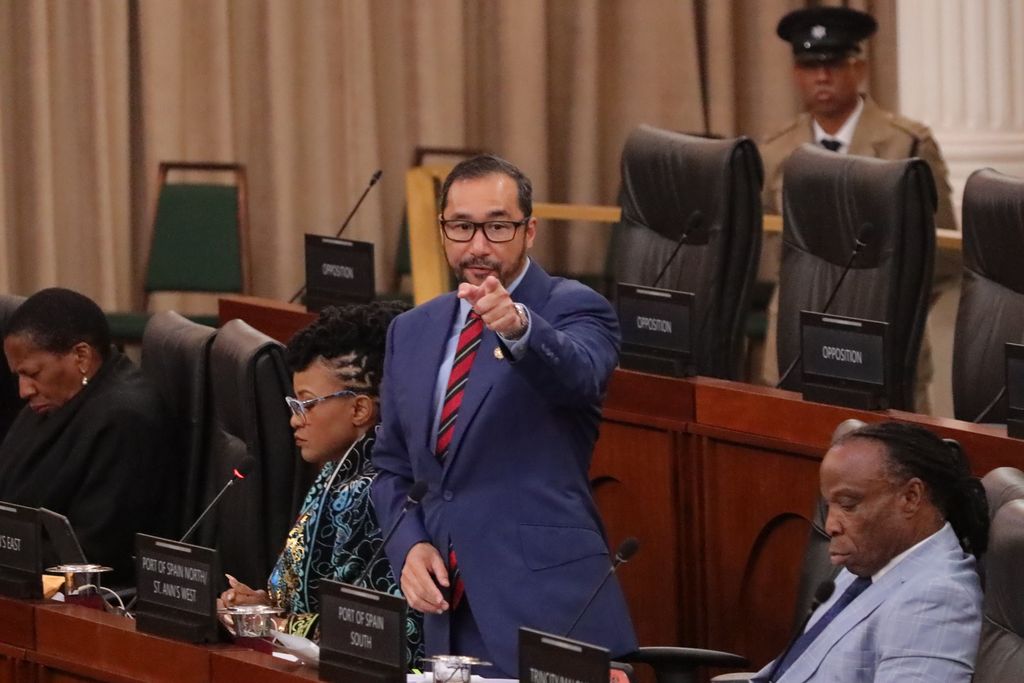
Former prime minister Stuart Young has accused the Government of using the Special Operations Bill to suppress constitutional rights, warning that the legislation could turn Trinidad and Tobago into what he described as a “police State.”
Young made the claims during yesterday’s debate in the House of Representatives, as the Government defended legislation that would establish seven policing districts, six in Trinidad and one in Tobago, and provide a legal framework for special operations involving the T&T Police Service (TTPS) and, where necessary, the Defence Force.
Criticising the pace at which the bill was brought before Parliament, Young described it as a “hustled debate,” saying MPs had been given less than 48 hours to consider what he characterised as far-reaching legislation.
He said the Opposition would not support legislation it considers unconstitutional or designed to suppress citizens’ rights.
“This piece of legislation is dangerous,” Young said.
“The UNC is passing legislation here today that makes Trinidad and Tobago nothing less than a police state, with a trampling of the constitutional rights of all citizens, not just those who engage in criminality.”
Rejecting arguments that law-abiding citizens have nothing to fear from the bill, he called that assertion “complete rubbish.”
Young linked his concerns to the recent State of Emergency, referencing the use of Preventive Detention Orders (PDOs), under which individuals were detained without being charged.
“This bill is unconstitutional and it is further confirmation of the galloping dictatorship that has befallen T&T,” he said.
“The PDO statistics bear that out. Over 800 applied for, over 700 granted, over 500, almost 600 executed. So 600 persons detained. How many charged out of that 500? Just over 200. So what happened to the other 300? Innocent citizens? If they’re not innocent, why didn’t you charge them?”
Young argued that the legislation raised serious concerns about constitutional protections, particularly regarding property rights and the process by which citizens could be deprived of certain freedoms. He focused on provisions governing closed areas, contending that residents and others entering or leaving such zones could be required to obtain permits.
“This bill, and that imposition of a permit system in closed areas for everyone who resides in or has to enter or leave a closed area, is nothing short of what unfortunately is part of this world’s history in South Africa under apartheid. This bill mirrors that,” he said.
Young maintained that the restrictions would primarily affect law-abiding citizens, as criminals could simply relocate their activities elsewhere.
“The criminal element will just pick up and move. The one per cent will leave the closed area. No criminal is going to stay there and say, ‘Well, I am going to operate in a cordoned-off area.’ That’s UNC logic. It doesn’t operate that way. It is the law-abiding citizen, it is your rights they are trampling on.”
He also challenged the role of the President under the proposed legislation, arguing that Cabinet would ultimately determine when an area is designated a closed area.
“Don’t be fooled that the President has any role to play in this apart from a rubber stamp. It is the Cabinet of Trinidad and Tobago that is deciding everything with respect to this bill. So it is the Government that is deciding everything.”
In support of his argument, Young cited Section 80(1) of the Constitution, which generally provides that the President acts in accordance with the advice of Cabinet or a minister acting under Cabinet’s authority, except where the Constitution or law provides otherwise. He said the Government should not seek to shield itself behind the Office of the President.
“They don’t have the guts to face the population and say, ‘Aye, is we the Government, is we the Cabinet who’s going to decide what is a closed area.’ They’re trying to hide behind a President. It is not the President who decides. The President has no say whatsoever, and the courts know that. So that is not a safeguard.”
Young further warned that citizens were becoming desensitised to debates about constitutional rights and that democratic safeguards were being steadily eroded.
“I fear that the population of T&T is becoming so numb to the words ‘constitutional’ and ‘constitutionality’ and their fundamental rights being suppressed that they’re allowing the dictatorship to grow and to gallop. It is not creeping. We are in a dictatorship. That is clear.”
He also referred to recent court decisions in Belize and Jamaica, suggesting those rulings could become relevant if the legislation is challenged before the courts.
Moonilal rejects claims
During his contribution, Minister of Energy and Energy Industries Dr Roodal Moonilal rejected Young’s characterisation of the bill, accusing him of fearmongering and deliberately misleading the public.
Moonilal dismissed the Opposition’s concerns about how citizens would be informed when areas are declared closed, describing them as “futile and irrelevant.”
“The member is wilfully and deliberately misleading the population,” he said.
He stressed that a closed area would not necessarily encompass an entire policing district, noting that the legislation allows for smaller zones to be designated based on intelligence gathered by law enforcement.
“A closed area could be a few streets, a closed area could be one street, a closed area could be his house. A closed area is any area within a district,” Moonilal said.
He explained that police would use intelligence to identify locations where serious criminal threats exist rather than automatically placing an entire district under restrictions.
Moonilal also rejected concerns that the legislation could lead to a nationwide curfew or the militarisation of society.
“The issue of militarising society doesn’t stand here. The military is helping the police. They have resources, manpower and equipment. They are helping and working with the police under a statutory framework for the first time, I think,” he said.
He maintained that the involvement of Defence Force personnel alongside police officers did not mean security forces would operate outside the law.
While acknowledging that criminals may move from one area to another, Moonilal argued that this did not undermine the effectiveness of the proposed measures. He also dismissed concerns that the Government was seeking to circumvent parliamentary oversight, noting that legal mechanisms remained available to challenge any disputed actions.
“You can file anytime. There are instruments available in opposition to that,” he said.
Related News

563 SoE detainees to be freed in batches over six days

PCTT urges holistic preparation as new academic year begins
PM tells parents to do their part before children end up in court