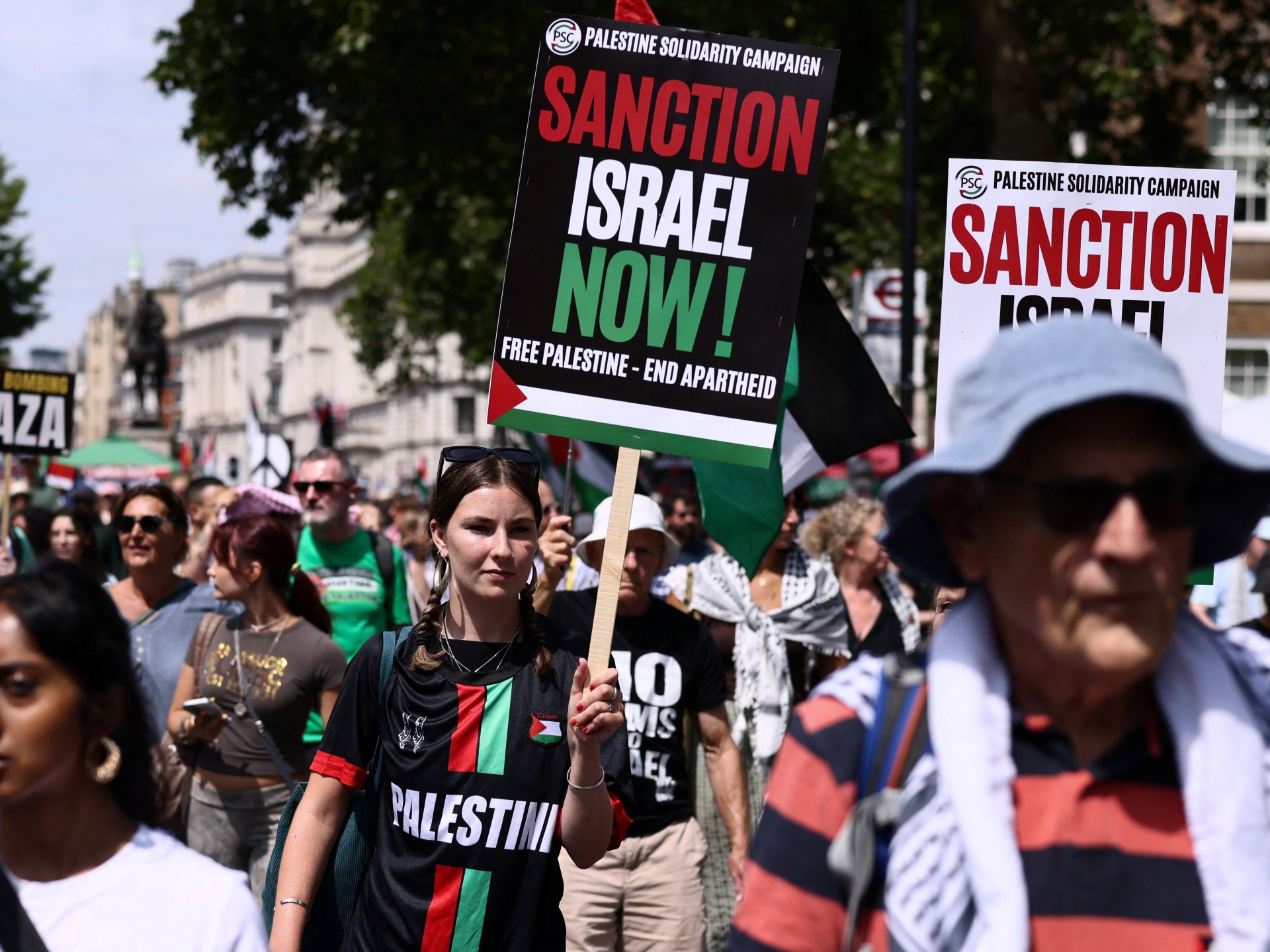

East London’s Hackney Council is to vote on a motion to “de-twin” from Israel’s Haifa after almost six decades in protest against Israel’s genocidal war on Gaza.
The London Borough of Hackney and Israel’s third largest city, which is north of Tel Aviv on the Mediterranean coast, made a twinning declaration on July 26, 1968, pledging to encourage “friendly contacts and exchanges between the ordinary citizens”.
- list 1 of 3Thousands rally in London in support of Gaza, demand new PM take action
- list 2 of 3Andy Burnham’s in-tray: The challenges facing the new UK PM
- list 3 of 3‘Active in BDS’: Document reveals how Israel scrutinised global NGOs
end of list
The arrangement was part of a longstanding tradition for cities in the United Kingdom to pair up with foreign cities in a bid to encourage cultural exchanges, trade and tourism between them.
According to the council, the agreement with Haifa has been “dormant” since the COVID-19 pandemic and the council “will not engage in any twinning activity with Haifa whilst conflict is ongoing”.
During local elections in May, which saw the Green Party take over control of Hackney Council from the ruling Labour Party, the topic of de-twinning from the Israeli city altogether became a key issue. The Green Party has long taken a strongly pro-Palestine stance and has voiced opposition to Israel’s war on Gaza.
As a result, on Tuesday evening, the council is scheduled to vote on a motion that would terminate the agreement with Haifa and review Hackney’s twinning programmes generally.
The move has received backlash from Jewish groups in England.
Al Jazeera approached Hackney Council for comment but has not yet received a response.
Here’s what we know:
Why is Hackney proposing to ‘de-twin’ with Haifa?
According to Hackney Council documents published before the vote, the council has been petitioned to end twinning relations in protest against the war on Gaza and the ongoing humanitarian crisis in the enclave.
Advertisement
In 2024, the Hackney Palestinian Solidarity Campaign submitted a petition to end the twinning partnership. Former Hackney Mayor Caroline Woodley said the agreement was “inactive” and would be reviewed once the conflict ended.
A cross-party motion was again launched in October by the Greens and Hackney Independent Socialist Groups.
The council said public calls have only “intensified” since a September report by the Independent International Commission of Inquiry on the Occupied Palestinian Territory, a United Nations fact-finding mission. Its report accused Israeli forces of breaches of international law and the Genocide Convention in Gaza and in the occupied West Bank, where violence against Palestinians has been on the rise for some time.
“Residents have also raised concerns that Haifa functions as a primary state naval facility and serves as the global headquarters for defence manufacturers, including Elbit Systems,” the council added.
Alongside the motion to terminate the twinning agreement with Haifa, a cross-party twinning working group has also been proposed.
What has the Green Party said?
In the Hackney Greens’ manifesto in the run-up to May’s local elections, the party stated: “In Haifa, Palestinian people live under occupation and apartheid by the Israeli state; this is not a city that reflects Hackney’s values. Hackney’s current and future twinning relationships should reflect our values, rather than undermine them.”
It pledged that the Hackney Greens would de-twin from Haifa at the “earliest opportunity”, undertake a full review into all existing twinning relationships that fail to “uphold equal human rights or participate in apartheid, systemic oppression or genocide”, and “explore new twinning models rooted in solidarity”.
What has been the response from Jewish groups?
Phil Rosenberg, the president of the Board of Deputies of British Jews, which represents the UK’s Jewish community, slammed the Greens’ motion, calling it “spite over sense”.
“If Hackney Greens had any genuine interest in peace they would celebrate Haifa, not censure it. Haifa is a mixed city, led by a progressive Mayor. Second largest party on council are the Greens. Arab councillors increased their presence at the last election,” Rosenberg wrote in a post on X last week.
Haifa remains Israel’s largest mixed Arab-Jewish city. Since the war on Gaza began in October 2023, it has frequently seen antiwar protests from Israeli and Palestinian residents that have been met with Israeli police dispersing the crowds.
Advertisement
Former Hackney Councillor and Labour MP Luke Akehurst also criticised the motion, saying he was “disgusted by the performative and spiteful gesture politics” from the Greens to terminate the twinning agreement.
“The twinning happened because Hackney’s large Jewish community had family and personal links there. Haifa is a famously left-wing city (ironically the Israeli Greens are quite strong there) that is a model for coexistence between Jews and Arabs,” Akehurst wrote on X last week.
“The twinning arrangement includes medical exchanges between the Homerton and Rambam hospitals. If you want peace between Israel and the Palestinians you should support initiatives that bring people together and create understanding, not cancel or boycott them,” he added.
According to Hackney Council, which cited the 2021 census, 6.7 percent of Hackney’s population is Jewish. However, it added that the census likely underestimated the number of Jewish residents, “potentially underestimating children by as much as 35 percent”.
Which other British cities are twinned with Israeli cities?
In northern England, the city of Newcastle also has a twinning arrangement with Haifa.
Bournemouth and Portsmouth in the south of England are twinned with the Israeli resort of Netanya. In North London, the Borough of Barnet is twinned with the suburb of Ramat Gan in Tel Aviv.
The civil parish of Elstree and Borehamwood in Hertfordshire is also twinned with the Israeli town of Shoham.
Related News
VIDEO: Mikel Merino the hero as Spain beats Belgium, move on to semifinals

China and Russia to hold annual joint naval drills
Tehran slams Trump’s threat to use frozen Iranian assets as ‘incendiary’