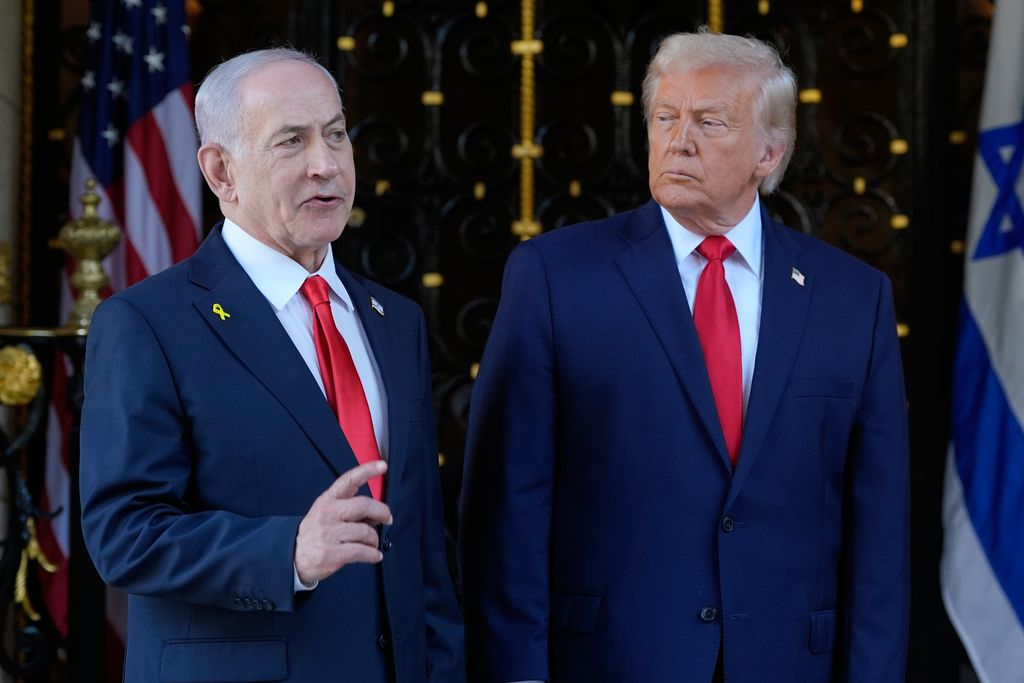

Israeli Prime Minister Benjamin Netanyahu and President Donald Trump met at the White House on Tuesday for the first time since they launched a joint war against Iran, offering a chance for Netanyahu to smooth out strains in their relationship.
The closed-door meeting lasted nearly an hour and a half and was “positive and productive,” according to White House press secretary Karoline Leavitt. The White House and prime minister’s office did not immediately offer more details.
It comes as both face growing pressures at home. Netanyahu is up for re-election and is embattled in part because of his deteriorating relationship with Trump. Trump is under pressure to end an unpopular war that has wreaked economic havoc and driven prices higher ahead of midterm elections this November.
Trump revealed some tension with Netanyahu ahead of their meeting, complaining about reports that the Israeli leader plans to discuss intelligence on Iranian activities at Pickaxe Mountain, a potential nuclear site that the U.S. president has threatened repeatedly to bomb.
“I know exactly what’s going on at Pickaxe,” Trump told “Fox & Friends.” He insisted that whatever Iran is doing is “not a big problem” and that “Bibi’s telling me that because he wants me to stay involved.”
“Why do you have to announce to the world?” Trump added, flashing his frustrations with his ally.
Near the White House where the public was able to gather near fencing, a small group of protesters chanted, “Netanyahu, you’re a tyrant” and “Bibi, you’re not welcome here,” referencing the prime minister’s nickname.
The two leaders also planned to discuss the framework agreement the U.S. and Israel signed with Lebanon over the Israel-Hezbollah war and the expansion of the Abraham Accords, according to a White House official, who spoke on condition of anonymity to preview the meeting.
“We have a little difference,” Trump said Monday when asked by reporters if he and Netanyahu were on the same page on Iran. “But pretty close, yeah.”
Trump and Netanyahu’s relationship has ebbed before
Trump has had a hot-and-cold history with Netanyahu over the years, but upon his return to the White House last year, their alliance seemed stronger than ever. When they started the war together in February, it was with a united front, touting their respective militaries as acting in lockstep to take out Iran’s leadership and pave the way for a government more friendly to the West.
But as Iran fought back — sending drones and missiles slamming into U.S. bases and high-rises in cities in the Gulf and choking off the Strait of Hormuz — Trump came under immense pressure both at home and by allies in the region to end the conflict.
Since then, Netanyahu, who wanted to continue the fighting in Iran and against its ally, Hezbollah, in Lebanon, has been sidelined as Trump sought a deal with Tehran. His visit to the White House this week comes as the disagreements with Trump and Vice President JD Vance have burst into the open over the war in Iran and more.
“The Americans are making it clear to the Israelis they are the ones who are running the war,” Israeli journalist and political analyst Amit Segal wrote Monday in the daily newspaper, Israel Hayom. “It is clear to everyone that Israel has been put in the back seat.”
Netanyahu keeping focus on Iran’s nuclear program
With U.S.-Iran tensions flaring again in recent weeks, Netanyahu planned to share with Trump Israeli intelligence on Tehran’s nuclear program, according to a person familiar with Netanyahu’s visit, who spoke on the condition of anonymity because they were not authorized to speak to the media.
Israel’s United Nations Ambassador Danny Danon told reporters in New York on Tuesday that Netanyahu wants to hear what Trump would like to see over the coming days and weeks.
“I cannot tell you which direction it will go. There are different options,” he said. “We are prepared for all scenarios, and we will discuss it with the president.”
Netanyahu said Sunday that he hoped to sit down with Trump “to hear what he has in mind” for Iran.
“Because I think, in many ways, it’s his decision” on how to move forward, Netanyahu told Maria Bartiromo on Fox News Channel’s “Sunday Morning Futures.” “If he can do so without returning to intense military fighting, that’s fine. Why not?
“But one way or the other, they have to end their nuclear program,” he said of Iran.
Steps to allow other forces in Gaza and in Lebanon
But even as Netanyahu sees an opportunity, he also needs to persuade Trump that he won’t play spoiler to U.S. diplomatic and reconstruction efforts in Gaza and in Lebanon, where the president has previously complained that “too many people are being killed” by Israeli strikes.
Israel has taken recent steps in both places.
In Lebanon, where the Israeli military occupies much of the south, Israel agreed to allow the Lebanese army to deploy to some villages as part of a “pilot program” testing their ability to secure areas where Hezbollah once operated. The U.S. State Department said Monday that the next round of talks between Israel and Lebanon will take place next week in Rome with a focus on expanding the program.
On Gaza, Israel’s security cabinet green-lit on Sunday a measure that would, in theory, grant entry to the first members of an international stabilization force outlined last year in a U.S.-backed ceasefire deal between Israel and Hamas.
Few countries have pledged troops for the force, however, and Israel would approve their entry into Gaza on a case-by-case basis.
The troops — including from Morocco and Uganda — would only be allowed to operate in a small, desolate area in Rafah in the south, where the plan is to vet and house some displaced Palestinians.
The Israeli military continues to carry out strikes it says target militants but that have also killed civilians.
Support for Israel has eroded
Israel has lost a significant amount of bipartisan support in the United States, particularly over its conduct in Gaza.
In June, Vance warned Israeli officials that Trump was their only friend among world leaders. Vance is expected to attend the meeting with Netanyahu, according to a person familiar with the plan who was not authorized to speak publicly and spoke on condition of anonymity.
An AP-NORC poll published earlier this month found a dramatic erosion of support among American adults for Israel.
“We’ve lost America. Thank you, Bibi,” wrote Ben Caspit, a political commentator for Israel’s Maariv newspaper. — WASHINGTON (AP)
_________
Story by ERIN CUNNINGHAM and MICHELLE L. PRICE | Associated Press
Associated Press writers Melanie Lidman in Tel Aviv, Israel; Darlene Superville and Seung Min Kim in Washington; Edith M. Lederer at the United Nations; and Bill Barrow in Atlanta contributed to this report. Erin Cunningham reported from Jerusalem.
Related News

Ministry touts steelpan’s role in shaping young people and cultural industry

AG defends Commission of Inquiry into ill-fated MV Barima tragedy

Running dry: T&T warned to rethink how it manages water