
Senior Reporter
shane.su[email protected]
As local and international authorities continue to focus efforts on dismantling drug trafficking networks, Prime Minister Kamla Persad-Bissessar and the Trinidad and Tobago Police Service (TTPS) say getting narcotics off the street is just one part of wider strategies to tackle the illicit trade.
Another key element includes following the funds generated by the drug trade, which Persad-Bissessar says is already underway by local authorities and their international counterparts.
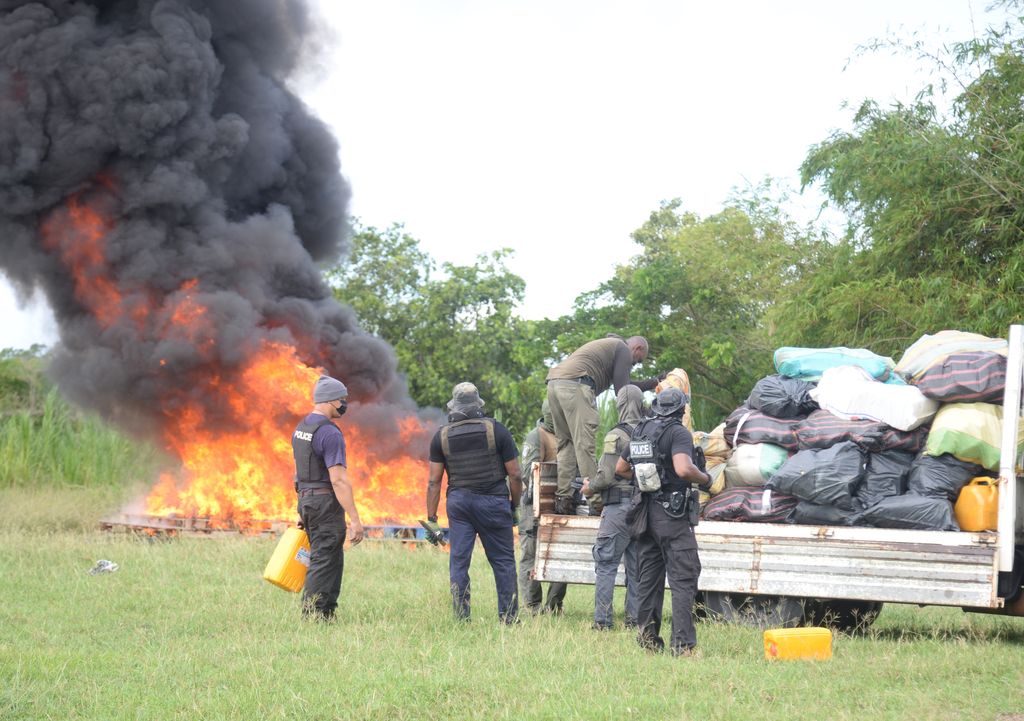
Persad-Bissessar made the remarks on her official Facebook account yesterday, hours after officers from the Special Investigations Unit (SIU), supervised by Police Commissioner Allister Guevarro, destroyed an estimated $1.68 billion worth of assorted drugs at the Caroni Cremation Site.
In her post, Persad-Bissessar commended the authorities for their work, noting that the cash value of the drugs destroyed represented an estimated one per cent of T&T’s annual GDP (gross domestic product), as she emphasised the lucrative nature of the drug trade.
She added that “local drug mafia” would face continued pressure from the authorities on multiple fronts.
“Not only are we going after their physical shipments of drugs, we are also displacing their accomplices in our financial institutions, distribution networks and public sector with the help of international law enforcement.”
Persad-Bissessar also accused the People’s National Movement (PNM) of allowing these networks to “run rampant” during their successive administrations.
“The local drug mafia that got so much under the PNM’s time in office is over.”
Addressing reporters at the cremation site yesterday, Police Commissioner Allister Guevarro also stressed the role of drugs in fuelling violent crime.
“The mere fact that we’re able to destroy $1.68 billion worth of narcotics here for the world to see means that it’s a lot of narcotics that isn’t making it into the hands of our children, a lot of narcotics that is not being sold to fuel gang violence against our citizens,” he said.
While a specific breakdown of the types of drugs was not available in detail, Guevarro said the narcotics destroyed included marijuana, cocaine and synthetic drugs like ecstasy, which were relatively new additions to the local drug market.
According to data compiled by the TTPS Crime and Problem Analysis branch, an estimated 211.87 kilogrammes of cocaine were seized in 2025 compared to 92 kilogrammes in 2024 and 237.67 kilogrammes in 2023.
Responding to the relatively sharp increase in cocaine between 2024 and 2025, Guevarro said such statistics were a positive indicator of police activity.
“We have more being seized; that means that the operations the police are carrying out are more successful in removing it from the streets.
“Yesterday (Monday), there was another successful operation by the Coast Guard during an interdiction, and very soon you may be seeing those drugs being destroyed as well.
“When those numbers go up, it gives me pleasure as head of the TTPS to realise that operations are working.”
Head of the Criminal Division ACP Kerwin Francis said in addition to intercepting and confiscating drug shipments, another element of anti-drug efforts was financial investigations aimed at following the flow of funds generated by the illegal trade.
“Once there is a (financial) benefit, those matters are taken before the court so that we can have confiscation orders made, and while those financial investigations are going on, we have the opportunity to restrain property that can be forfeited to the state, sold and the funds deposited to the seized assets fund.”
Data provided by the TTPS showed that a total of $5,676,710 was forfeited between January 1, 2025 and September 17, 2025 from various police divisions.
When asked about the proliferation of synthetic drugs like ketamine and fentanyl, Francis said that while such narcotics were seized locally, they did not appear to be consumed in large amounts.
He said the police were monitoring drug patterns and would take steps to address it if it showed widespread usage.
“We have not seen a large influx of that drug hitting the market, but because we have our ongoing monitoring systems, we are keeping a close eye on that development, and once there’s a need for a greater intervention, we will surely engage the policy-makers so that we can put those legislative mechanisms in place to curb the use of that particular dangerous drugs.”
He noted that given T&T’s landscape as an island, coastal divisions such as the North Eastern Division, the Eastern Division and the South-Western Division were “prone” to drug trafficking.
Gonzales hits back
at PM for blame
Responding to Guardian Media’s questions via WhatsApp yesterday, chairman of the PNM and former national security minister Marvin Gonzales described the Prime Minister’s accusations towards his party as a “satanic lie,” noting that she could not claim responsibility for drugs that were seized by police, using intelligence obtained years prior.
“These drugs were reportedly accumulated from seizures dating back to March 2005. That means a substantial portion—quite possibly the overwhelming majority—was seized while the PNM was in government between March 2005 and April 2025.”
He also questioned the UNC’s ability to effectively confront drug trafficking and accused her of attempting to weave her own narrative.
“The destruction of these drugs is a credit to the police officers and other law enforcement personnel responsible for the seizures—many of which occurred under the former PNM Government. It is not a political trophy for the Prime Minister.
“Kamla Persad-Bissessar cannot rewrite four years of seizures, erase her own disastrous national security record and manufacture political success from one cremation exercise.
“The dates matter. The facts matter. And the country remembers. It is time to burn and cremate the daily tissues of lies that emerge from the tongue of the Prime Minister.”