
Senior Reporter
dareece.po[email protected]
As Parliament prepares to debate the Special Operations Bill today, a dispute over the Trinidad and Tobago Police Service’s (TTPS) body-worn camera capacity has raised fresh questions about the safeguards that would accompany the expanded police powers proposed under the legislation.
Police Commissioner Allister Guevarro said yesterday that just over 100 body cameras were currently operational within the TTPS. However, former police commissioner Gary Griffith challenged that claim, disputing the reported battery limitations of the devices and questioning what had become of hundreds of cameras acquired during his tenure.
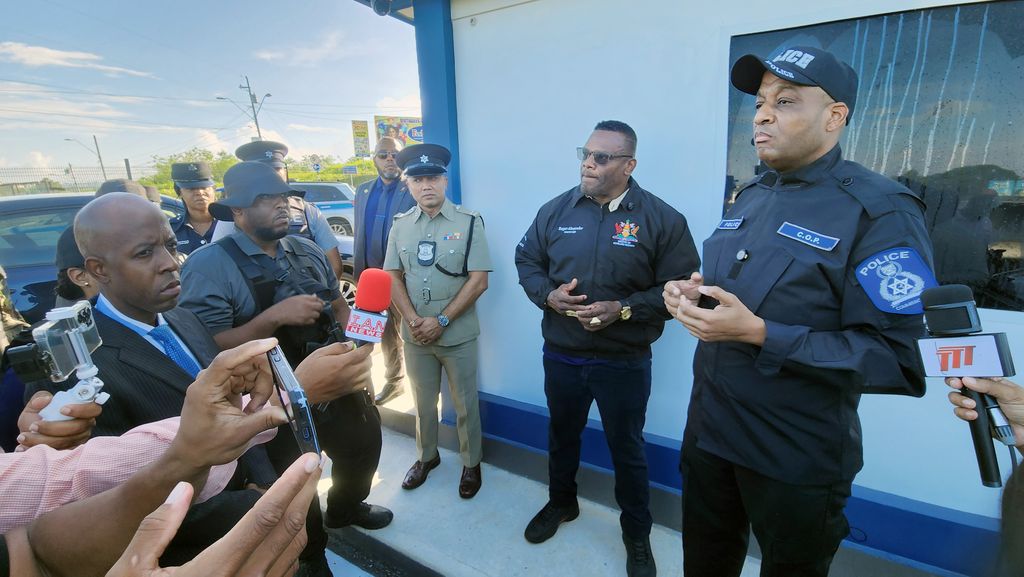
Guevarro was speaking to reporters at the opening of the Grand Bazaar Police Post, where he revealed that the TTPS was in the process of procuring additional body cameras. He did not indicate when the new devices were expected to arrive.
“I’ve always been very transparent with the fact that we only have one hundred and something working body cams at this time. We are currently in the procurement process and, as you all know, OPR is very strict,” Guevarro said.
The commissioner said the available cameras had been deployed to frontline officers but acknowledged that their limited battery life created operational challenges.
“Balancing the stock wouldn’t really be an issue because they are already deployed to frontline policing officers. The problem with the stock of body cams is that the battery charge is only about an hour and a half to two hours. So, even if a patrol goes out, by the time you reach an hour and a half, the battery goes dead,” he said.
Guevarro also expressed concern about officers manually switching cameras on and off during operations.
“Those particular body cams, once you put it on, stay on. I will not encourage officers to start and stop recordings because it will lend to a narrative of integrity issues in the recording. We were told that they were Axon body cameras, but they were not, sadly,” he said.
Griffith, who served as commissioner between 2018 and 2021, rejected Guevarro’s explanation regarding battery life, arguing that the cameras referenced should function for significantly longer periods.
“Everybody could type Google. Go on it. You will see five to 15 hours. If it is that there was an inferior model, that is one thing. But there were hundreds upon hundreds of Getac and Axon body cameras. To pinpoint and say these body cameras are not effective, can be turned on and off, and have a low battery life, I am challenging him on it because something is wrong,” Griffith said.
The former commissioner also questioned proposals to acquire as many as 7,000 cameras, arguing that the number far exceeded operational needs.
“You do not need more than 1,000 because you do not have more than one-seventh of the police service on operational active duty at any one time. This attempt to purchase 7,000 body cameras, one for every police officer, makes little sense when two-thirds of officers are not on operational duty and instead perform logistics, administrative, welfare, human resources or finance functions,” he said.
Griffith further criticised the pace of the current procurement process, noting that the TTPS had acquired 1,000 body cameras within two months during his tenure after funding was approved.
For Griffith, however, the issue goes beyond the number of cameras available. He argued that equal attention must be given to how footage is stored, managed and presented in court.
“There must be an arm, an entity outside of the police service. It can’t be the police extracting the footage, securing it, monitoring it, storing it and then sending it to the court. Things can happen. Things can be misplaced. Things can be cut and pasted,” he said.
Griffith proposed that an independent third-party agency be responsible for managing body-camera footage to ensure transparency and preserve public confidence in the integrity of the recordings.
“There should be an external agency, outside of the police service, doing the monitoring, securing, saving, extracting and forwarding of recordings to the court if required. That is important. It can’t be the police recording and then the police securing the recording,” he said.
Acknowledging that some officers may be wary of mandatory body-camera use, Griffith argued that the technology should not be viewed solely as a tool for investigating allegations of police misconduct.
He said body-camera footage can also protect officers by providing an objective record of interactions and helping to refute false or unfounded complaints made against them by members of the public.