
Senior Political Reporter
Former House speaker Nizam Mohammed says former House speaker Bridgid Annisette-George’s use of her casting vote in 2017 is not comparable to Senate President Wade Mark’s tie-breaking vote last Thursday that enabled passage of the Government’s Special Operations Bill.
According to Mohammed, Annisette-George’s casting votes dealt strictly with procedural matters designed to allow further debate or consideration of legislation back then. They neither passed, defeated nor amended any bills, leaving the status quo intact, he added yesterday.
His comments came in response to constitutional expert Professor Hamid Ghany’s analysis of the controversy surrounding Mark’s casting vote, which broke a 15-15 deadlock in the Senate between Government senators supporting the Special Operations Bill and Opposition People’s National Movement (PNM) and Independent senators opposing it. Mark’s decision has triggered debate because of the longstanding parliamentary convention, inherited from the British system, that presiding officers should use a casting vote to preserve the status quo when votes are tied. Notably, Mark himself voted to maintain the status quo in 2025 during deliberations on amendments to the Children’s Life Fund Bill.
While Ghany argued that Mark was under no obligation to cast his vote in any particular way, he also contended that the convention had effectively been displaced in 2017 when Annisette-George used her casting vote on four occasions, siding with the then PNM government and altering procedural outcomes.
Mohammed, an attorney, agreed only in part.
“I agree with part of Professor Ghany’s analysis, but not with the conclusion that the convention ceased to have relevance in Trinidad and Tobago in 2017,” he said.
“The Constitution requires the presiding officer to exercise a casting vote where the votes are equally divided, but it does not state how that vote must be cast. The traditional parliamentary convention therefore remains important in explaining how that discretion should ordinarily be exercised.”
Mohammed argued that the four votes cited by Ghany do not support the claim that the convention was abandoned.
“The 2017 votes must be examined in context,” he said. “They concerned adjournment, continuation of debate and consideration of amendments. They did not amount to a presiding officer using a casting vote to supply the majority necessary to effect substantive legislative change.”
Referring to Parliament’s Hansard records, Mohammed outlined the four instances:
March 15, 2017: Indictable Offences (Pre-Trial Procedure) Bill
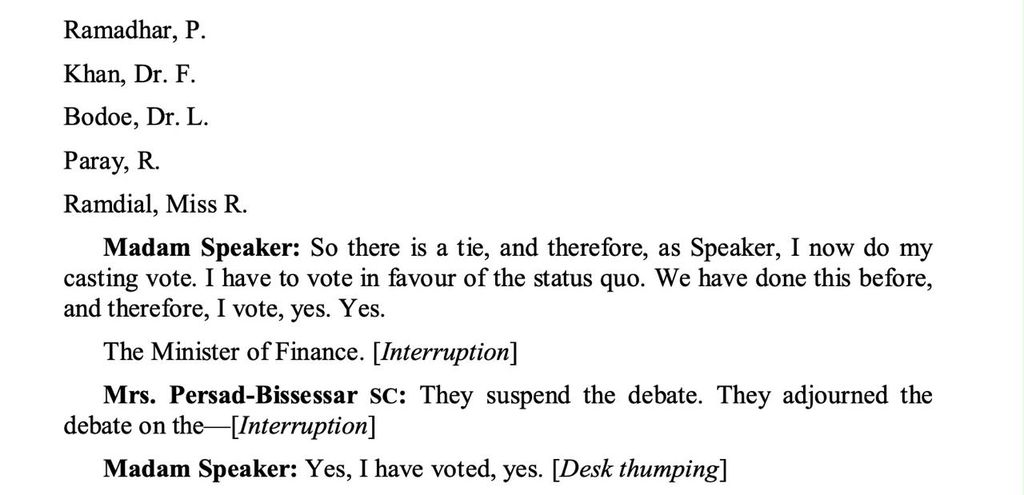
The tied vote concerned whether debate on the bill should be adjourned. Annisette-George voted in favour of adjournment, stating she was required to vote “in favour of the status quo.” As a result, the bill remained before the House for further consideration.
According to the Hansard record, she said: “Therefore, as Speaker, I now do my casting vote. I have to vote in favour of the status quo. We have done this before and therefore I vote yes. Yes.”
September 8, 2017: Bail Bill Amendments
A tied vote arose over whether debate on Senate amendments to the Bail Bill should be adjourned. Annisette-George again voted for adjournment, leaving the substantive issue unresolved.
September 8, 2017: Criminal Procedure (Plea Discussion and Plea Agreement) Bill
The House was tied on whether Senate amendments to the bill should be considered. Annisette-George voted in favour of consideration, allowing debate to continue rather than terminating proceedings on the matter.
September 8, 2017: Adjournment of the House
The House split 17-17 on a motion to adjourn until the following week. Annisette-George cast her vote in favour of adjournment.
Mohammed maintained that none of these votes resulted in legislation being enacted, defeated or amended.
“Those votes do not establish any change in the principle historically followed by Trinidad and Tobago’s presiding officers,” he said. “Certainly not to the extent of supporting the proposition that a casting vote may be used to create substantive legislative change where a government fails to secure a majority.”
He added that Ghany’s interpretation “appears skewed,” arguing that the 2017 precedents cannot be used to justify the use of a casting vote to secure passage of legislation that would otherwise have failed to obtain majority support.
Mohammed said Erskine May, widely regarded as the authoritative guide to parliamentary procedure, acknowledges that a presiding officer is not legally bound to cast a deciding vote in a particular way and may, strictly speaking, vote according to conscience. However, he noted that Erskine May immediately goes on to explain that to preserve the Chair’s impartiality, the established practice is to exercise the casting vote, where practicable, in a manner that prevents the decision of the House from being made final solely by that vote.
Mohammed said Erskine May identifies three longstanding principles governing the casting vote: to allow further discussion where possible; where further discussion is impossible, not to permit a substantive decision to be made without a majority; and, when deciding amendments, to preserve the existing text.
“So it is accurate to say these principles are parliamentary conventions rather than express constitutional directions,” Mohammed said. “It is much more difficult, however, to derive from Erskine May the proposition that the presiding officer is simply free to vote as he or she wishes and that preservation of the status quo is no longer relevant. Erskine May expressly continues to recognise and explain those principles.”
He added that a presiding officer’s departure from convention on a particular occasion does not necessarily extinguish a constitutional convention, particularly when later presiding officers continued to apply it.
“That is especially so where presiding officers after Annisette-George, namely former Senate president Christine Kangaloo and Wade Mark in 2025, continued applying the status quo principle,” Mohammed said.
He argued that this record contradicted Mark’s more recent claim that there has been “no consistent practice in Trinidad and Tobago” governing the exercise of the casting vote.
“That history sits uneasily with Senate President Mark’s assertion,” Mohammed said.
“His conduct in 2025 suggests otherwise. He did not then treat the casting vote as an entirely unfettered discretion. He identified the governing principle, namely preservation of the status quo, and applied it repeatedly.”
Reiterating Erskine May’s three guiding principles, Mohammed said: “Where a casting vote is the vote that itself produces a final substantive legislative change despite there being no majority among members voting, that is difficult to reconcile with May’s second principle. That is quite different from casting a vote to adjourn proceedings or permit further consideration.”