Sturge asks critics of Special Operations: Do you rather a police state or bandit state?
 20 September 2026

Shane Superville
Senior Reporter
shane.su[email protected]
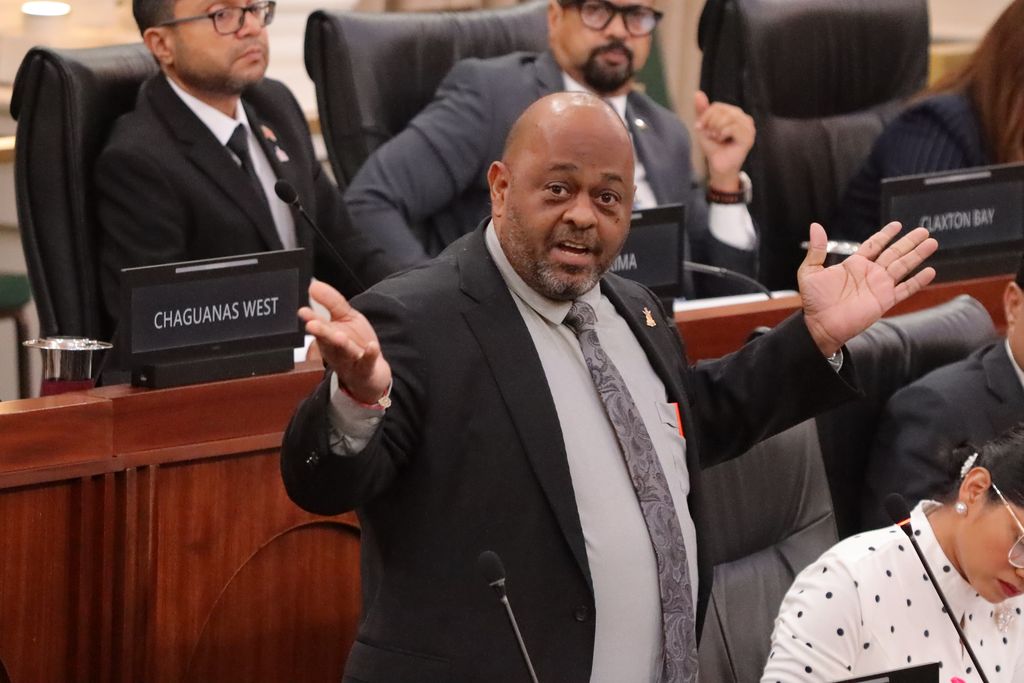
Defence Minister Wayne Sturge has doubled down on the Government's introduction of the Special Operations Bill as a crime-fighting measure, challenging critics of the strategy who have described it as the first step towards a "police state," to consider the alternative as a "bandit state" ruled by violent criminals.
The Bill was passed in the Lower House with a simple majority early on Saturday morning.
It replaces the defeated Zones of Special Operations (ZOSO) Bill, and establishes seven policing districts nationwide and allows the President to declare "closed areas" and curfews by order once an application is made by the Minister of Homeland Security.
Sturge appeared on a televised morning news programme yesterday where he clarified some aspects of the strategy, while defending provisions that allowed limited areas to be closed or cordoned off in a bid to quell the movement of criminals and illicit items.
Referring to a spate of murders in Second Caledonia, Morvant, last week, Sturge said it was impractical for the authorities to declare such a large geographic area as an area of special operations given manpower constraints.
He noted, however, that even with the deployment of police, safeguards including the mandatory use of Body-Worn Cameras as provided for in the Bill would be used in tandem with support from the Police Complaints Authority (PCA) and the TTPS Professional Standards Bureau (PSB) to ensure officers acted professionally.
For this reason, Sturge responded to critics of the Bill, arguing that it was a necessary arrangement to effectively subdue crime.
"It's not that it's going to be the wild, wild west or a police state or anything like that and for the people who make this noise about a police state... what do they rather, a bandit state?
"What do you rather, not that the police come to your area and you can move freely, you don't have to worry about your children getting shot when they go out to play football over some beef?
"What do you rather, the gangster controls the area? The gangster who doesn't have much education and unable to reason things out, and on a whim decides, 'Look, this man ratting on me, so I going and kill he,' this is a civilised society; we have to take the country back."
Sturge said if a designated area was identified as a hotbed for crime and violence, it could be closed off by the police, while law-abiding citizens would be allowed to leave and enter with a permit, noting that the system in place would allow them to apply for and receive these permits via WhatsApp or email.
While he did not reveal which number or email address residents would have to apply to, he said permits for movement could be issued and revoked using these platforms.
In situations where internet access was limited, he said people could also leave a designated area by simply speaking with senior police officers assigned at checkpoints and explaining to them the reason for leaving and re-entering.
He also said the authorities were mindful of situations where criminals would try to work around cordons by forcing law-abiding citizens with permits to act as “mules” to smuggle guns and drugs across barriers.
Sturge said in such situations, police officers would be vigilant and use their discretion on a case-by-case basis.
"If you see Tanty is struggling with a heavy bag going to the market or doctor, you say 'Tanty, you want help with that?' and then you peek in and see a black nozzle (of a gun).
"You have to give the police credit; they do this every day, and the thing is you will look at Tanty's demeanour; she's not doing this willingly; she's sweating profusely. There are many ways and I don't want to spell them out. The law requires there is reasonable suspicion."
He contended that such an approach to searching people acting suspiciously was not limited to the Special Operations Bill, as it was also applicable in any situation where police suspected something was wrong.
However, when contacted for comment, general manager of the ROOTS Foundation Mtima Solwazi took issue with Sturge's comparison of a police state versus a hypothetical "bandit state," noting that it was unfair for the public to choose one as both were harmful.
Solwazi, who has worked alongside at-risk youth, promoting community-based social interventions as a means of crime-fighting, said that while he was not opposed to the Government's efforts to tackle violent crime, he felt the cost of flushing out criminals from neighbourhoods should not be to lock down an area to achieve it.
"We don't want either and it is very unfair to put on the population, 'Choose one.'
"Of course we don't want a bandit state and if removing those elements of gangsters and criminals means that we have to have a police state... Oh gosh man... there are other ways.
"Don't tell me we have to choose between a police state or a bandit state. We are choosing none."
Referring to the recently launched TTPS anti-bullying initiative titled Flip the Script, Solwazi said such programmes should be encouraged and replicated as a viable means of tackling crime without forceful means.
Solwazi said additional clarification was needed for the permit system within designated zones as he was unclear on how long such permits would be valid for.
"Am I getting a weekly permit? Is it a monthly permit, or is it every day I have to apply for a permit to go to work?"
He also responded to Sturge's description of an elderly woman or 'Tanty' being possibly coerced by criminals into carrying guns and the need for the police to be aware of such tricks, noting that a simple errand could be a drawn-out, complicated venture for some people, without having any sinister motives.
Sturge also said that while the police could establish these zones with or without the support of the military, soldiers could be called upon to assist crime-fighting operations depending on manpower, the type of terrain within a designated area and the type of risk police officers would be exposed to.
He said that while each situation would be assessed on it's own merit and the circumstances to ensure the safety of officers, he acknowledged the danger and resistance officers could face while on duty.
"Sometimes the police would go into an area and they would have certain types of weapons and they would be outgunned by people who have bigger guns or better guns and at that point you have to bring in backup.
"Not in all situations the army would be brought in... they would be brought in if, for instance, they are outgunned, if there is a manpower issue or if they have to go into a certain type of terrain like the jungle or so on... the police do not have that type of everyday training but the army... they are in the bush every day."
Sturge maintained that on any joint exercise the police would assume a leadership role, while defence force personnel would be in a supportive capacity.
When contacted for comment, retired DCP Operations Jayson Forde said joint police-army exercises were not new to crime-fighting initiatives, noting that such a deployment would require a risk assessment.
"The army forms part of our national security infrastructure and if the powers that be feel that the army is needed to assist, they will work out their logistics and bring them in as they see fit.
"So it comes down to the situation... you have to analyse the situation, so it's not the first time or the last time the defence force will be assisting in any kind of operations."
Forde said he preferred to reserve comment on the details of the Special Operations Bill until he read the amendments and new provisions himself, but stressed that any anti-crime strategy would be done with the intention of improving society.