
The Government is defending the extraordinary powers contained in the Special Operations Bill, arguing that the public’s interest in peace and order outweighs any limited infringement of individual rights and insisting the measures are aimed solely at what Defence Minister Wayne Sturge described as the “bandit class.”
Piloting the legislation in the House of Representatives yesterday, Attorney General John Jeremie acknowledged some provisions could affect constitutional rights but maintained any restrictions would be “reasonable and proportionate.”
“We have examined the constitutionality of the proposed legislative measures and we consider that the interests of the population in peace and order trumps the relevant individual rights that might possibly be infringed by the proposed measures,” Jeremie told the House.
The AG said this reasoning also informed the Government’s decision to seek passage of the legislation by a simple majority, unlike the previously defeated Zones of Special Operations (ZOSO) Bill, which expressly invoked Section 13 of the Constitution and required a three-fifths majority.
Jeremie identified the rights potentially affected as including liberty, enjoyment of property, respect for private and family life and freedom of movement.
“Our view is that any such infringement is reasonable and proportionate,” he said.
Citing the Privy Council decisions in Suraj and Suratt, Jeremie argued that not every law affecting fundamental rights requires a special majority, provided it serves a legitimate objective and satisfies the test of proportionality. He acknowledged, however, that legislation passed by a simple majority faces a higher burden of justification if challenged in court.
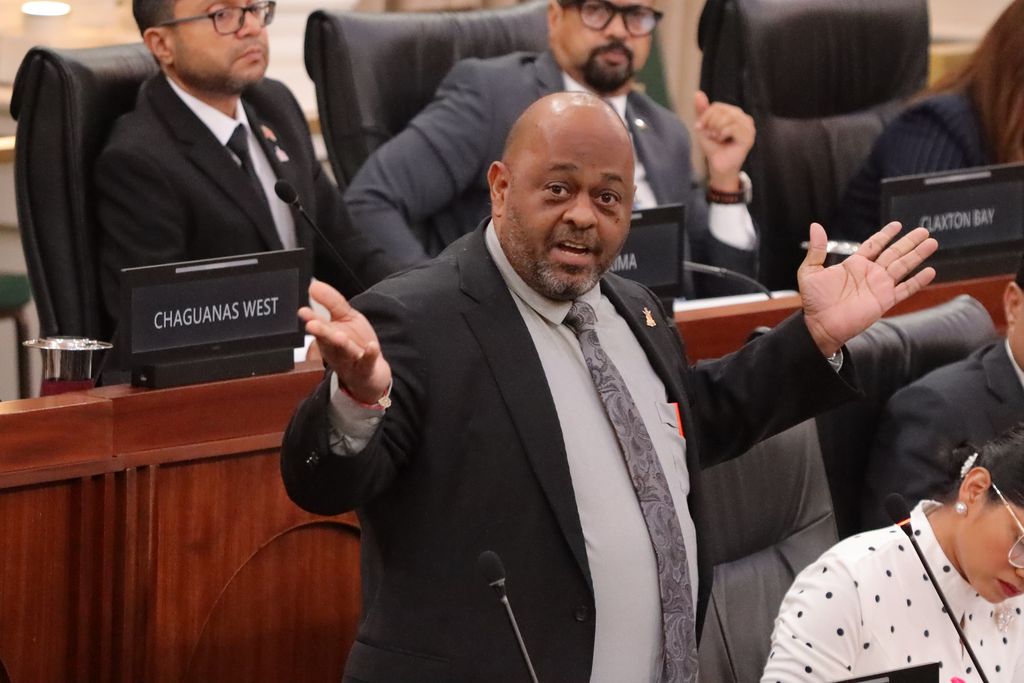
Defending the enhanced powers proposed in the bill, Sturge stressed that they were not intended to target law-abiding citizens but a small minority responsible for violent crime.
“These are serious times. It calls for serious measures,” Sturge said, adding that if reducing crime required “limiting the right of a small number of the criminal class so that the law-abiding can continue to live,” the Government believed that approach was justified.
Throughout his contribution, Sturge repeatedly referred to those targeted by the legislation as the “bandit class,” saying the measures were intended to disrupt criminal elements rather than impose restrictions on the wider population.
“What we are doing is we are looking to target a minority of people who are causing mayhem,” he said.
Sturge noted that even within a declared closed area, residents could not be arrested simply because they lived there. Police officers, he said, would still need reasonable suspicion that a person had committed, was committing or was about to commit an offence.
“So not the shopkeeper. Not the little child who had to go to school,” he said.
Jeremie similarly argued that the legislation was designed to “target gangs and criminals, not law-abiding citizens.”
The bill divides Trinidad and Tobago into seven permanent policing districts and empowers the President, once specified conditions are met, to designate locations within those districts as “closed areas.”
Within such areas, security forces would be granted enhanced powers, including warrantless searches based on reasonable suspicion, search and seizure, cordons, curfews, arrests and detention.
However, Jeremie said the legislation was “replete” with safeguards intended to ensure those powers are exercised proportionately.
Among the safeguards are mandatory training for officers involved in special operations, monthly operational reports and an annual report to Parliament, joint police-military protocols and standard operating procedures, parliamentary oversight of closed-area declarations, permits to facilitate movement during cordons and curfews, restrictions on search and seizure, judicial oversight of detention and provisions requiring the use of body-worn cameras.
The bill also contains a two-year sunset clause.
Jeremie said the President would not be able to declare an area closed arbitrarily. Before doing so, he said the President must be satisfied on reasonable grounds that public safety and peace are under threat because of factors such as escalating violent or gun-related crime, the presence of illegal firearms, or gang control and intimidation, and that ordinary law-enforcement measures are insufficient.
The President must provide Parliament with the reasons for any declaration within seven days. Declarations may also be revoked by the President or annulled by the House of Representatives.
The legislation further provides several layers of judicial oversight for detention.
Where a person remains in custody for more than 36 hours without the required court order, the officer in charge must notify an officer of at least assistant superintendent rank, who is required to investigate the circumstances and ensure the detainee is brought immediately before a magistrate.
Sturge said a magistrate would determine whether continued detention was justified and, where an extension is sought, the matter would ultimately be considered by a High Court judge.
“This is not the Government saying you have to be detained for a certain period of time. This is the court saying we are supervising it.”
The bill also guarantees access to legal counsel, medical treatment, food, welfare items and visits from a spouse or family member.
Jeremie said the safeguards support the Government’s position that the legislation strikes an appropriate balance between enhanced security powers and constitutional protections.
“We will build a nation of peace where the weak are safe and the strong are just,” he said in closing.
Sturge also defended provisions governing body-worn cameras, arguing that officers cannot reasonably be expected to keep cameras activated during every moment of an operation.
The bill states that police officers and Defence Force members engaged in special operations within closed areas must use body-worn cameras “as far as is possible having regard to available resources.”
Sturge said there may be occasions when officers need to deactivate cameras while gathering information from residents who fear being recorded.
“When you’re in a neighbourhood, the police go there, they want information. And if the person knows that your camera is on, you think they’re talking?” he asked.
He said some residents may worry that recorded information could eventually fall into the hands of the criminals they are reporting.
His comments came a day after Prime Minister Kamla Persad-Bissessar told the House that body-worn cameras “must” be used by police officers operating in closed areas.
Sturge described the bill as a “common sense piece of legislation” that combines enhanced security powers with extensive safeguards and accountability measures.
He also pointed to provisions requiring all weapons and ammunition assigned to officers involved in special operations to be registered, including their ballistic signatures, as an additional accountability mechanism.
Sturge said the Government was confident the legislation would help disrupt criminal gangs while protecting law-abiding citizens.
“We are confident,” he said.
“There will be a victory. The victory will be the victory of good over evil.”