
Senior Reporter
Chief Justice Ronnie Boodoosingh has called on judicial officers and court staff to work hard and less from home to make the Judiciary more efficient and productive.
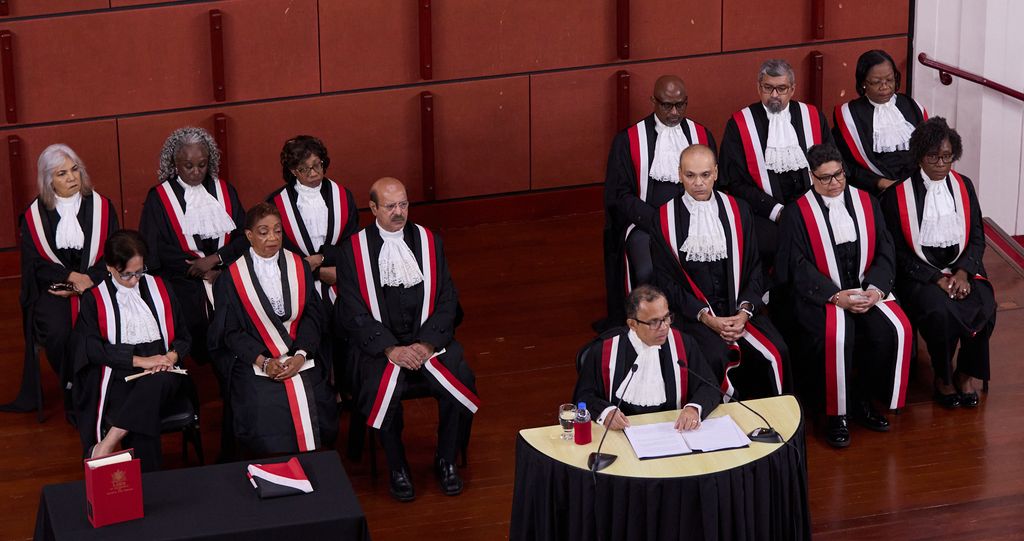
Boodoosingh made the call yesterday as he presided over his first Law Term opening since being appointed last year to replace former chief justice Ivor Archie after his retirement.
In his speech, Boodoosingh laid out his vision for the Judiciary to carry out its constitutional mandate with integrity, fairness, independence, transparency, efficiency and timeliness.
He said: “I am calling on you to support my vision for a high-performing Judiciary. This means we have to manage cases more effectively, sit for longer, dispose of more cases and give proper reasons for our decisions and judgments.”
Boodoosingh suggested that improving the Judiciary’s performance is the best way to improve public trust and confidence and respond to legitimate constructive criticism.
“We must not be afraid of scrutiny of our work, both the volume and quality. Judicial independence is not inconsistent with accountability for what we do,” he said.
Referring to statistics compiled during the 2025/2026 Law Term, Boodoosingh noted that the civil courts had managed to dispose of 140 per cent more cases that were filed during the period.
However, he raised concerns over the length of time litigants still had to wait for judgments after cases were concluded.
Boodoosingh revealed plans to introduce minimum standards for the hearing and determination of cases and requirements for judicial officers to provide status reports on their management of their case-load.
Dealing with the much-maligned criminal division, Boodoosingh highlighted an improved case disposition rate but said reduction in the backlog of cases is dependent on third-party stakeholders such as the police, defence attorneys and the Office of the Director of Public Prosecutions (DPP).
While he noted that the number of judges assigned to the division and the specialised court facilities made available to them had increased, he suggested that more work could still be done.
Boodoosingh said he was especially concerned with operations of the Magistrates’ and District Courts remaining virtual even after the end of the Covid-19 pandemic.
Although he admitted that such technology can still be used for certain hearings, he suggested that such technology could not replace more effective in-person hearings.
He presented statistics which showed magistrates were disposing of between 80,000 and 100,000 cases annually before the introduction of such hearings and approximately 10,000 cases after the widespread use of virtual hearings despite being required to preside over fewer cases.
“While online hearings may be more convenient for many persons, including for lawyers, magistrates and police officers, as far as Magistrates’ Courts are concerned, they have not been as effective as in-person hearings in getting cases completed and getting them completed in a timely manner,” he said.
He also took issue with magistrates presiding over cases for only a few hours a day.
“A magistrate should generally be hearing cases from 9 am to 12 pm and 1 pm to 3 pm on a daily basis,” Boodoosingh said.
“We cannot keep complaining about delay and at the same time wanting to continue the way we are going,” he added.
Boodoosingh noted that the Judiciary had received approvals to conduct major renovations to the San Fernando Supreme Court building and the Port-of-Spain Magistrates’ Court.
He noted that less serious repairs at all other court locations could be financed by redirecting funds that would have been used to service now-terminated leases for a National Insurance Property Development Company Ltd (Nipdec) building formerly used by the Family Court and an official Chief Justice residence.
“To quote a famous businessman, we need the money. We too are reviewing our infrastructure and operations to see where we can cut costs, make things more efficient, and to sell off unused assets,” he said.
Boodoosingh also announced plans to live stream certain major hearings of the Court of Appeal and to introduce a mobile judicial centre to provide access to justice to citizens living in rural communities.