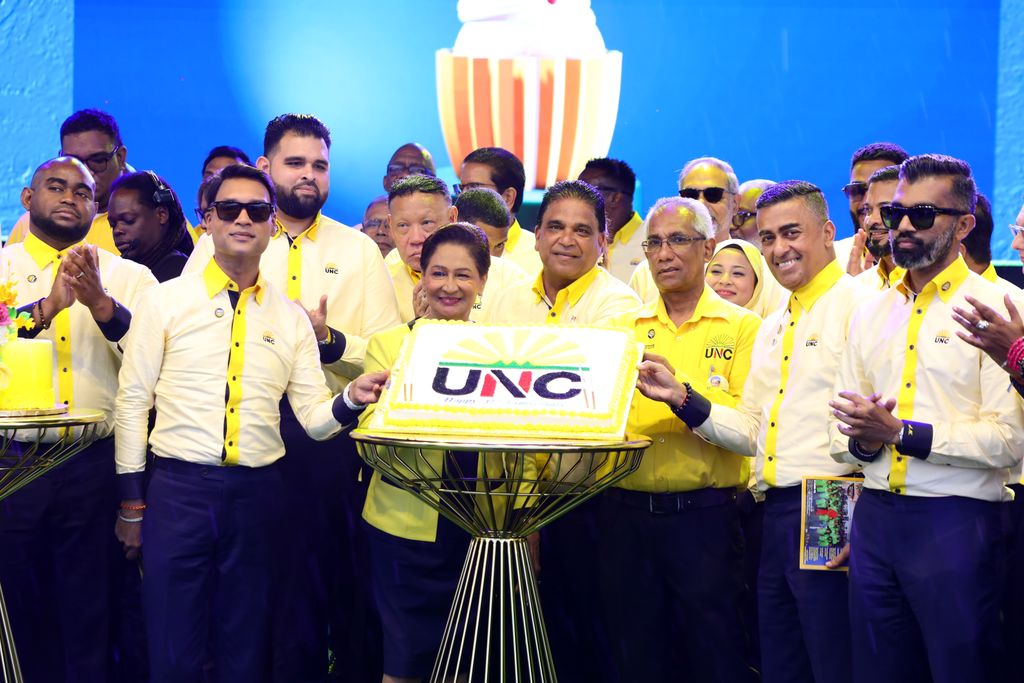

Political analyst Dr Shane Mohammed has given Prime Minister Kamla Persad-Bissessar an 80 per cent rating for her first year in office, describing her leadership of the United National Congress (UNC) as “outstanding” and resilient.
However, he has warned that the rest of her Cabinet must transition from “actors” to “actioners” to meet the Government’s mandate, saying they are ultimately putting too much of the burden on her. He said Persad-Bissessar and just eight Cabinet members are currently “carrying” the Government, arguing that the performance of the remaining “non-performers” has dragged the administration’s overall rating down to 66.25 per cent.
In a detailed assessment of the UNC administration’s performance on the anniversary of the party’s first year in office following victory at the polls on April 28 last year, Mohammed said the Prime Minister has distinguished herself through what he called a more mature and adaptive leadership style compared to her previous tenure. (See page 19)
Persad-Bissessar was assessed across seven criteria: adjustment to office; understanding of existing domestic and foreign conditions; leadership approach, style and techniques; accessibility to citizens and the media; management of the Cabinet; representation of Trinidad and Tobago; and fulfilment of her mandate.
He noted that she has shifted “more towards macro managing than micro managing,” while still maintaining a firm grip on key legacy projects in areas such as energy, national security, economic development and foreign policy.
“She is outstanding in her resolve and resilience,” Mohammed told Guardian Media, adding that the Prime Minister “remains true to herself, consistent in her intentions,” while recognising that governance “is not linear.”
He further credited her with demonstrating “strong adaptive leadership qualities, which are required in current domestic, regional and global circumstances,” noting that her political experience and understanding of global volatility have shaped her approach to governance.
According to the analyst, one of the Prime Minister’s strengths has been her accessibility and relationship with both the public and the media.
“She is responsive to media, whether via telephone or in person, and has not dismissed the media in a disparaging manner,” Mohammed said, adding that she has built a connection with citizens where “people believe that she can solve problems, renew hope and expectations across the society.”
He also highlighted her consistent messaging, pointing to her repeated commitment to “peace, security and prosperity,” while acknowledging that achieving those goals will take time.
“Better days are coming, no doubt,” Mohammed said, echoing the Government’s central message at its Report to the Nation on Saturday in Couva, but cautioning that “the bridge to those better days must be upheld by collective responsibility.”
Despite the strong rating for the Prime Minister, Mohammed made it clear that her performance stands in contrast to that of several members of her Cabinet.
“I still see a Prime Minister, supported by a few, carrying the weight and responsibility of the whole Government,” he said, warning that she continues to shoulder “the burden of weak and underperforming ministers.”
He argued that while Persad-Bissessar has provided the vision and leadership, ministers have not uniformly risen to the level required to deliver on that agenda.
“At this stage, if ministers don’t understand that they must deliver, she has a country to run, realign, redirect, re-energise and return to profitability,” he stated.
Mohammed pointed to what he described as a disconnect between ministers and the public, suggesting that some have failed to appreciate the relationship the Prime Minister has cultivated with citizens over the years.
“Ministers seem to not fully understand this; this is a problem,” he said, adding that some supporters have become “alienated by ministerial behaviours.”
He also raised concerns about what he characterised as a sense of entitlement among some officeholders, warning against any perception that loyalty to the Prime Minister equates to “ownership” of her political capital.
“That is not a flaw of the Prime Minister. This is an arising issue,” he noted.
His most pointed criticism came in a call for a fundamental shift in how the Government operates.
“The Prime Minister and Government require more actioners than actors in order to achieve the full mandate,” Mohammed said, arguing that tangible delivery, not rhetoric, will determine whether the administration succeeds within its five-year tenure. He added that such a shift is critical not just for achieving policy goals, but for maintaining political support over the full term.
“This will result in not only attaining power but sustaining power,” he stated.
Mohammed’s broader evaluation of the Cabinet found significant inconsistencies in performance. While he acknowledged that “several ministers have settled into office and hit the ground running,” he said others remain ineffective or disengaged.
The political analyst said only eight out of the 26 Cabinet members are performing.
Guardian Media asked Mohammed to name the eight but he only revealed his “top three” ministers: Works and Infrastructure Minister Jearlean John, Urban Development and Local Government Minister Khadijah Ameen and Attorney General John Jeremie.
“Jearlean has hit the ground running. She has adapted more than just as a minister. She has implemented her project management skill set, and she has brought into this government the years of public service that she would have had,” he said.
“She has remained grounded with her constituents, but not only constituents, also the people outside of constituents, across the country. And she’s done something that is also very evident. It shows she’s not only stuck to just UNC, she’s gone national.”
On Minister Ameen, Mohammed said, “Khadijah Ameen was always an activist. She transitioned from activism into national executive, into local government representation, former chairman of the regional corporation in Tunapuna, went on to be an advisor to a minister, went on as MP. One of the things about Khadijah Ameen that has remained true to her, which is very authentic, is that she’s relatable.”
As it pertains to the Attorney General, Mohammed said, “I think he’s a very important asset to the Government. You need a senior counsel that has the experience in the law. His academic qualifications, his experience, it is wide-ranging. Because he served before in another administration, he understands what is required in this regard.
“He comes across as a bad cop. He comes across as knowing how to handle that bad cop role. He understands the law, and he also understands the ills of governance, the flaws in governance, the ethical processes of governance. And you can see he’s a no-nonsense man.”
However, Mohammed is of the firm view that “others are struggling to find their footing in their roles and have become forgettable.”
He also identified gaps in communication and accessibility, noting that some ministers are responsive and engaged, while others “just don’t answer, respond, assist or practice any sense of empathy to the population.”
These disparities, he said, are also contributing to frustration among supporters, particularly activists who feel sidelined.
He stressed that governance must be inclusive and grounded in service.
“Governance cannot be by malice or bad mind, nor can it be by only friend and familial ties,” he said.
Ministers were evaluated using five criteria: adjustment to office (behavioural); understanding of their portfolio (operational); access to citizens; delivery of promises, including assistance provided; and delivery of services, including projects and other tangible outputs.
Based on those five performance criteria, Mohammed concluded that their overall performance amounts to 30.7 per cent.
Despite these concerns, the report credits the administration with a number of achievements, including an “exceptional legislative agenda,” improvements in national security strategies, and “outstanding strides” in the energy sector and international positioning of Trinidad and Tobago.
Mohammed also pointed to progress in infrastructure, wage negotiations and relations between Government and Tobago, while highlighting Government’s continued commitment to addressing national challenges.
However, he said key areas still require urgent attention, including economic diversification, price regulation, delays in replacing major employment programmes, including CEPEP and URP, and ongoing Cabinet leaks.
Overall, the Government received a score of 66.25 per cent after its first year in office.
For Mohammed, the success of the UNC administration will depend on whether that gap can be closed, before public patience runs out.
Meanwhile, political Analyst Dr Winford James is giving the Government a 6 out of 10 for its first year in office.
He told Guardian Media that while the Government has accomplished quite a few things in 12 months, he is disappointed with the Prime Minister’s position on foreign affairs matters and the communication between ministers and the public.
Unlike Mohammed, James said he cannot separate the Prime Minister and her Cabinet as he believes it is one entity.
James said the Prime Minister stayed true to her word with the labour movement and has done a lot for workers in her first year, particularly the granting of 10 per cent pay rises to most public servants.
“She won the election by treating labour in the way that labour wanted to be treated. She gave them seats. She gave them 10%,” James said.
However, James said he could only give a 6 out of 10 due to her foreign policy and the conduct of her ministers.
“The Prime Minister shouldn’t have been aligning herself at every opportunity with the Trump administration. She should not have disrespected Caricom in the way that she has and continues to do. She didn’t have to muddy the waters where Venezuela is concerned. I think Mrs Persad-Bissessar has failed badly on Caricom. She has failed badly on the alignment with Trump.”
Asked how her ministers performed in the last 12 months, James said, “I don’t know what they’re doing. I’m hearing a set of noise.”
He used the Housing Ministry as an example.
“Philip Edward Alexander. He has actually taken over the ministry from David Lee. And he’s the one apparently, they have chosen to talk to the public. But generally speaking, I cannot tell you what the ministers of this Government are doing. It’s almost as if they’re still trying to find their feet,” he said.
“There’s no discussion with the people. That’s one of the problems. There’s no discussion with the people about what they’re doing. When they have problems, it’s almost as if they alone have the answers to those problems.”
Related News
Head of Municipal Police sent on leave as probe into murder of WPC, gun theft intensifies

Heerah not opposed to Govt’s terror designation but urges caution
Arima Mayor urges stronger security after Corporal Eversley killing