Western Europe bakes under a ‘heat dome’ as temperatures climb and authorities warn of health risks
 24 June 2026
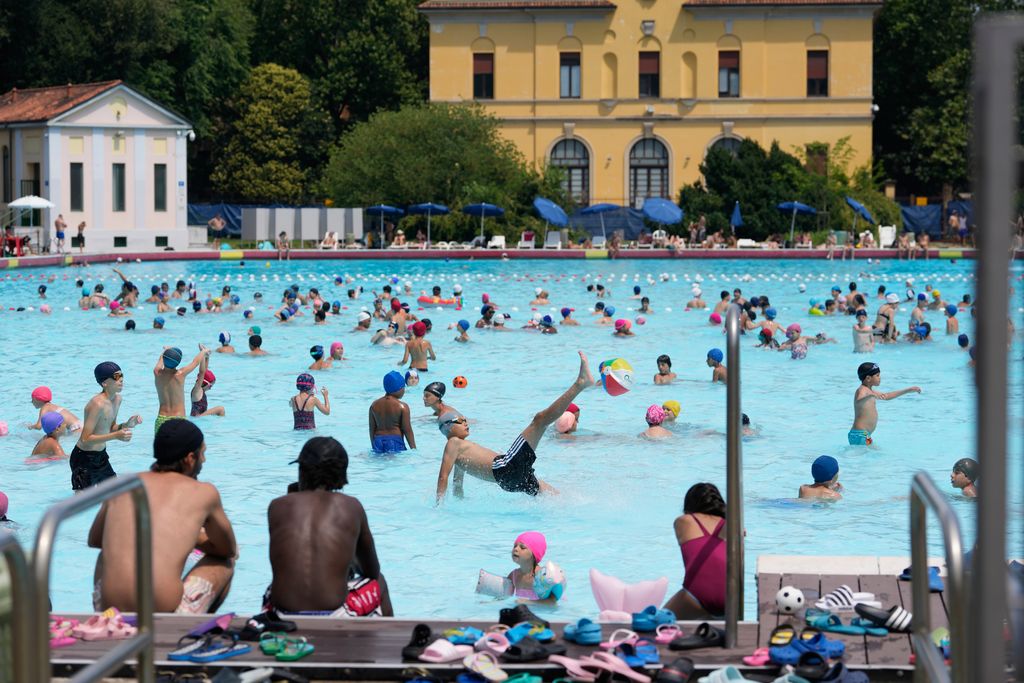

Much of western Europe baked under a “heat dome” Wednesday as temperatures soared toward 40 degrees Celsius (104 Fahrenheit) in places, and weather agencies warned that the extreme conditions could endanger lives across countries, many of which have limited air conditioning.
France recorded its hottest-ever day for the second day running. The Meteo France weather agency said the country’s national thermal indicator — an average of temperatures measured at 30 weather stations — hit a new record of 30 C (86 F), the latest in a series of never-before-registered highs. The mercury surpassed 40 C (104 F) in some locations, including in Paris.
The French weather agency put three-quarters of the country under a red alert for extreme heat starting at midday Thursday until the same time Friday. The warning encompassed tens of millions of people. In the usually temperate Brittany region of northwest France, a heat-related equipment failure knocked out power to tens of thousands of households that had to endure without electric fans.
Meanwhile, the U.K. recorded its hottest June day, with 36 C (96.8 F) reported at Gosport and Wisley in southern England. The national weather forecaster issued a red alert for heat in much of central and southern England, as well as Wales.
Authorities warned people to take extra care when swimming in unsupervised areas, such as rivers or lakes, following the deaths of around 40 people in France over the past week.
UK braces for another breach of 40 degrees Celsius
In the U.K., which has a reputation for being gray and drizzly even in summer, the heat was particularly uncomfortable, not least because so much of the country’s infrastructure, such as buildings and transportation systems, was built for cooler weather.
The heat dome — a stationary high-pressure system that traps heat and humidity — took shape at a time when human-caused climate change fuels increasingly extreme weather. The U.N. climate agency projects that the next five years will likely shatter more heat records.
“Heat waves are becoming more frequent, longer and hotter with climate change, as a direct result of the fossil fuels we are releasing as a society,” said Hayley Fowler, a professor at the Centre for Climate and Environmental Resilience at Newcastle University in the northeast of England. “We can expect to have to cope with more and more of these types of events in the years to come.”
More than 1,000 schools in England have closed due to the heat, and many train services have been canceled, with passengers being urged to avoid nonessential travel in areas covered by the warning.
The red heat warning was only the second issued by U.K. authorities following July 2022, when temperatures exceeded 40 C (104 F) for the first time. The temperature is set to fall short of 40 C on Wednesday but could breach that level — considered almost unimaginable not long ago — on Thursday.
“Red warnings are reserved for the most severe events,” said Mark Sidaway, deputy chief forecaster for the Met Office, the U.K. weather agency. He said officials expected the effects to extend “beyond those who are normally more vulnerable to the heat.”
It’s been so hot that male journalists covering the U.K.’s tradition-bound Parliament were allowed to remove their jackets Wednesday in the press gallery of the House of Commons.
Authorities try to contain risks
In France, Italy and Spain, more than 100 million people were warned to be extra vigilant about the dangers of the heat wave.
With the mercury rising, many of France’s major attractions, including the Eiffel Tower and the Louvre museum in Paris, have restricted visiting hours. Schools and transportation schedules were also upended.
Anna Forsgren, a tourist from Sweden, said she was relieved to have made it into the Louvre before the 4 p.m. closing time, after waiting decades to visit. She said it was “unbelievably hot inside, so we wonder if it’s going to damage the art in some way.”
Tens of thousands of homes in northwest France were without power after two electrical transformers in Brittany were taken out of service late Tuesday following an explosion apparently linked to the heat wave. Around 68,000 households were still affected by the power outage on Wednesday.
In Italy, 16 cities, including Rome, Milan, Florence and Turin, were under heat alerts. The “bollino rosso” signals that the risks are not restricted to the elderly.
Temperatures were predicted to climb toward 41 C (105 F) in Florence and 38 C (104 F) in Milan, while Rome and Naples were forecast to stay below 36 C (96.8 F).
In Vatican City, the faithful fanned themselves and huddled under umbrellas in St. Peter’s Square to attend Pope Leo XIV’s weekly audience.
“We did not feel any heat at all, only great love for the pope,” said Monica Ruiz, a 52-year-old pilgrim from Spain.
Businesses adjust for cooler hours
One remedy being touted came from soccer’s World Cup, which is currently taking place in the U.S., Canada and Mexico. The European Trade Union Confederation said employers should offer the same cooling breaks used at the World Cup and grant all workers paid breaks to help keep them safe in intense heat.
“Taking a break in high temperatures is a commonsense precaution, but too many employers are refusing to put these and other necessary measures in place or even discuss them with trade unions, leading to a rising number of avoidable deaths in European workplaces,” ETUC General Secretary Esther Lynch said.
Businesses across Europe have heeded that advice.
At a major building project spanning Paris’ busy ring road, construction workers have shifted to earlier hours. Managers at the site have introduced staggered schedules, with most workers now starting at 6 a.m. and finishing around 1 p.m.
“As soon as the sun comes out, the workers are really going to take time to take breaks every hour and cool down,” deputy site manager Travis Demarque said. —LONDON (AP)
_______
Story by PAN PYLAS and SYLVIE CORBET | Associated Press
Associated Press writers Danica Kirka and Jill Lawless in London, Sylvie Corbet in Paris, Colleen Barry in Milan, Samuel Petrequin and Alexander Turnbull in Paris and Giada Zampano in Rome contributed to this report.