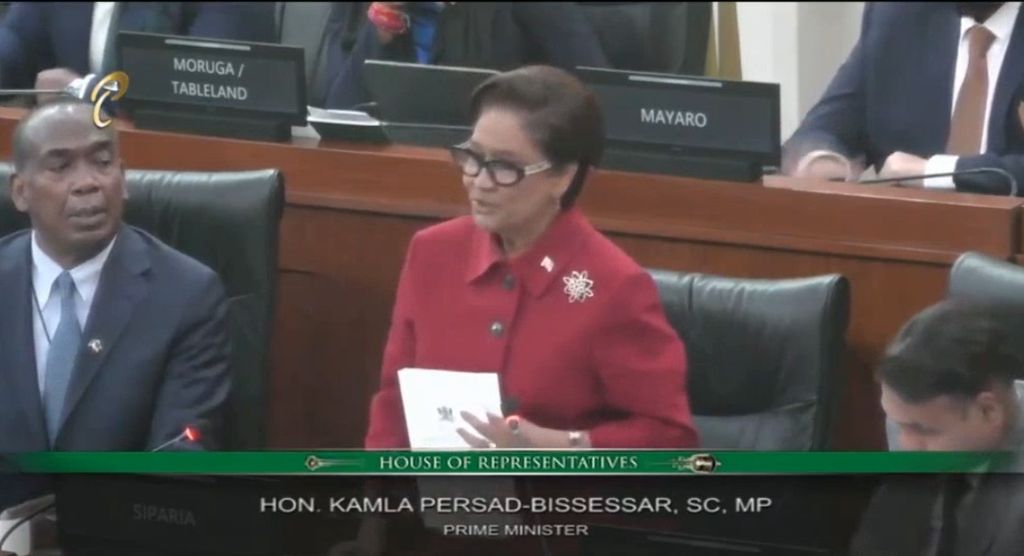

Prime Minister Kamla Persad-Bissessar has defended the Government’s use of emergency powers, insisting that restrictions imposed under the State of Emergency (SoE), including the controversial 500-metre no-protest zones, are lawful, constitutional and necessary to protect national security.
Speaking during Wednesday’s parliamentary debate on Government’s motion to extend the SoE for a further three months, Persad-Bissessar argued that critics were ignoring a fundamental principle of constitutional law.
“Any lawyer doing Law 101 knows that no rights are absolute. Constitutional rights are never absolute,” she told the House.
The Prime Minister said freedoms such as speech, assembly and association are all subject to regulation, particularly during a State of Emergency authorised under Sections 8, 9 and 10 of the Constitution.
“So when you speak about freedom of assembly, it could never be that everybody will assemble in the same place at the same time. There are regulations. These are regulated. There’s no absolute freedom,” she said.
She maintained that every measure implemented since the declaration of the SoE on March 3 has been carried out within the framework of the Constitution and in accordance with powers granted during a public emergency.
“The Constitution itself provides for when these rights can be overshadowed or regulated. So we are working within the confines of the Constitution,” Persad-Bissessar said.
The Prime Minister rejected claims that Government had stripped citizens of their rights, arguing that opponents of the emergency measures were continuing to exercise the very freedoms they claimed were being suppressed.
“We have not taken away that right,” she said, referring to access to the courts.
She questioned whether anyone had actually lost their freedom of movement, freedom of expression or freedom of association.
“Is anybody stopping you from coming to Parliament? Is your freedom of movement impeded?”
“When you’re gathering tomorrow in your meeting, is anybody stopping you from assembling? Associating? Is anybody stopping you from speaking? Where are your rights? Which rights are being impeded?” she asked.
Persad-Bissessar said only those involved in criminal activity had seen their activities disrupted by the emergency regulations.
“The only persons I’ve impeded are those who are not law-abiding.”
The Prime Minister also accused critics of engaging in what she described as an “oxymoronic” argument by holding public meetings and demonstrations while simultaneously claiming they were being prevented from protesting.
“It is oxymoronic for people to stand up on a public platform and say their freedom of expression is being taken away. You’re standing on a political platform saying everything under the sun and saying your freedom of expression is being hindered.”
Addressing criticism of the recently established no-protest zones around key State institutions, Persad-Bissessar sought to demonstrate that the restrictions affected only a tiny portion of the country’s land area.
According to calculations she presented in Parliament, Trinidad and Tobago’s total land area is approximately 5,131 square kilometres, while the 500-metre restricted zones surrounding the 15 designated buildings cover only 11.77 square kilometres.
“That is 0.23 per cent of our total land area,” she said.
“Therefore, all citizens have 5,119.23 square kilometres of land where they can protest.”
She added that this means citizens still have access to 99.77 per cent of the country’s territory for demonstrations, assemblies and other public gatherings.
The Prime Minister pointed to a “protest” held outside the Office of the Prime Minister this week as evidence that citizens remain free to demonstrate.
“These people delivered a letter to my office yesterday, and a response will be forthcoming,” she said.
Referring to the group of trade unions that delivered a letter asking that the PM reconsider the 15 no-protest zones, Persad-Bissessar noted that they gathered outside her office despite claiming the regulations prevented protests.
“You’re outside the Office of the Prime Minister and you’re saying you cannot protest, but you’re out there, 13 people gathered in an assembly. You deliver this letter.”
Persad-Bissessar also offered a national security justification for the 500-metre exclusion zones.
“At that distance, I am told, the effects of small arms and rifle gunfire are negated,” she said.
She argued that the restrictions were introduced following what she described as repeated attempts to provoke police officers and the gathering outside the Office of the Director of Public Prosecutions (DPP) during the “19 Bullets, 19 Protests” campaign.
“The action was taken following repeated attempts to provoke the TTPS and the mobbing of the Office of the DPP.”
The Prime Minister said the State had a duty not only to protect legitimate protesters but also public servants, visitors and workers operating within critical government facilities.
“The State has a duty to protect legitimate protesters. I acknowledge that. To protect public servants. To protect citizens working in and visiting critical, high-risk, high-security buildings.”
She further claimed intelligence reports indicated that some public gatherings had been infiltrated by criminal elements.
“Gatherings were being infiltrated by gang members. That’s what the intelligence shows us.”
Turning to the broader question of whether the SoE should continue, Persad-Bissessar maintained that the measure remains necessary because criminal organisations have not yet been dismantled.
“The state of emergency is not an affront to liberty,” she said.
“For now, given where we are with the state of lawlessness, this SoE acts like a guardian.”
She argued that criminal syndicates remain active and that ongoing intelligence-led operations require additional time to identify and prosecute those responsible for serious violence.
“They remain emboldened, they remain organised and they remain patient.”
“To withdraw the measures now prematurely would be for us to surrender hard-won ground and imperative investigations of singular national importance.”
Persad-Bissessar also pointed to what she said were measurable reductions in crime during the emergency period, citing figures presented earlier in the debate by Government ministers.
“Why would there be a 42 per cent decrease in homicides if it were not working?” she asked.
The Prime Minister ended by insisting that the majority of citizens support the continuation of the emergency measures.
“I caused a poll to be done and the majority of law-abiding citizens support the extension of the SoE,” she said.
Later in her contribution she again referenced polling commissioned by her administration, saying it showed “full support by the majority of the people of our country” and high levels of confidence in the protective services.
“I say again that law-abiding citizens back the SoE,” Persad-Bissessar declared, adding that the temporary measures were necessary to prevent Trinidad and Tobago from enduring “another violent 25 years” of crime and bloodshed.