
Sascha Wilson
Senior Reporter
sascha.wil[email protected]
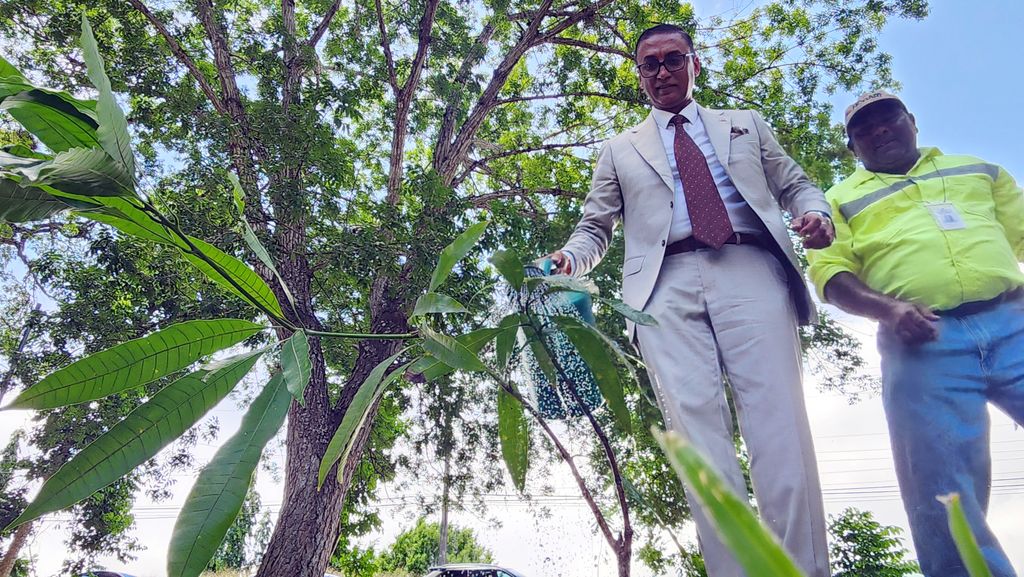
Penal-Debe Regional Corporation chairman Gowtam Maharaj is urging residents to help protect newly planted fruit trees at Palmiste Park, following the theft of previously planted trees by private groups.
He was speaking to the media at the launch of the Public Fruit and Food Orchards Initiative at Palmiste Park, San Fernando, on Friday.
Asked about security concerns following the theft of plants previously planted by private groups at the park, Maharaj said there would be support from the Municipal Police.
But he also urged residents to remain vigilant.
“So, we also depend on the resident associations and citizens to also help, be alert and help us with the security of the plants. It is really a beautiful initiative, and it is a sad day if we really must imprison ourselves to the point that every plant must have a policeman standing next to it.”
Councillor Raven Ramsawak also urged members of the public not to pick the fruit to sell.
The Palmiste Historical Society and residents have undertaken tree-planting exercises at the park for years, but their efforts have been thwarted by theft. Just recently, 50 fruit trees were stolen.
In his feature address, Agriculture and Fisheries Minister Ravi Ratiram said the initiative will eventually extend to recreational grounds, schools and green spaces in Housing Development Corporation communities.
Given the challenges facing the agriculture sector, including changing climatic conditions, supply chain disruptions and the migration of pests and diseases, Ratiram said creative and innovative solutions were needed.
He pointed to the significant decrease in cocoa cultivation, from 90,000 hectares to 4,000 hectares, but said the Government is targeting 200,000 new cocoa plants through its rehabilitation programme.
Through the public orchard initiative, Ratiram said the Government is making food more accessible to the public.
“So, this initiative does exactly what we are speaking about by transforming underutilized public spaces into community food assets, but we are also taking a deliberate step into the digital age through the ministry's geographic information system unit.”
Ratiram said every orchard will be mapped and spatially documented using mobile technology and software to improve accountability and transparency.
He also spoke about the lack of accountability in previous tree-planting programmes through the Forestry Division.
“You know the forestry programme that has been running in Trinidad and Tobago over the years gone by, despite all the different ghost gangs and criminal activities and corruption that would have happened in that forestry programme, we also would have had some genuine activities of tree-planting exercises.
“That programme was launched since 2003-2004 and it would have lost its mandate doing all sorts of other things, but if it is that we were mapping these trees, we would have had some level of accountability because today, when we look back at the last 20 years, what has the programme contributed? There's a big question mark.”
“We are ensuring that as we pilot the way forward, we must have a high level of accountability, transparency and whatever funds that are being spent, we must have value for money being spent.”
Ratiram added that the Government intends to initially roll out five orchards, which are expected to produce about 500 kilogrammes annually.
An estimated 100 fruit trees, including mango and cocoa, would be planted at Palmiste Park.