
SHASTRI BOODAN
GML Correspondent
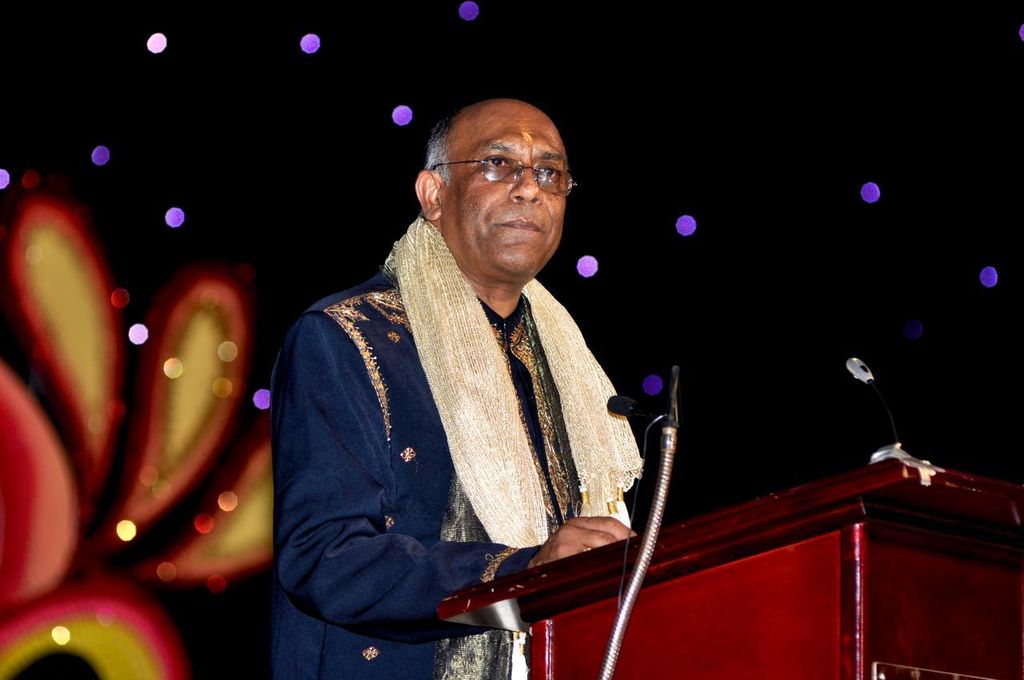
Divali Nagar is more than a commercial event, but its economic activities can help sustain its cultural mission, says National Award recipient Dr Suruj Rambachan.
In a social media post, Rambachan, who holds the Order of the Republic of Trinidad and Tobago (ORTT), said culture and economic activity were sometimes treated as though they belonged to opposing worlds, a view he described as mistaken.
“A talented cook who sells traditional food, an artisan who creates handcrafted products, a designer who produces cultural clothing, a musician who performs or a vendor who introduces a new product is participating in economic activity. Each is also contributing, in a different way, to the cultural experience of the Nagar,” he said.
Rambachan said an event of Divali Nagar’s scale provided an opportunity for small entrepreneurs to reach customers, test products, develop business relationships and earn income.
He added that the economic activity surrounding the event could also benefit transport operators, suppliers and other businesses.
“The precise scale of these benefits should be established through evidence, but the wider principle is clear: cultural events can create economic opportunities as well as cultural value,” he said.
Rambachan said Trinidad and Tobago should create more opportunities for people to turn their skills, ideas and talents into productive enterprises.
He said young people should recognise that culture could provide a pathway to entrepreneurship and employment, rather than being viewed only as a subject to study or an interest to pursue in their spare time.
However, he stressed that economic activity must complement the cultural mission and that the institution’s priorities must remain clear.
“Commerce is not inherently the enemy of culture. Poorly managed priorities can be. The distinction matters,” he said.
Rambachan acknowledged that Divali Nagar had attracted criticism from people who believed it had become too commercial, adding that every cultural institution should periodically examine whether its activities reflected its founding purpose and whether the balance between religion, education, entertainment and commerce remained appropriate.
However, he said a fair assessment must also consider the practical realities of financing an event of such magnitude.
He pointed to the costs associated with lighting, electricity, security, sanitation, stage production, equipment, administration, maintenance and other services needed to host the event.
“How does one finance an undertaking that attracts thousands of visitors and requires lighting, electricity, security, sanitation, stage production, equipment, administration, maintenance and the many other services necessary to make the event possible?
“Who pays the bills? Who meets the costs when the performances are over, the equipment has to be maintained and preparations begin for another year?” he asked.
Rambachan questioned whether the National Council of Indian Culture (NCIC) should be expected to deliver an event of national importance while avoiding the economic activities that could help make it financially sustainable.
“These are not unreasonable questions. They are essential questions,” he said.
He added that goodwill alone could not cover every expense, despite volunteers giving hundreds of hours, businesses contributing resources and community members offering assistance.
Commercial participation, he said, could provide income to support the wider cultural undertaking.
“There is nothing inherently wrong with that. The presence of a vendor selling food does not erase the cultural value of a dance performance. A craftsperson earning a living does not diminish the artistic merit of a handcrafted product. A business contributing to the event does not automatically undermine its religious significance,” he said.
Rambachan said it was important to distinguish between raising funds to sustain a cultural institution and allowing the pursuit of revenue to displace its purpose.
He said the long-term survival of cultural institutions depended on having a clear and viable funding model.
“We cannot demand excellence without resources. We cannot insist on ambitious cultural programming while pretending that large events can be sustained by enthusiasm alone. And we cannot reasonably expect an organisation to meet substantial financial obligations without developing a viable funding model,” he said.
Rambachan said the answer was not to abandon commercial participation, but to manage it responsibly, protect the cultural mission and ensure the right balance was maintained.