Pope urges U.S. and Iran to return to peace talks, condemns capital punishment
 23 April 2026
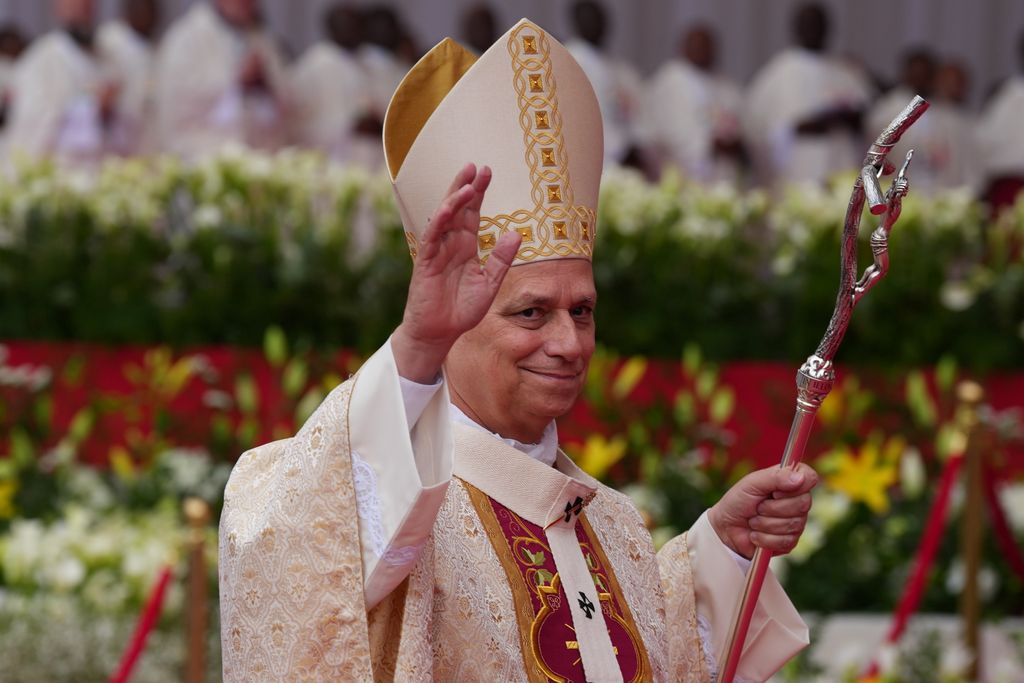

Pope Leo XIV urged the United States and Iran to return to talks to end the war Thursday and condemned capital punishment, in a wide-ranging press conference en route home from his trip to Africa.
Leo also asserted that countries have the right to control their borders but mustn’t treat migrants worse than “animals,” and lamented that the church’s morality teaching is often reduced to sexual issues.
On Iran, capital punishment and peace
After a trip that was dominated by the very public back and forth between Leo and U.S. President Donald Trump over the war, Leo urged the United States and Iran to return to negotiations.
He called for a new “culture of peace” to replace the recourse to violence whenever conflicts arise.
He said the question wasn’t whether the Iran regime should change or not. “The question should be about how to promote the values we believe in without the deaths of so many innocents.”
He revealed that he carries with him the photo of a Muslim Lebanese boy who had been killed in Israel’s recent war with Hezbollah. The boy had been photographed holding a sign welcoming the pope when he visited Lebanon last year.
“As a pastor I cannot be in favor of war,” he told reporters aboard his plane. “I would like to encourage everyone to find responses that come from a culture of peace and not hatred and division.”
Asked if he condemned Iran’s recent executions, Leo said he condemned “all actions that are unjust” and included capital punishment in the list.
“I condemn the taking of people’s lives. I condemn capital punishment. I believe human life is to be respected and that all people from conception to natural (death), their lives should be respected and protected.
“So when a regime, when a country takes decisions which take away the lives of other people unjustly, then obviously that is something that should be condemned,” he said.
Pope Francis changed the church’s social teaching to declare capital punishment immoral in all cases.
On migration and the rights of states
Leo affirmed the right of countries to impose immigration controls on their borders and acknowledged that uncontrolled migration had created situations “that are sometimes more unjust in the place where they arrive than from where they left.”
“I personally believe that a state has the right to impose rules for its frontiers,” he said. “But saying this, I ask: ‘What are we doing in the wealthier countries to change the situation in poorer countries’ to provide opportunities so that people aren’t compelled to leave?”
Regardless, he said migrants are human beings and deserve to be respected in their human dignity and not be treated “worse than house pets, animals.”
On LGBTQ+ blessings and morality
Leo was asked about the recent invitation by Cardinal Reinhard Marx, archbishop of Munich, for the priests and pastoral workers in his archdioceses to adopt a set of guidelines formalizing and ritualizing blessings of same-sex couples.
The guidelines were approved last year by a controversial German church governing body made up of the German bishops’ conference and a Catholic lay group that has been working to have a greater say in church decision-making.
The Vatican in 2023 allowed for such blessings, but it made clear that they were not to be formalized or ritualized. The Vatican allowed them to be offered spontaneously and informally, as a priest gives a final blessing to all people at the end of Mass.
Leo said the Holy See had made clear to German bishops that “we do not agree with the formalized blessing” of gay couples or couples in other “irregular situations.”
The Vatican’s 2023 declaration allowing an informal blessing, promulgated with virtually no consultation outside the Vatican, sharply divided the church, with African bishops delivering a continent-wide dissent and refusing to implement it. Homosexual activity is criminalized in several African countries.
Asked how he would handle keeping the church unified over such a divisive issue, Leo spoke broadly about how culture war questions of sexual morality had dominated church discourse, particularly in the West, far too much.
“I think it’s very important to understand that the unity or division of the church should not revolve around sexual matters,” he said. “We tend to think that when the church is talking about morality, that the only issue of morality is sexual.
“And in reality, I believe that there are much greater and more important issues such as justice, equality, freedom of men and women, freedom of religion that would all take priority before that particular issue.”
The comment was significant because it suggested that even though he is American, Leo believes the church in the U.S. and the West has excessively reduced its moral teachings to revolve only around sex at the expense of other pressing issues.
A pope who keeps on eye on how he’s being covered
History’s first U.S. pope showed himself keenly aware of how his Africa trip had been reported and interpreted, including about his sometimes-tame public addresses to African leaders who are accused of corruption or authoritarianism.
With a few notable exceptions, Leo kept his political remarks to the leaders largely diplomatic, using a language of encouragement and subtle messaging rather than headline-grabbing condemnations.
He also allowed some of the circumstances of his visit to speak louder than his words: a choreographed song and dance routine by prisoners in a country known for gross human rights abuses, or the extravagant luxury of a president’s hometown in a country where more than half the population lives in poverty.
Leo insisted that his primary reason for visiting Algeria, Cameroon, Angola and Equatorial Guinea was as a pastor, to accompany his flock in their faith.
He added that the Holy See can sometimes achieve more behind the scenes via its diplomatic work, including through the release of political prisoners, than with “great proclamations criticizing, judging or condemning.” —ABOARD THE PAPAL PLANE (AP)
__________
Story by NICOLE WINFIELD | Associated Press
Associated Press writer Monika Pronczuk contributed to this report.