
Senior Reporter
Government Senator David Nakhid says the Attorney General will eventually provide further details on questions swirling around the State’s sweeping designation of three major Middle Eastern organisations as terrorist entities.
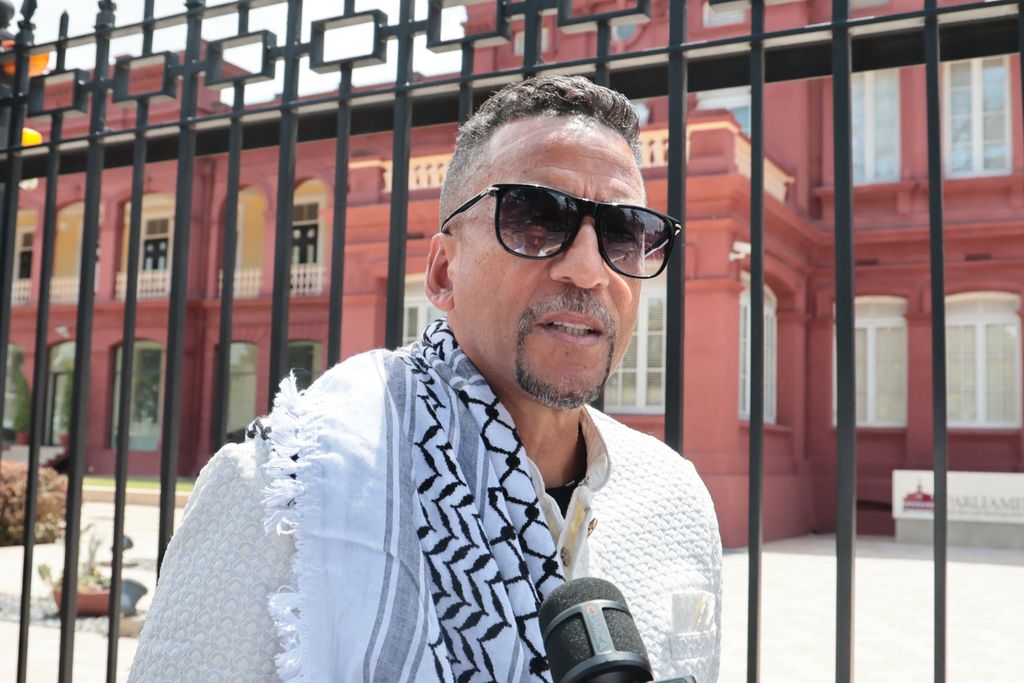
Speaking outside Parliament yesterday, Nakhid backed the move amid public questions over how it was rolled out.
“My position is always with the Government,” Nakhid said.
“People will make their own judgement either way and the AG will give you the information that you need in subsequent time.”
The development marks a major national security step, with the High Court ordering the immediate freezing of all Trinidad and Tobago assets linked to Hezbollah, Hamas and Iran’s Islamic Revolutionary Guard Corps (IRGC).
The orders, published in the Trinidad and Tobago Gazette on Monday, represent one of the most far-reaching uses of the Anti-Terrorism Act in recent years.
According to the Gazette, Justice Carol Gobin issued freezing orders on April 8 in relation to both Hezbollah and the IRGC. A separate order issued by Justice Jacqueline Wilson on April 9 listed Hamas as a declared entity.
The High Court orders directed that all property owned or controlled locally by the three organisations, whether wholly, jointly, directly or indirectly, must be immediately frozen. The measures also extend to assets that may be held through intermediaries or proxy arrangements. However, the local organisation/s linked to the three groups were redacted in the gazetted notice.
Opposition Senator and former attorney general Faris Al-Rawi largely endorsed the legal framework behind the move yesterday, noting that he helped shape the legislation that allows such designations.
“I drafted the law that amended the Anti-Terrorism Act to allow for the designation of terrorists and terrorist groups. Those are done pursuant to the Anti-Terrorism Act and United Nations Security Council Resolutions.”
Al-Rawi explained that the process is court-driven and rooted in international listings. “You have to do an application to the court. I’ve done hundreds of designations. It was a tool that I thought was very necessary,” he said.
He added that the system is also critical to law enforcement.
“The purpose of listing is so that it’s known in our courts and that you can freeze assets and deal with individuals. Anything that protects Trinidad and Tobago, we certainly support.”
However, he warned that designation alone is not enough to secure convictions, pointing to gaps in the justice system.
“What is missing is witness protection, anonymous witness evidence, the use of CCTV camera evidence, and the Crown prosecution model,” he said.
Independent Senator Sophia Chote raised a different concern, however, warning of unintended consequences for humanitarian efforts by Muslim organisations.
“My concern is this, that people who donate to charitable organisations for victims of the genocide in Gaza and victims of war should not be deprived because their charitable organisations are considered to be terrorist organisations,” she said.
Pressed on safeguards, Chote added, “Well, I don’t know what safeguards have been put in place but certainly victims should not be penalised.”