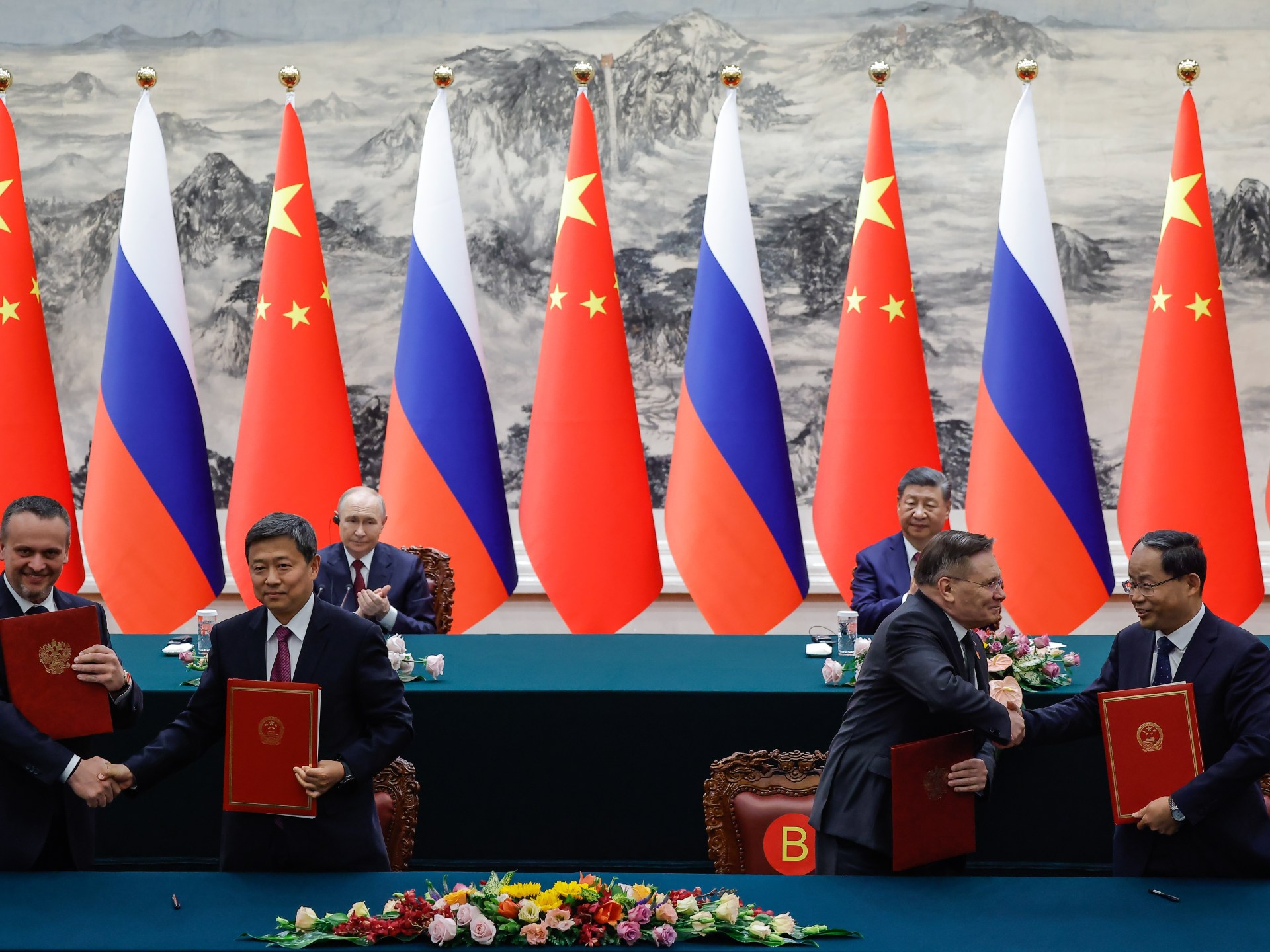

Russian President Vladimir Putin and his Chinese counterpart, Xi Jinping, have signed a joint declaration following their meeting in Beijing, focusing on building a “multipolar world and a new type of international relations”. The two countries also announced that they had signed a large package of deals solidifying bilateral cooperation in the future.
The meeting came just days after United States President Donald Trump completed his own visit to China for a two-day summit with Xi.
Here are what statements from Beijing and Moscow say about five key issues following the Russia-China summit.
Establishing a ‘multipolar world’
On Wednesday, the Chinese Foreign Ministry said: “The two countries will also issue a joint statement on advocating for a multipolar world and a new type of international relations.” Russian presidential aide Yuri Ushakov described this declaration as a 47-page policy document.
A “multipolar world” is understood as one in which economic, military and diplomatic power and influence are placed in the hands of three or more countries, rather than just one or two.
“Xi is calling for a more multipolar world, where the US has less power and influence,” Al Jazeera’s Katrina Yu reported from Beijing as the meeting was under way.
Both Putin and Xi have spoken out against the “unipolar” hegemony that they say the US has over the world.
In 2022, shortly after the beginning of Russia’s war with Ukraine, Putin accused the US of stoking hostilities in Ukraine to maintain its global influence.
Advertisement
“They need conflicts to retain their hegemony,” Putin said during a speech. “The era of the unipolar world order is nearing its end.”
Chinese state media reported that during the latest meeting, Xi said to Putin: “The tide of unilateral hegemony is running rampant.”
Bilateral relations reach ‘unprecedented’ level
A press statement posted on the Kremlin website said relations between Russia and China had reached “a truly unprecedented level and continue to develop”.
The Chinese Foreign Ministry statement said: “Both sides should follow the trend of peace, development, cooperation, and win-win results to promote higher-quality development of China-Russia relations.”
The statements added that bilateral cooperation extends to the worlds of economics, sport, education and the media.
The Kremlin statement adds that this year marks the 70th anniversary of partnership between the Russian TASS news agency and the Chinese Xinhua news agency.
Deepening economic cooperation – and moving away from the US dollar
The Kremlin statement said Beijing and Moscow had signed around 40 intergovernmental, interagency and corporate documents. “Many of these focus on the further deepening of our economic cooperation,” it noted.
The statement added that, last year, trade between the two countries reached almost $240bn, while the Chinese statement said bilateral trade grew by 20 percent in the first four months of this year.
Since the war in Ukraine broke out in February 2022, Russia has become increasingly reliant on Chinese technology and manufacturing. Last month, Bloomberg reported that Russia now imports more than 90 percent of the technology targeted by US and European Union sanctions via China, using Chinese suppliers and intermediaries to obtain components with military and dual‑use applications vital to drone production and other defence industries.
“Both sides should build on this momentum, deepen the alignment of China’s 15th Five-Year Plan with Russia’s development strategy until 2030, promote the upgrading of mutually beneficial cooperation in various fields, and serve the development and revitalization of both countries,” the Chinese ministry statement said.
The Kremlin statement said that nearly all import and export transactions between Russia and China are in roubles and yuan. “In other words, we have actually created a stable system of mutual trade that is protected from external influence and negative trends in the global markets,” it said.

Ensuring energy supplies
The Kremlin said on Wednesday that an understanding had been reached for the route and construction of the long-delayed joint Siberia 2 pipeline, but details are still being negotiated. Once completed, the pipeline will transport 50 billion cubic metres of Russian gas annually to China via Mongolia, significantly expanding energy flows between the two countries.
Advertisement
The Kremlin’s statement said that Russia and China are actively cooperating in the sphere of energy.
“Our country is one of the largest exporters of oil, natural gas (including LNG) and coal to China. We are definitely ready to continue to ensure reliable and uninterrupted supplies of these types of fuel to the rapidly growing Chinese market,” the statement said.
As European markets have largely closed to Russia as a result of the war in Ukraine, China has emerged as a crucial buyer of Russian oil and other energy products, benefitting from steep discounts on Russian products.
In December 2022, the Group of Seven (G7), the EU and Australia placed a cap on the price of Russian oil at $60 per barrel, ostensibly to reduce Russia’s ability to fund its war in Ukraine. The cap was later reduced to around $48 by the EU and the United Kingdom.
The ‘Year of Education’
Both statements said Xi and Putin had agreed to expand student exchange programmes and cooperation between universities and research platforms to boost joint scientific research.
Related News
Russia places UK ex-Defence Minister Ben Wallace on wanted list

FBI’s lack of progress on Israeli killing of journalist ‘troubling’: CPJ

Hamas confirms killing of Qassam Brigades leader in Israeli attack