
Senior Reporter
dareece.po[email protected]
Prime Minister Kamla Persad-Bissessar’s months-long challenge to the process used to reappoint Caricom Secretary General Dr Carla Barnett will now be determined by the Caribbean Court of Justice (CCJ), after regional leaders yesterday agreed to seek an advisory opinion from the regional court.
The decision, announced during a media conference at the 51st Regular Meeting of the Conference of Heads of Government in St Lucia, was welcomed by Persad-Bissessar and political analysts, who said it allows both Trinidad and Tobago and Caricom to move forward while preserving regional unity.
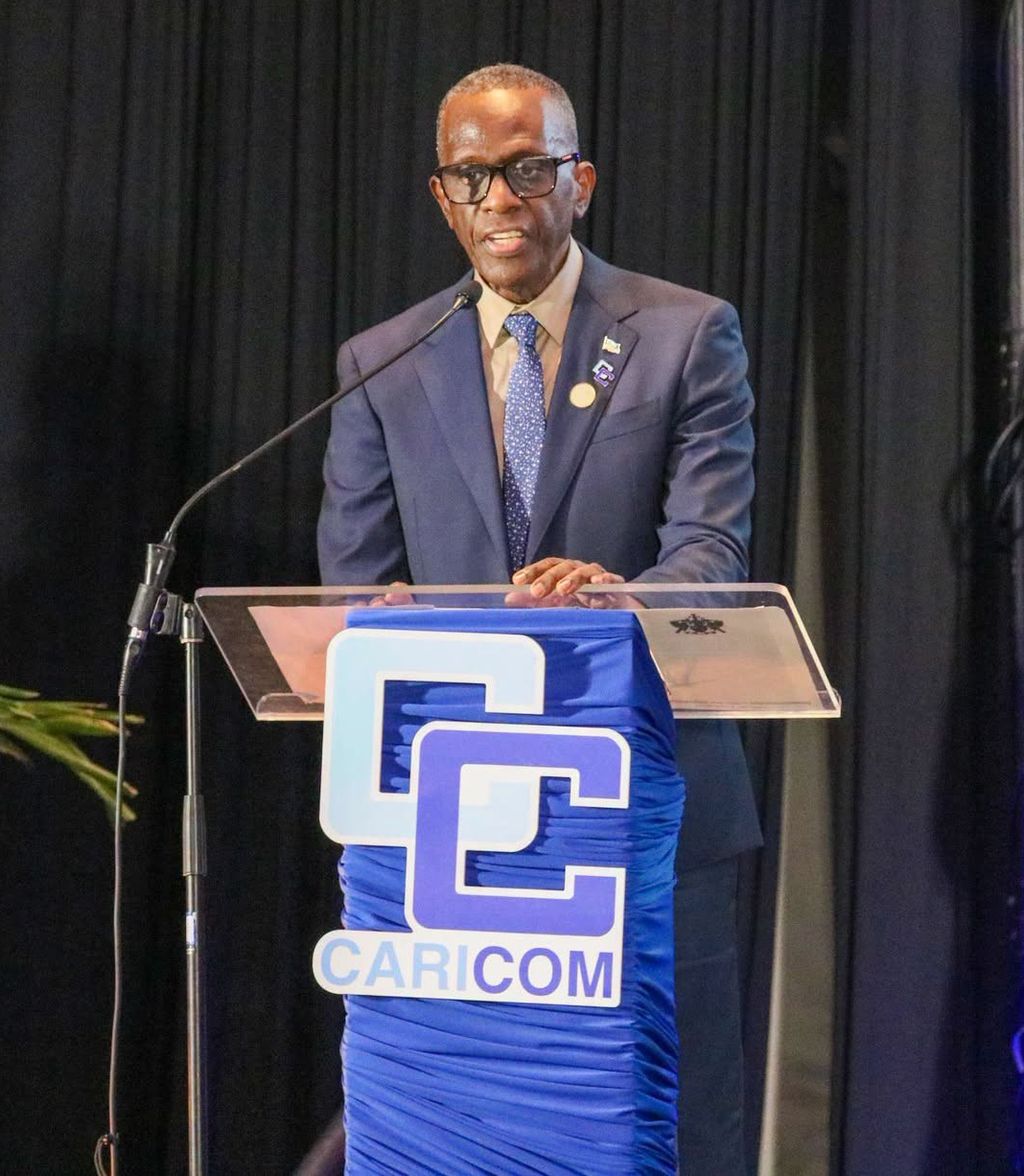
Reading from a prepared statement yesterday, Caricom Chair and St Lucia Prime Minister Philip J. Pierre said T&T had maintained its objection to the process used to reappoint Barnett during the heads of government retreat.
“To facilitate this request, the community agrees to commence proceedings to secure such advisory opinion in accordance with Article 212 of the Revised Treaty of Chaguaramas. The community acknowledged that this is the very purpose for which the CCJ was created – to be a treaty interpretation body,” Pierre said.
He said Caricom also agreed to maintain the current arrangements until the CCJ adjudicates on the matter.
“The Community further agreed that the status quo with respect to the reappointment of the Secretary General shall remain unless and until the Community considers the said advisory opinion from the CCJ,” he said.
“The community agreed that this way forward allows for this matter to be resolved in an amicable manner, without prejudice to the ability of the community to conduct its affairs.”
He added, however, that the referral should not be interpreted as a reflection on the conduct of any member state or official.
“This process does not impugn the integrity of any member state or individual; rather it reflects the community’s collective commitment to continuous institutional improvement with the highest standards of good governance.”
Pierre said regional leaders remained committed to the objectives of regional integration and would continue working together to address the challenges facing the community.
In a statement issued hours later, Persad-Bissessar welcomed the decision, reiterating that T&T’s objection had always been to the process used to reappoint a Secretary General, not to Dr Barnett herself.
She thanked fellow leaders for supporting T&T’s proposals and praised Pierre’s role in brokering an agreement.
“This outcome is a testament to the chairmanship of Caricom by the Honourable Philip J Pierre, Prime Minister of St Lucia, who facilitated consensus and the opportunity for the region to move forward in unity, to advance the well-being of all the people of Caricom,” Persad-Bissessar said.
Article 212 of the Revised Treaty of Chaguaramas gives the CCJ exclusive jurisdiction to issue advisory opinions on the interpretation and application of the treaty at the request of member states involved in a dispute or by the community itself.
Contacted yesterday, political analyst Peter Wickham said the agreement represented a diplomatic solution that benefited both sides. “I think that it’s the type of diplomacy that allows Trinidad and Tobago to claim a win, and it also allows Caricom to claim a win. And I think that that’s how democracy should work. And I like the fact that the Heads would have huddled overnight to come to a conclusion, and they have essentially communicated an outcome that all sides are supporting. So, I’m happy with how things went,” Wickham said.
He also noted Persad-Bissessar’s praise for Pierre contrasted with her criticism of the previous Caricom chairmanship.
“If she is happy to essentially throw shade at a former chairman and throw support at the current chairman, and if that’s what it takes for us to get past it, then so be it. So, I noted that, and I’m not particularly concerned because clearly, she had some concerns with how it was being handled in the past. But, you know, I continue to maintain that part of the reason why Dr Drew had challenges is because she did not attend the meeting. If she did, those challenges would not have arisen.”
Meanwhile, political scientist Dr Indira Rampersad said the outcome demonstrated the value of diplomacy and regional cooperation. She said Persad-Bissessar could have pursued the matter directly before the CCJ because T&T remains subject to the court’s original jurisdiction, despite not acceding to its appellate jurisdiction. However, she said the Prime Minister chose to work through Caricom.
“She opted to go the multilateral route through Caricom and that is laudable because, you know, it speaks to collective good and it speaks to regional integration. So, I think whatever the outcome is from the CCJ, I think that this decision of Caricom led by the honourable Philip Pierre is a magnanimous one.”
Rampersad said the decision also benefits T&T because taxpayers fund the country’s contributions to Caricom. She added that, regardless of the CCJ’s eventual opinion, resolving the dispute through the court is a positive outcome for the country.
What is the CCJ and why is Caricom turning to it?
The Caribbean Court of Justice (CCJ) is the Caribbean's regional court, established in 2001 to serve two main roles. It is the highest court of appeal for countries that have adopted its appellate jurisdiction, and it interprets and applies the Revised Treaty of Chaguaramas, the legal foundation of Caricom.
It was officially inaugurated on April 16, 2005, in Port of Spain.
The court was created to strengthen Caribbean integration by providing an independent regional judicial body. It performs two distinct functions: interpreting Community law (Caricom) and, for some countries, serving as the highest court of appeal.
The court's original jurisdiction
In its original jurisdiction, the CCJ interprets and applies the Revised Treaty of Chaguaramas, which governs the Caribbean Community and the Caricom Single Market and Economy (CSME).
The court hears disputes between member states and Community institutions, as well as certain cases involving businesses and individuals. It can also issue advisory opinions when requested by member states or the Community under Article 212 of the treaty.
It is this jurisdiction that Caricom will invoke to determine whether the process used to reappoint the Secretary General complied with the treaty.
All 15 Caricom member states participate in the court's Original Jurisdiction. The CCJ also serves as the final court of appeal for countries that have chosen to replace the United Kingdom's Judicial Committee of the Privy Council.
Only five countries have adopted the court's Appellate Jurisdiction, namely Barbados, Belize, Dominica, Guyana and St Lucia.
The remaining Caricom member states, including Trinidad and Tobago and Jamaica, continue to send their final appeals to the Privy Council in London.
Unlike a lawsuit, an advisory opinion does not determine guilt or liability. Instead, it provides an authoritative interpretation of Community law.
Related News

Tobago police officer charged after Bloody Bay shooting

Suspected police killer dies in police shoot out
Agriculture Ministry, FAO plan animal disease drill for July