
Lead Editor-Politics
akash.sama[email protected]
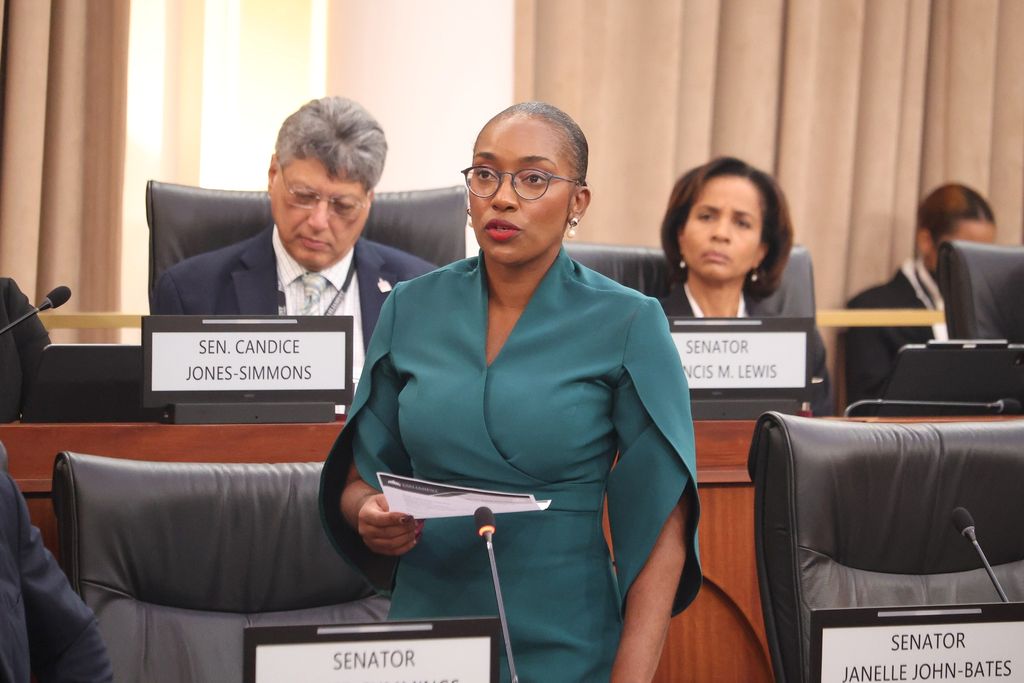
Embattled People’s National Movement (PNM) Senator Janelle John-Bates has offered her resignation from the Upper House to her political leader, but Pennelope Beckles has not yet decided if she will accept it.
But while the Opposition Leader considers her decision, Senate President Wade Mark yesterday ruled that both John-Bates and Senator Faris Al-Rawi be referred to the Committee of Privileges.
The agenda of yesterday’s sitting focused on whether the Upper House would accept the Public Accounts and Administration Committee (PAAC) report that calls for Parliament to formally review John-Bates’ conduct and consider whether her assistance in drafting a witness statement for former health minister Terrence Deyalsingh constituted a “conspiracy to commit contempt of Parliament” that compromised the integrity of the committee’s inquiry into pharmaceutical procurement.
But moments before the debate began, John-Bates made a statement to the Senate.
“I recognise that my involvement in this matter has given rise to public concern and has contributed to a level of controversy that risks distracting from the important work of this Honourable Parliament and from the issues affecting the people of Trinidad and Tobago,” she told the House
John-Bates then apologised to the Parliament and the public but did not admit to any wrongdoing.
“I apologise unequivocally to the citizens of our country and to the members of this Senate. It was not my intention to obstruct or impede the work of the committee or the Parliament, and I deny that I conspired to commit a contempt of Parliament.”
She added, “I hereby inform the Senate and the national community that I have offered my resignation to the Honourable Leader of the Opposition.”
John-Bates then sat down and stayed in the chamber for the remainder of the sitting.
But the Lower House also sat in the afternoon.
Guardian Media used the opportunity to ask Opposition Leader Beckles, on her way to the Red House, if she had accepted the resignation.
However, Beckles said, “Well, I’m happy that she apologised, so it’s under active consideration at this time.”
Asked if there’s a timeframe she is working with, Beckles said, “No, I’m not going to give a timeline.”
The Opposition Leader was also asked if she would decide on Al-Rawi’s Senate future.
“I’ve asked him for a report and I was still going to meet with him,” she replied, underscoring that the decision rests with her.
But in the Upper House, Government Senator David Nakhid sought to refer both John-Bates and Al-Rawi to the Committee of Privileges.
As it relates to John-Bates, Nakhid said the senator should have recused herself from the PAAC sitting once she had gotten involved in assisting Deyalsingh.
He said, “Mr President, the inescapable conclusion on the face of the material in the committee’s report is that Senator John-Bates would have continued to sit as a member of the committee to treat with the very evidence of Mr Deyalsingh, which she herself curated, had it not been for the chairman’s intervention. It is also obvious that Mr Terrance Deyalsingh knew of Senator John-Bates’ membership on the committee when he submitted his memorandum of evidence.”
Turning his attention to Al-Rawi, Nakhid said, “Senator Faris Al-Rawi SC, former attorney general, who edited that memorandum and whose name appears prominently and frequently in that document, knew that Senator John-Bates was a member of the committee. He not only participated in the scheme, but to date he has never publicly distanced himself from the impropriety of Senator John-Bates’ conduct.”
Although Al-Rawi is not a member of the PAAC, critics believe his involvement in assisting Deyalsingh with his witness statement is still unethical, given his senatorial appointment.
But later in the sitting, Al-Rawi shot back.
“I will declare that I am the attorney-at-law for M Terence Deyalsingh,” Al-Rawi told the Upper House.
He also underscored that the PAAC report does not take issue with him.
“My name does not appear in the report!”
Al-Rawi described the report being debated as being “poisoned at its roots.”
Seeking to defend Senator John-Bates, Al-Rawi said she was not given an opportunity to explain herself before the PAAC drafted the report.
“Are we being asked, Mr President, to interfere in a matter where the report has acknowledged, as the Minister piloted, that Senator John-Bates has not been given an opportunity to be heard? I certainly haven’t been called upon to say or do anything.”
He also questioned the impartiality of PAAC chair Jagdeo Singh.
Al-Rawi cited a 2024 newspaper article where, speaking in his capacity as an attorney-at-law, Singh made comments about an alleged “drug cartel” in the pharmaceutical industry. Singh also said that he has clients who are pharmaceutical importers.
The PAAC, which Singh chairs, deals with the state’s importation of pharmaceuticals.
“The chairman should never have sat. He needed to recuse himself. Automatic recusal.”
PNM Senator Foster Cummings also raised concerns with the PAAC.
The issue of the “track changes” was ventilated during an “in camera” or private session of the sitting. But Cummings lamented that it was leaked to the media.
Some Independent Senators also took issue with the leak.
However, there was little sympathy for John-Bates’ conduct.
Senator Marlene Attzs told the Upper House, “Can a sitting member of a committee assist a witness in preparing evidence for that very committee? Mr President, the answer must be unequivocally no. Because once that line is crossed, the member is no longer a neutral examiner serving the public interest.”
Senator Desiree Murray, meanwhile, said, “I wish to state without equivocation that the alleged or admitted action taken by the member in question was in my considered view unethical.”
Government Senator Anil Roberts commiserated with John-Bates, given her inexperience in the Parliament, but told her that it was the PNM who failed her.
“Because it was incumbent upon them to say no, young junior senator, understand the procedure and guide you in a different manner rather than to take you down there, throw you under the bus, and hide like cowards now.”
When the report was put to a vote, 18 members voted in favour, including three independent senators, seven voted against and four members abstained.
Before the Senate’s adjournment, Senate President Wade Mark ruled that there was a “prima facie case” for both Al-Rawi and John-Bates to be referred to the Privileges Committee.
“Accordingly, I now refer both matters to the Committee of Privileges for investigation and report.”
Political analyst Dr Bishnu Ragoonath yesterday said Beckles’ hesitation in not accepting John-Bates’ resignation could send a bad signal to the PNM membership.
He stated, “The facts are not in dispute. The fact is clear that the senator would have done certain things that would not have been overly ethical or in that context. To that extent, the political leader should accept it. However, by not immediately accepting it, the political leader is simply demonstrating to some extent that the PNM is not going to stand up for what is under her leadership. The PNM is not necessarily going to insist on ethical standards and so on. But that is for the political leader of the PNM to determine whether or not that’s the image she would like to create for the PNM.”
Asked what ramifications there could be should Beckles not accept John-Bates’ resignation, Ragoonath said, “It is clear that the senator took charge of a situation which she should not have involved herself into. But the fact of the matter is, it sends a message to the membership of the PNM as to the leadership on these issues with regard to upholding higher standards of integrity for membership.”
Meanwhile, political scientist Dr Indira Rampersad said, “I did say that she should have also resigned as a senator, not just from the committee, because if challenged, this could amount to professional misconduct. So, Penelope Beckles should accept her resignation. She should accept it without hesitation. That’s the proper thing to do.
Timeline of the John-Bates controversy
March 23, 2026:
A witness statement is prepared by former Minister of Health Terrence Deyalsingh in response to a Public Accounts and Administration Committee (PAAC) inquiry into the state’s acquisition of pharmaceuticals. Leaked documents later suggest this is when Senator John-Bates and Faris Al-Rawi reportedly edited the document.
April 13, 2026:
The scheduled PAAC meeting is abruptly adjourned. Chairman Jagdeo Singh offers a public apology, citing a “regrettable” but unavoidable situation. It is later revealed that during an in-camera session, the committee discovered that Deyalsingh’s submitted Microsoft Word document contained visible “Track Changes” and comments attributed to John-Bates.
April 15–16, 2026:
Media reports emerge alleging that John-Bates “coached” the witness she was meant to scrutinize. Confirmation follows that the People’s National Movement (PNM) intends to replace her on the committee.
April 17, 2026:
The PNM removes John-Bates from the PAAC. She is replaced by Vishnu Dhanpaul. John-Bates later stated she respects the decision to allow the committee’s work to continue without being “overshadowed.” The PAAC also prepares a “Special Report” on her conduct.
April 27, 2026: The PAAC resumes its work without John-Bates.
April 30, 2026: A Joint Select Committee (JSC) on National Security was postponed after questions were raised about the presence of John-Bates on the Committee. Concerns were expressed by government members questioning if she would pollute the proceeding.
May 1, 2026: Moments before the Upper House begins debating the PAAC report, Senator John-Bates makes a personal explanation in the Senate. She denies conspiring to commit contempt of Parliament but offers an unequivocal apology and announces she has offered her resignation to the PNM leader to preserve the integrity of the institution.