
Senior Reporter
Government Senator Phillip Alexander has defended Attorney General John Jeremie’s controversial use of the term “one per cent” during Wednesday’s debate on the extension of State of Emergency (SoE), arguing that the phrase is globally associated with wealth and privilege rather than any specific ethnic group.
Jeremie’s comments have triggered strong criticism from members of T&T’s Syrian-Lebanese community, after he warned that Government’s focus would extend to “those who describe themselves in percentages, such as the one per cent,” a phrase that has historically been linked to the Syrian-Lebanese business community.
Businessman Gary Aboud was among those condemning the remarks, describing them as discriminatory, hateful and racist, while calling on Jeremie to exercise greater responsibility in his public statements.
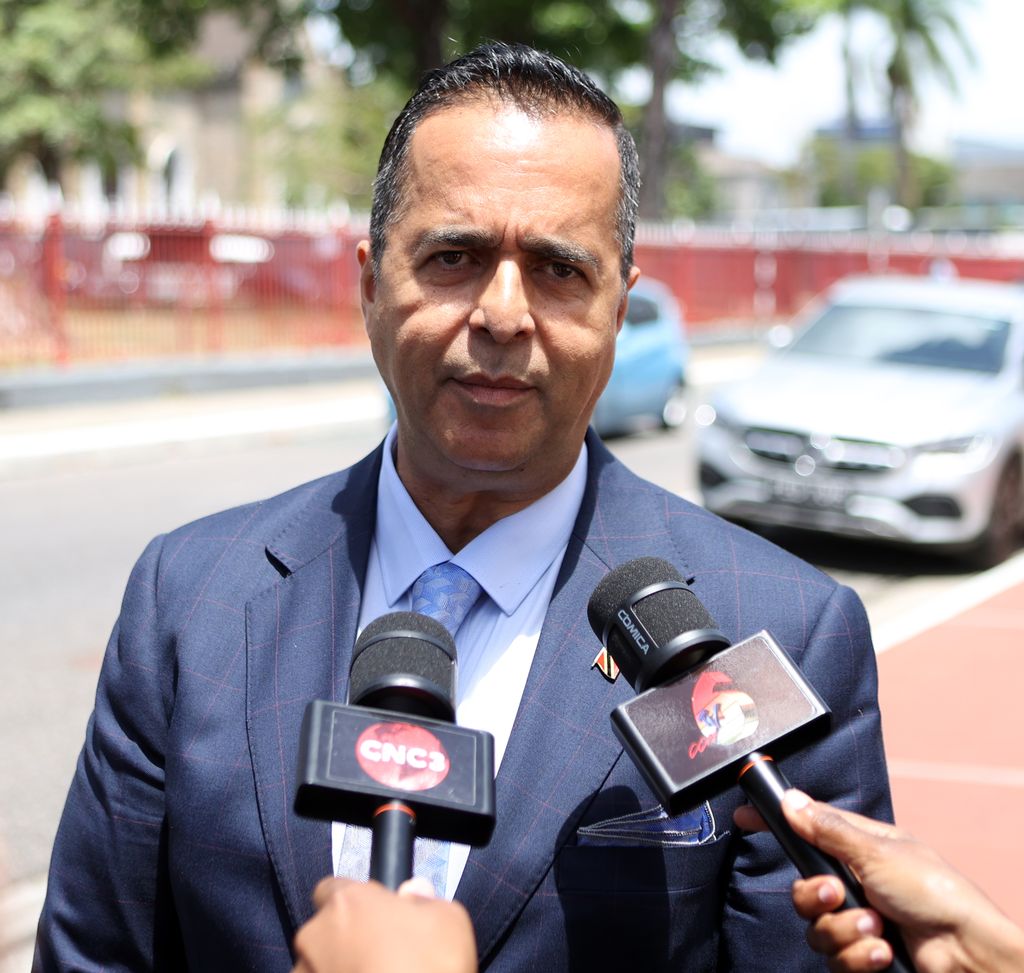
However, speaking with reporters outside Parliament yesterday, Alexander rejected suggestions that Jeremie’s comments targeted the Syrian-Lebanese community.
“I have Syrian ancestry and unfortunately, tagging the word one per cent to the Syrian community happened in a video that was done with Anthony Bourdain, and that went viral on its own,” Alexander said.
“But globally, the term one per cent refers to the top one per cent of the wealthiest people in a country. That is why we are the 99 per cent as a movement.”
Alexander said the AG was referring to longstanding concerns about wealth concentration and unequal treatment under the law.
“In Trinidad and Tobago, we have had, for quite some time, a disproportionate distribution of wealth and there has been a disproportionate use of law enforcement where wrongdoing is concerned, and I think that is what the AG is referring to when he said certain people have the keys to the city,” he said.
“I understand the point he was trying to make. He mostly inferred that this is a warning to those who would contemplate taking any action against the State that this time around, there would be no separating sheep from goat, that all who engage in any kind of criminal wrongdoing will feel the full brunt of the law. And we, as Trinidadians and Tobagonians, have been asking for that for a long, long, long, long time.”
Asked whether the wording used by the AG could have been interpreted differently, Alexander maintained there was nothing objectionable about the language.
“What word would you use? Richest? Wealthiest? At some point, everybody could claim everything,” he said.
He added, “I heard Kareem Marcelle saying PNM people is the new ‘N’ word. I think we are at the dirty deep end of the ocean now. I don’t know what can you say and people wouldn’t claim and put their own meaning on. The reality is there are terms accepted globally and he used globally accepted terms and I don’t see anything wrong with that, speaking as a proud member of the Syrian community.”
But Opposition Senator Faris Al-Rawi, speaking outside Parliament yesterday, strongly disagreed with Alexander’s defence, insisting the AG’s comments could only reasonably be interpreted as a reference to the Syrian-Lebanese community.
“The AG is a very precise man, very experienced man. I listened to his contribution,” Al-Rawi said.
“He started by reading the wording from Peter George in an Anthony Bourdain interview. After he had done that, he then made references to one per cent ownership of media, which could only be the Sabga family.
“If anybody in Trinidad and Tobago speaks plainly, the minute you say one per cent, you think the Arab community in Trinidad and Tobago, full stop.”
Al-Rawi dismissed attempts to broaden the interpretation of the phrase, arguing that Jeremie’s comments amounted to an attack on an ethnic minority group.
“The feeble attempt by the Prime Minister to allege there is a one per cent attributable to everybody in Trinidad and Tobago was a claw-back attempt to hide what, in my view, is a blatant statement against the Arab community in Trinidad and Tobago, which is an ethnic minority in Trinidad and Tobago,” he said.
“There is no secret that I am half Arab. My father is Iraqi, my mother is Trini, and I view that statement as a direct statement to the Syrian-Lebanese community in Trinidad and Tobago.”
While stressing that criminal activity should be prosecuted regardless of who is involved, Al-Rawi said public officials must avoid language that could be perceived as discriminatory.
“If there is evidence of crime in this country, deal with it,” he said.
“But you see making statements in Parliament in a vague, opaque sort of way where you have us guessing, I don’t buy that.”
Al-Rawi pointed to legislation enacted during his tenure as Attorney General, including unexplained wealth laws and beneficial ownership measures, arguing that authorities already possess legal tools to pursue illicit wealth.
He added: “There is no room for discrimination, there is no room for statements otherwise and if you’re going to apply the law, you don’t preface it in the manner in which it was said. I expect more from the Attorney General. He is a very experienced man.”
Meanwhile, Independent Senator Courtney McNish said he did not interpret Jeremie’s comments as offensive or targeted at any particular ethnic group.
“Let’s be honest with each other, we know the group or the class of persons generally referred to as the one per cent,” McNish said.
“I do not think the AG was attacking that class of people directly. I think the point he was trying to make, that I took from it, was listen, criminals exist on all levels of our society. So you can be from the upper class, the rich and elite, that is not to say you are above the law. And the law will pursue you if there is evidence that you are engaged in criminal activity. That’s how I took it.”