
Senior Reporter
Homeland Security Minister Roger Alexander says “something was going wrong” for the Trinidad and Tobago Police Service (TTPS) to accumulate more than $93 million in telephone bills over four financial years. He said his ministry was taking a more hands-on approach to spending and accountability.
Alexander acknowledged that the bill was among the financial obligations inherited by the current administration. He said the Government must now examine how such a substantial amount was allowed to accumulate.
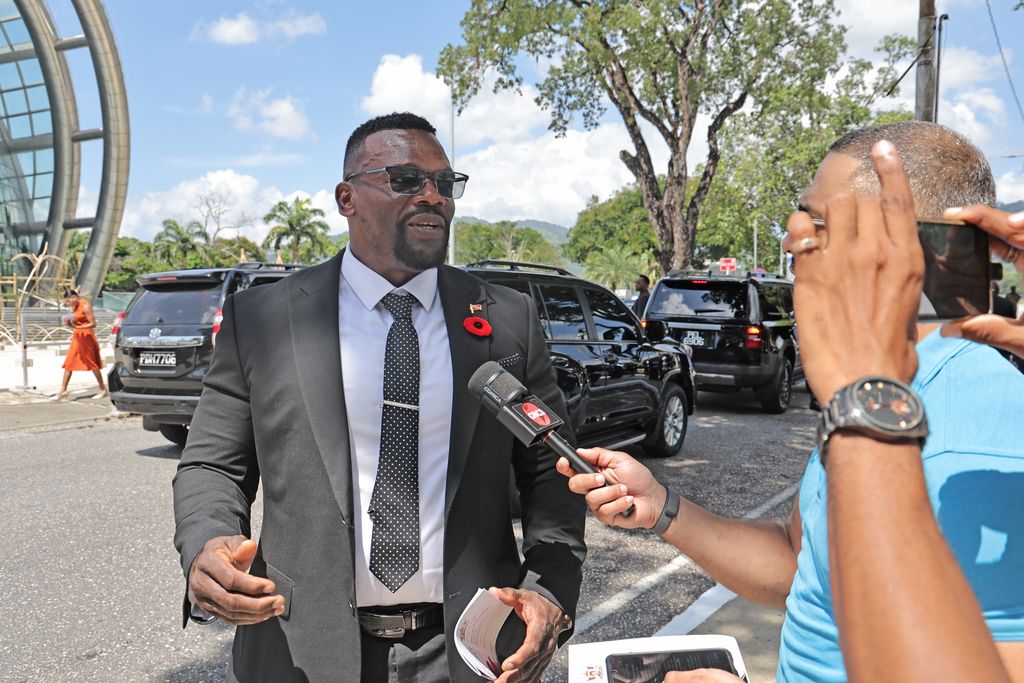
He was responding to questions from Guardian Media on Sunday after the National Day of Remembrance wreath-laying ceremony at Memorial Park in Port-of-Spain.
The minister questioned how the Police Service could incur a telephone bill of that size over four years, particularly when members of the public were reportedly having difficulty reaching police stations.
“Now, how does one accumulate a bill of that magnitude over a four-year period? Now, something was going wrong, but then persons were still saying that they were calling and they were not getting through and all these things. So there’s a number of issues involved there,” Alexander said.
He maintained that the current administration had inherited the situation and was working to address longstanding issues.
“It’s about what we inherited. And you’re here four years. We weren’t here for four years. So everything we met, we have to now treat with. And that is the problem, you see,” he said.
Alexander said he was taking a different approach to managing the ministry, with greater personal involvement in its operations and financial decisions.
He said he would no longer accept payment requests without first understanding the reasons for the expenditure.
“It’s about a different approach and a more hands-on approach by the minister in his ministries. So nobody’s telling me, well, you know, well, we have to pay this. I want to know why. You see, why this reach so much? I want to know why. Show me the reason. This is happening now,” he said.
The minister said he speaks with Police Commissioner Allister Guevarro daily about a range of matters, describing their relationship as one built on open communication.
“I speak to the Police Commissioner every day on a number of issues. Alright, so both of us have what we call an open-door policy,” Alexander said.
He said the approach should extend throughout the Police Service, particularly in its engagement with the public.
“So we want to demonstrate that, you know what? It begins with us,” he said.
The comments follow a Freedom of Information response dated November 4, which disclosed that the TTPS paid TSTT $93,147,216.56 over four financial years between 2021–2022 and 2025–2026.
The highest annual expenditure was recorded in 2021–2022, when the Police Service paid $32.22 million. It paid $28.39 million in 2022–2023 and $19.12 million in 2023–2024. Expenditure then fell to $13.4 million in 2025–2026.
The total excludes expenditure for 2024–2025 because the amount was incorrectly printed in the TTPS response.
The $93 million covers all telephone services, including fixed lines, mobile services, airtime and data. The Police Service did not provide a breakdown by category.
The TTPS also disclosed that 516 phones were purchased during the period under review. Three cases involving devices that were unaccounted for, lost or not returned remain under investigation.
The response did not state how many phones were involved in the cases, their value or whether any devices or money had been recovered.
The Police Service also confirmed that officers’ issued official phones are subject to a maximum monthly limit of $500, unless otherwise approved.
Alexander has also dismissed concerns that Democratic gains in the United States midterm elections could affect security cooperation between Washington and Port-of -Spain.
Asked whether the political shift, which saw Democrats take control of both chambers of Congress, could affect Trinidad and Tobago’s security arrangements with the US, Alexander said he did not anticipate any difficulties.
“How can it? We came from, in fact, we have a democratic country. I hope I answered your question. It’s as easy as that. There’s no issues,” he said.
He said democracy should be embraced.
“We were elected through democracy. And we love when democracy prevails,” Alexander said.
His comments follow similar assurances from Prime Minister Kamla Persad-Bissessar, who previously dismissed concerns that Democratic gains in the midterms could undermine Trinidad and Tobago’s relationship with Washington.
Persad-Bissessar described the results as predictable, saying midterm elections have historically presented challenges for the party occupying the White House.
“These midterm results were very predictable and in line with the cycle of midterm election results going back decades,” she said.
The issue has drawn attention amid the expansion of security cooperation between Trinidad and Tobago and the US under the Trump administration.
That cooperation includes the Shield of the Americas, also known as the Americas Counter Cartel Coalition (A3C), which focuses on regional maritime interdiction, intelligence sharing and efforts to combat transnational drug and weapons trafficking.
The US has also deployed a contingent of Navy SEALs to Trinidad and Tobago in an advisory and logistical capacity. They are assisting with security capabilities, border protection and training for members of the local protective services.
Alexander also confirmed that the procurement process for police body-worn cameras was nearing completion as the Government moved to expand the Police Service’s capacity to record interactions between officers and members of the public.
The development comes amid renewed attention to body-camera use under the Government’s revised Zones of Special Operations legislation.
“It’s almost at the end. I understand there are persons who are showing interest. But before I say that, let me tell you what we don’t want. Trinidad and Tobago have an old 1946 strategy. They mentioned that they are going to get it from England, but they go down to another location far far, get it for $10 for 17, bring it and disguise it under the English system,” Alexander said.
Persad-Bissessar previously said police officers conducting operations in designated special zones would be required to wear body cameras. Defence Force members providing military assistance would also be subject to requirements for recording operations.
The proposed safeguards include mandatory human rights and use-of-force training, conflict de-escalation procedures, weapons registration and the formal recording of complaints.
The body-camera requirement was a major point of contention during debate on the previous Zones of Special Operations Bill.
However, the availability of operational cameras within the TTPS remains a concern.
In January, senior police officers told Guardian Media that fewer than 200 body cameras were operational across the service.
Deputy Commissioner of Police Junior Benjamin said at the time that about 190 cameras were active, while Guevarro later estimated that about 180 were usable.
More recently, Guevarro said just over 100 cameras were operational and assigned to frontline officers. He also identified battery life as a significant challenge, saying the cameras lasted about 90 minutes to two hours.
The TTPS had previously announced an expression of interest in June for the supply, delivery and commissioning of additional body-worn camera systems, describing the technology as essential to transparent and accountable policing.
The Government also cancelled a nearly $25 million contract to supply 3,000 body-worn cameras, saying the decision would save taxpayers millions of dollars.
Related News

TSTT firebombing may have been an inside job, says Padarath

Haitian gang leader killed as security forces intensify operations

Bmobile sponsors Ramleela groups after cuts to Divali Nagar