$10M for drone units in budget; devices to be used in crime hotspots, curb prison breaches
 18 October 2026

Senior Reporter
elizabeth.gonza[email protected]
Drones are set to play a greater role in crime prevention, law enforcement and public safety, with the Government allocating $10 million to establish a new Air Guard Drone Unit and upgrade the Police Service’s Air Support and Drone Unit.
The technology is expected to help officers monitor crime hotspots, improve traffic management, and strengthen efforts to detect and prevent prison breaches involving the illegal delivery of contraband.
It comes as the Prison Officers Association reported well over 100 drone breaches at the nation’s prison facilities so far this year.
Efforts to obtain the exact statistics from senior prison officials were unsuccessful.
This year’s breaches followed more than 600 drone sightings reported in just six months last year.
The 626 sightings were recorded from April 4 to October 4, 2025, according to then acting Commissioner of Prisons Hayden Forde. Most were reported at the Maximum Security Prison in Arouca. The figure counts sightings, not breaches or deliveries of contraband.
“Since April, we have had close to 626 drone sightings over various prisons, so it is showing that people are bent on trying to get contraband into our system,” Forde said in October 2025.
Last year, Attorney General John Jeremie revealed in Parliament that drones had entered the restricted area of Teteron Barracks, Chaguaramas, where high-risk prisoners were being held.
Jeremie said, “I have been cleared to say that the location that the problematic inmates, those locations that they were removed to were very recently also infiltrated by two drones, and that is what I have been permitted to say on that.”
He added, “The Defence Force, which has custody of those areas, has dealt with that situation.”
The Defence Force separately reported two sightings between Staubles Bay and Teteron Barracks on July 24 and 25, 2025, and a third over Teteron on July 26. The available reports do not establish whether those sightings overlap with the incidents described by Jeremie.
Despite the interceptions and the beefing up of security at prison facilities, drone-related smuggling attempts have continued. On September 17, 2026, prison officers found a crashed DJI drone carrying 30 packs of cigarettes on the roof of the Maximum Security Prison. On October 8, 2026, officers recovered a package containing 20 packs of cigarettes suspected of being delivered by drone to the same prison.
Head of the Prison Officers Association Gerard Gordon believes the time has come for decisive action when it comes to dealing with illegal drones.
“It would appear that the challenges surrounding drones are going to continue because, certainly, the criminal elements are not letting up in their attempts to traffic illegal and unauthorised articles into the prison via this technological means.
“We continue to make our call for the employment of anti-drone technology to really be able to not only simply get a handle on this particular issue, but certainly to have it totally eradicated.
“And so, we lend our support to the Trinidad and Tobago Prison Service and the ministry (Homeland Security) in hopes of meeting that particular end.”
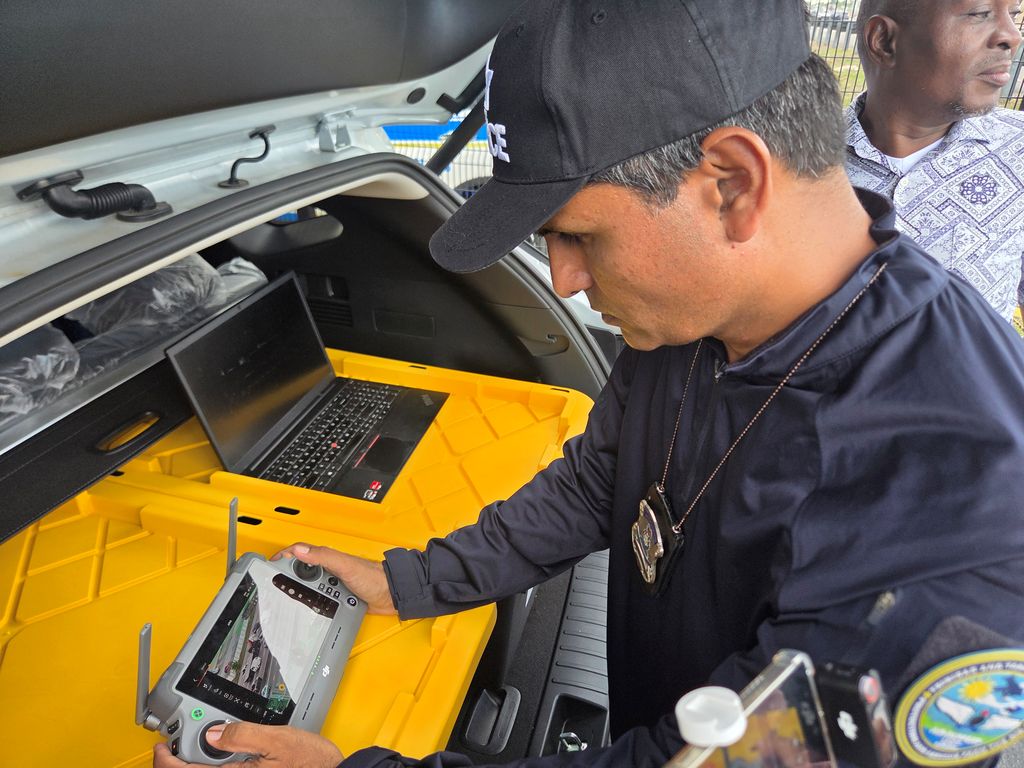
The TTPS is also welcoming the allocation to its drone unit. Deputy Commissioner of Police Junior Benjamin told Guardian Media that drones will help officers fight crime in hotspot areas.
“We have to understand the reason why we need drones within the service because it helps in crime prevention, especially in hotspot surveillance. If we are going to improve greater police visibility, especially in high-risk areas and where we see a lot of things happening, drones will help us tremendously in terms of visibility, to get information and to be able to see things, especially in some areas.
Drones are already used by the Police Service in its coastal and marine units and play an active role in operations there.
But the DCP in charge of Administration and Operational Support added that drones will also play a role in officers’ safety and transparency.
“When we think about officers’ safety, in terms of operations that we go (on), we recognise the importance of having those drones there as very critical so that we are able to see what is happening in those operations. And it also helps with the integrity that is needed to ensure that if anything adverse happens, we can accout to the public. Therefore, it is important.”
Benjamin explained that the upgrade of the drone unit would also lead to greater capabilities in search and rescue and traffic management. Traffic congestion has recently become an issue after motorists endured hours of delays heading into Port-of-Spain following vehicular accidents and a traffic light hiccup.
“In terms of search and rescue operations, the police are always called out to find persons in places you can’t go. The drones will also help us in this area. Very interesting for us as well is that traffic congestion is something that we are seeing more and more prevalent now, and we believe it could help in traffic management, as we seek to alleviate that. It is going to help us with that,” Benjamin said, adding that drone technology will also be used for disaster and emergency responses.
Guardian Media was unable to get onto the Defence Force about the allocation for the Air Guard Drone Unit.
Page 152 of the 2027 Public Sector Investment Programme (PSIP), published on October 12, provides $5 million to establish an Unmanned Aerial Vehicle Unit within the Trinidad and Tobago Air Guard.
The PSIP states, “This Unit is expected to enhance intelligence, surveillance, target acquisition and reconnaissance capabilities.”
The document does not identify the number or type of drones, the supplier, the delivery date or the unit’s annual operating cost.
The Air Guard’s total 2027 development allocation is $9.7 million. The proposed UAV unit represents about 52 per cent of that allocation.
The Coast Guard had received two drones donated by the United Nations Office on Drugs and Crime in the 2024 financial year. The donation was recorded in the Ministry of National Security’s appropriation account published by the Auditor General. Their current operational status has not been established.
For the TTPS, $5 million is allocated for the upgrade of the Air Support/Drone Unit. In 2026, $2 million was allocated, later revised downwards to $1.6 million.
The PSIP allocation for the Air Support/Drone Unit stated that the money would be used for six industrial or commercial-grade mapping drones. The published budget does not establish whether all six drones were purchased and delivered.
The 2027 PSIP lists bomb disposal trucks among several vehicle types under a $20 million Police Service vehicle allocation. Bomb disposal trucks also appeared in earlier investment plans. The published entries do not establish whether the earlier vehicles were purchased or whether the new allocation is for replacement or additional vehicles.