
Lead Editor-Politics
akash.sama[email protected]
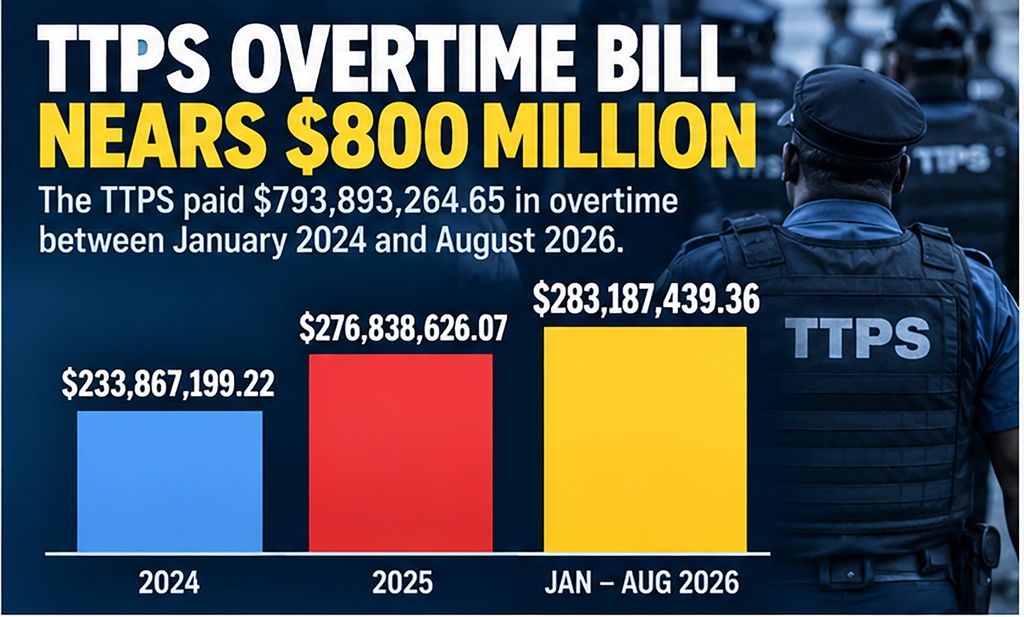
The Trinidad and Tobago Police Service (TTPS) has paid out nearly $800 million in overtime in just two years and eight months, with expenditure for the first eight months of 2026 already surpassing the entire bill for 2025, even as the country prepares for another round of heightened policing under the new Special Operations legislation.
Official figures obtained through a Freedom of Information (FOI) application reveal that the TTPS paid $793,893,264.65 in overtime between January 2024 and August 2026. Of that amount, $283,187,439.36 was paid between January and August this year, exceeding the $276,838,626.07 spent throughout 2025 by $6,348,813.29 with four months still remaining in the year.
The figures come against the backdrop of two recent States of Emergency (SoEs) which covered much of 2025 and 2026, during which time police officers undertook heightened security operations, including increased patrols, roadblocks and other deployments.
However, the records do not identify how much overtime expenditure was directly attributable to the SoEs.
With the Special Operations legislation now law and additional policing measures expected to be implemented, questions are now emerging about whether the overtime bill could climb even higher.
The figures were disclosed in a seven-page response from the TTPS Office of the Head of Legal Services, dated September 29, 2026.
The information was provided following an FOI application filed by attorney Keron Ramkhalwhan, of Juris X Chambers, on behalf of citizen Vishal Persad.
The application, dated August 20, requested the total overtime payments made to police officers between January 2024 and August 2026, along with a breakdown by police unit and division.
In its response, the TTPS confirmed that both requests were approved and that the information had been compiled by its Finance Branch.
The records reveal a significant acceleration in overtime spending. In 2024, the TTPS paid $233,867,199.22 in overtime. That increased by approximately $42.97 million, or 18.4 per cent, to $276,838,626.07 in 2025.
However, the first eight months of 2026 have already eclipsed both annual totals. The average monthly overtime bill so far this year stands at approximately $35.4 million, compared with $23.07 million in 2025 and $19.49 million in 2024. That represents an increase of approximately 53 per cent in average monthly payments compared with last year.
A breakdown by police unit and division reveals that the Guard and Emergency Branch consistently accounted for the largest net overtime payments.
In 2024, the GEB recorded approximately $29.66 million, followed by the IATF with $25.21 million, Southern Division with $23.93 million and Northern Division with $20.71 million.
The GEB again led in 2025 with $29.97 million, followed by the IATF with $26.97 million and Southern Division with $26.82 million.
For the first eight months of 2026, the GEB recorded $19.10 million, followed by Southern Division with $16.99 million, Northern Division with $16.50 million and the IATF with $15.88 million.
Across the three reporting periods, the GEB accounted for approximately $78.7 million in net overtime payments, while the IATF recorded approximately $68.1 million.
However, the divisional financial tables report net payments after deductions, while the monthly overtime tables contain different totals. The two sets of figures cannot be directly reconciled without further clarification from the TTPS.
Deputy Commissioner of Police (Administration) Junior Benjamin is, however, defending the overtime bill, arguing that the expenditure must be weighed against the results delivered by the TTPS, particularly its efforts to reduce murders.
Speaking to Guardian Media yesterday, Benjamin insisted that maintaining police visibility and deploying officers to combat crime came at a cost.
“There’s a price to be paid and therefore, the overtime is but, I think, a small, a small price to pay to ensure at the end of the day that we’ve seen such a great reduction,” Benjamin said.
He pointed to what he described as improvements in the country’s murder figures, arguing that sustained police deployments, including those involving the Inter-Agency Task Force and officers in Tobago, had contributed to the results.
Benjamin said the public should consider what the TTPS had accomplished through its operations rather than focusing solely on the financial cost.
However, he acknowledged that the two recent States of Emergency had significantly contributed to the rising overtime expenditure.
Asked how much of the $793.9 million could be attributed to the heightened policing operations during the SoEs, Benjamin said he could not provide a precise figure.
“I can’t really say how much of it. I can say definitely it contributed a great deal to it.”
Despite defending the spending, Benjamin revealed that he has been given a mandate by the Police Service Commission to reduce overtime expenditure by ten per cent. He explained that instructions had already been issued to strengthen the authorisation and monitoring of overtime payments, including closer scrutiny of the hours officers worked.
Benjamin said unusual claims would be flagged and investigated to ensure there was no impropriety.
He also identified staffing shortages as a major factor behind the reliance on overtime, estimating that the TTPS was more than 1,000 officers short of its previously authorised strength.
He said the service was working to recruit and train at least 1,000 additional officers within the next year, explaining that recent recruitment had largely been offset by officers leaving the organisation.
“What we are turning out is just enough for those who are also leaving,” he said.
His comments come as the Government pursues a five-year recruitment programme announced by Homeland Security Minister Roger Alexander in May, aimed at increasing the TTPS establishment from 7,884 to 10,200 officers, with 2,316 additional positions.
Asked whether the implementation of the new Special Operations legislation could drive overtime spending even higher, Benjamin said the TTPS intended to draw on additional resources to minimise the burden on its existing officers going forward under the new legislation.
He said special reserve police officers and members of the Defence Force would assist with the operations, reducing the need for regular police officers to shoulder the entire workload.
“It is not that the police are going to be doing it all by themselves,” he said, adding that the arrangements would help the TTPS maintain its operational commitments without placing excessive pressure on personnel.
Benjamin also praised Commissioner of Police Allister Guevarro, saying he deserved recognition for the crime-fighting strategies being implemented by the TTPS.