UN chief says power has polarized the world and urges leaders to cooperate
 22 September 2026
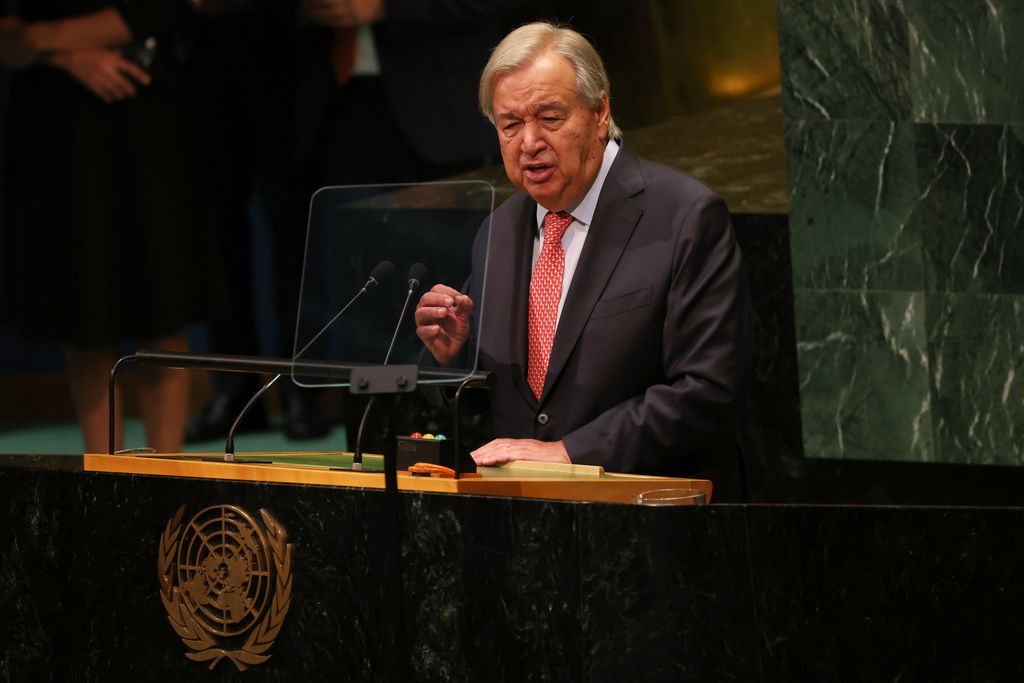

In a no-nonsense farewell speech, U.N. Secretary-General Antonio Guterres urged global leaders Tuesday to respond to the defining challenge today: Will the world continue on its path to fragmentation or cooperate to tackle the existential threats from climate crisis, runaway artificial intelligence and intensifying inequalities?
At the heart of these crises is power, Guterres told the annual high-level gathering at the U.N. General Assembly, pointing to the “irreversible” move toward a multipolar world, the “extraordinary transfer of power” from governments to a handful of private corporations and individuals, and the increasing handover of power from humans to machines with artificial intelligence.
Guterres urged leaders to avoid what he called “the great fracture – the division of the world into two rival blocs with separate economic, technological and security systems.”
He rebuked might-makes-right thinking, telling superpowers to recognize “that their power isn’t so super” — that “military power alone cannot security peace” and that “no power can solve today’s challenges along.”
The future will be shaped by how the world addresses “four great tests of power” – power over war and peace, power fueling climate chaos, power unleashed by artificial intelligence and “power that concentrates wealth and drives inequality,” he said
War and peace
Peace and security is “the first great power test in the 21st century,” the U.N. chief said, appealing to leaders to maximize their weeklong meeting to demand an end to fighting in the Middle East, Ukraine, Sudan, Myanmar and elsewhere – and demand a return to dialogue.
Climate crisis
The climate crisis, Guterres said, is in many ways “the most profound intergenerational power imbalance of all – one generation consuming the future of the next.”
The world faces a near certain breach of the 1.5 degree Celsius (2.7 degrees Fahrenheit) safety threshold set 11 years ago to prevent the worst of global warming, he said, and “the dangers are real, but so is the hope.” He pointed to the past decade which has fueled “one of the most promising shifts in power of our time” to clean energy.
Artificial intelligence
As for artificial intelligence, “the danger is not technology. The danger is technology without accountability,” he said, and its developers are now sounding the alarm.
Guterres urged AI rivals to come together – as the Cold War rivals did after World War II – “to manage shared existential risks.”
“Let us resolve that life-and-death decisions must never be surrendered to machines,” he said. “Killer robots must have no place in our future.”
Inequality
Stressing that inequality is a power problem, the U.N. chief said, “Never has humanity possessed so much wealth, knowledge and technological capability. Yet for billions, progress remains out of reach.”
He decried that for these billions, food, clean water, education, decent work, health care and dignity remain out of reach – and lamented that most U.N. goals to end poverty and promote development won’t be met by 2030.
Future leadership of UN unclear
Guterres’ second five-year term will end on Dec. 31, and the future leadership of the United Nations is unclear: After three straw polls in the Security Council of the eight contenders, no clear successor to Guterres has emerged.
Guterres said the backbone “for the effective, legitimate and responsible exercise of power in the 21st century” exists in the United Nations Charter which is based on “the primacy of international law. Upholding human dignity and the pursuit of justice in all its dimensions.”
But he stressed the critical need to reform the 81-year-old United Nations, established by the victorious powers in World War II to protect succeeding generations from the scourge of war to reflect the dramatically changed 21st century world.
Guterres urged presidents, prime ministers and ministers gathered in the assembly chamber to commit to the wide-ranging reform package the U.N.’s 193 member nations have adopted and strengthen the world body’s determination “to build a future that works for everyone.”
His voice rising with emotion, Guterres closed vowing to “never, ever give up” on the values for which the U.N. stands – the rule of law, the sovereignty of nations, and human rights to name a few.
“Wherever I will be, whatever I will be doing, I will keep championing the conviction that peace is possible,” he said, before leaving the rostrum amid a sustained standing ovation. He put his hand on his heart.
UNITED NATIONS (AP)