
Senior Reporter
Grand Chief of the First Peoples Sovereign Nations Eric Lewis is calling for greater visibility, recognition and Government support for Trinidad and Tobago’s Indigenous communities.
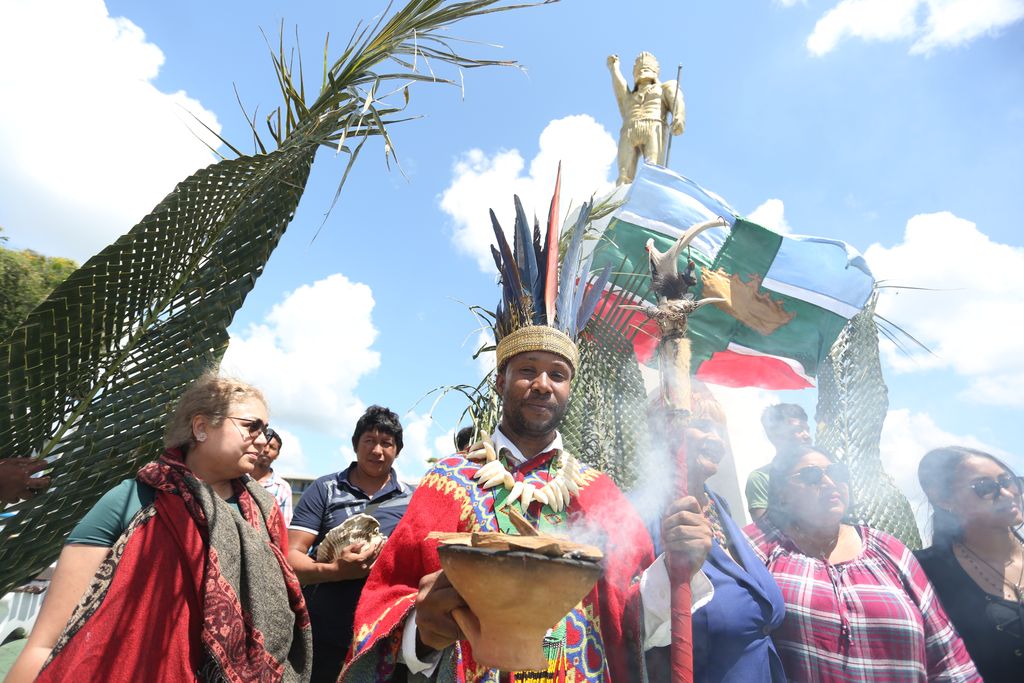
Lewis made the appeal yesterday, as the First Peoples marked the United Nations International Day of the World’s Indigenous Peoples 2026 with a series of ancestral and commemorative ceremonies.
The observances began at Parliament with an ancestral heritage and Indigenous legacy ceremony, before moving to the San Fernando Promenade for a smoke ceremony honouring Chief Utayani.
Lewis said the choice of San Fernando was significant, as the area has deep Indigenous roots.
“This is an Indigenous space, and still is an Indigenous space,” he said.
He said the ceremonies are intended to remind the wider population that Indigenous peoples are not simply part of the country’s history.
“Indigenous people still exist here in Trinidad and Tobago, and Indigenous-descended people are still here,” Lewis said.
Lewis said greater recognition of Indigenous communities is needed, pointing to the prominence given to other aspects of the country’s heritage.
“Just like as we honour Emancipation, we honour Indian Arrival, Divali, and all these other ethnic celebrations, as well as we honour our religious celebrations, Indigenous communities have a voice and presence today.”
He said he wants that presence to be reflected more strongly in government policy and national life.
“We hope that more of our Government officials would come to the forefront to work with us, because that is something that we have been asking for,” he said.
Lewis said political involvement could help strengthen the visibility of Indigenous communities across T&T.
He stressed that Indigenous heritage is not restricted to one part of the country.
“It’s not that Indigenous people settled only in one part of Trinidad, but Indigenous people settled all of Trinidad.”
Lewis is also calling for greater recognition of Indigenous names, particularly in the naming of national places and institutions.
He pointed to the recent discussion surrounding a proposal to rename the Piarco International Airport.
“Piarco is an Indigenous name,” he said, noting Indigenous names should be preserved and incorporated more prominently into the national landscape.
“One of the things that we’d like to see is more of the Indigenous names of things be returned to our Indigenous name, or other things be named or given an Indigenous name.”
Lewis also wants the country to go a step further.
“The next thing that we’d like to have is an Indigenous holiday, our First Peoples holiday,” he said.
He suggested replacing an existing public holiday with one dedicated to First Peoples.
“Perhaps we could replace Corpus Christi with First Peoples holiday,” he suggested.
Lewis said such a move would give the country an opportunity to formally acknowledge its Indigenous heritage while respecting religious observances.
“People who want to go to church, go to church. At the same time, Trinidad should recognise First Peoples holiday.”
For Lewis, the recognition must also extend to the land itself. He urged the country to embrace what he called “Mother Trinidad” and “Kairi,” the Indigenous name associated with the island.
“Many people have reaped from Mother Trinidad, which is the Indigenous land called Kairi. But not many Trinidadians are patriotic sufficiently towards Mother Trinidad.”
He said the country must never lose sight of the people who occupied the land before subsequent populations arrived.
“We need to recognise our Indigenous heritage and always remember that there were people here before others that came.”
Meanwhile, Opposition Leader Pennelope Beckles also recognised World Indigenous Peoples Day, describing Indigenous heritage as fundamental to the country’s identity.
In a Facebook post, Beckles said: “Trinidad and Tobago recognises a truth that predates our flag and every institution we now call our own: this nation was first a homeland to Indigenous peoples, and it remains one still.”
As the Member of Parliament for Arima, Beckles highlighted the Santa Rosa First Peoples Community and her participation in Santa Rosa Month, the Water Ritual and the reburial of ancestral remains at the Red House.
“Arima does not simply host this community, Arima is, in no small part, defined by it.”
She also praised Chief Ricardo Bharath Hernandez for his advocacy on behalf of the Indigenous community, including his engagement with the Inter-American Development Bank, the Caribbean Development Bank and the United Nations.
Beckles said his advocacy has consistently called for recognition and the honouring of the UN Declaration on the Rights of Indigenous Peoples.