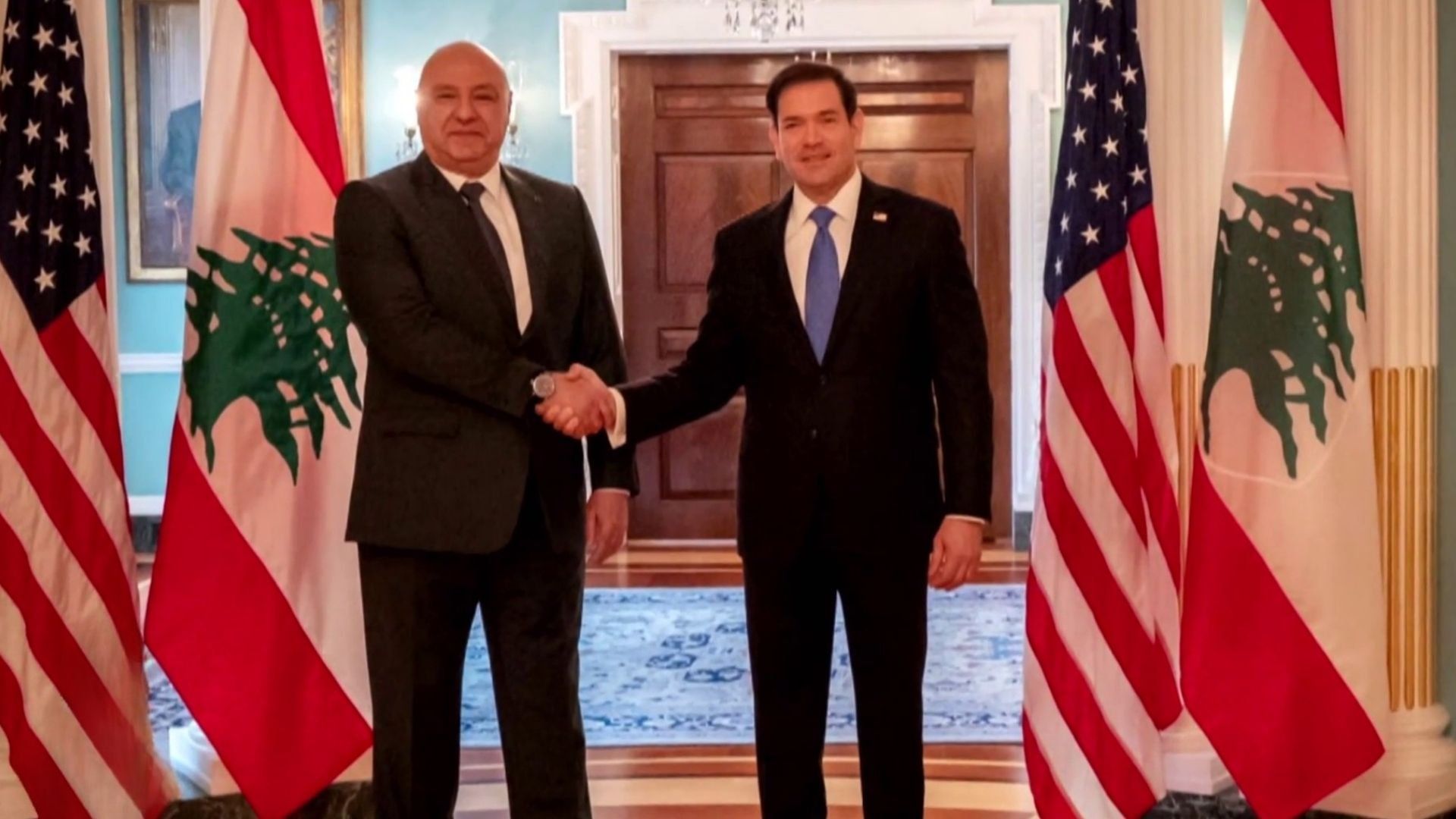

President Joseph Aoun is in Washington, DC, seeking the backing of the United States for an Israeli withdrawal from southern Lebanon and support for the Lebanese army as it moves to assert control over areas long dominated by Hezbollah.
Aoun is due to meet US President Donald Trump on Tuesday, before he concludes his four-day visit, following another round of US-mediated talks between Lebanese and Israeli officials in Rome last week, where negotiators discussed how to implement an agreement signed by the two sides on June 26.
- list 1 of 4Lebanon’s President Joseph Aoun meets Rubio ahead of Trump talks
- list 2 of 4Lebanese food influencer sentenced to life for drug smuggling
- list 3 of 4Lebanon’s military starts ‘pilot zone’ takeover in south
- list 4 of 4Lebanese army enters ‘pilot zone’, as villagers return amid Israel deal
end of list
Aoun and his wife had arrived at Joint Base Andrews on Saturday at the start of the official visit, according to the Lebanese presidency.
It is the first visit to Washington by a Lebanese head of state since Michel Sleiman met President Barack Obama in 2009.
Secretary of State Marco Rubio, who met Aoun on Sunday, said Washington would back the agreement’s full implementation, warning that Lebanon would “never be fully at peace” as long as the Hezbollah issue remained unresolved.
“How do you replace Hezbollah? You defeat and replace them with a government that is strong enough to be the sole force of arms in the country,” Rubio said after the meeting.
Sceptics in Lebanon fear that a military confrontation with Hezbollah could lead to a civil war. Government officials have also urged investment in the country’s battered infrastructure to empower the weakened state, which Rubio echoed.
“This is not just about military stuff,” he said. “This is about how can we attract more US and international investment into Lebanon.”
Advertisement
The Israeli military said on Monday the planned gradual withdrawal, dubbed the “pilot zone programme”, had begun.
The plan will see Israeli forces withdraw from a small number of areas in southern Lebanon, even as it remains in others it has invaded since escalating its war on Hezbollah in March, killing more than 4,300 people and displacing 1.2 million others.
The plan would also see Lebanese troops confiscating Hezbollah’s weapons in parts of southern Lebanon.
On Tuesday, a senior Lebanese security official told the Reuters news agency that troops had begun deploying in the southern town of Zawtar al-Gharbiyeh after Israeli forces withdrew from the area.
Though recent talks in Rome signalled that the agreement’s implementation will begin soon, the negotiations have also exposed the challenges facing Aoun’s government.
Hezbollah has rejected Lebanon’s direct negotiations with Israel and efforts to strip the group of its arms, while Israel has insisted it will not fully withdraw unless Hezbollah is disarmed and demilitarised.
Lebanon’s government came to power on a reformist platform in early 2025, pledging to disarm all non-state groups, including Hezbollah.
Lebanese troops later deployed across parts of southern Lebanon to collect Hezbollah weapons under a ceasefire agreement following the 2024 war.
But those efforts were complicated after fighting flared again in March, when Hezbollah launched attacks on Israel in support of Iran, which was under attack by Israel and the US. This triggered another Israeli offensive in Lebanon.
Lebanon’s government blames Hezbollah for dragging the country into another war with Israel, but it has also been critical of Israel’s subsequent ground invasion and massive aerial campaign in the country.
While grappling with strong political opposition from Hezbollah and its allies within the deeply divided country, Lebanon’s leadership insists that Israeli withdrawal and international financial support for Lebanon’s cash-strapped army are crucial for a sustainable security solution.
Related News
Reform UK’s Farage failed to disclose funds from convicted criminal: Report
US judge voids Trump’s IRS settlement, alleges self-dealing
Trump’s new 50 percent Canada tariffs: What products are affected and why?