CNN founder Ted Turner, a brash and outspoken television pioneer, has died at age 87
 06 May 2026
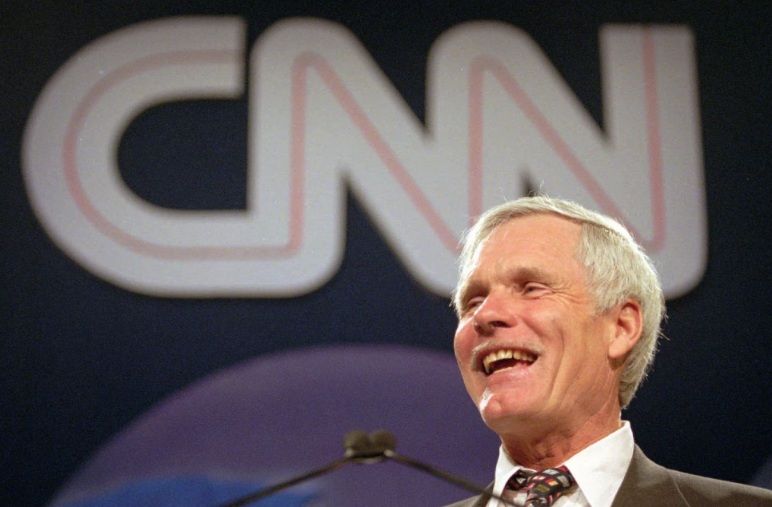

Ted Turner, a brash and outspoken television pioneer who raced yachts, owned huge chunks of the American West and transformed the news business by launching CNN and introducing the 24-hour news cycle, died Wednesday. He was 87.
Turner died surrounded by his family, according to Turner Enterprises, the company that oversees his vast business interests and investments.
Turner owned professional sports teams in Atlanta, defended the America’s Cup in yachting in 1977 and donated a stunning $1 billion to United Nations charities. He married three women — most famously actor Jane Fonda — and earned the nicknames “Captain Outrageous” and “The Mouth of the South.”
He once bragged: “If only I had a little humility, I’d be perfect.”
He was slowed in later years by Lewy body dementia. Long since out of the television business, he concentrated on philanthropy and his more than 2 million acres of property, including the nation’s largest bison herd.
His garrulous personality sometimes overshadowed a driven, risk-taking business acumen. By the time he sold his Turner Broadcasting System to Time Warner Inc. in a 1996 media megadeal, Turner had turned his late father’s billboard company into a global conglomerate that included seven major cable networks, three professional sports teams and a pair of hit movie studios.
President Donald Trump, reacting to Turner’s death, called him “one of the Greats of All Time.”
“Whenever I needed him, he was there, always willing to fight for a good cause!” Trump posted on social media.
The creation of CNN
Turner’s signature achievement was creating CNN, the first 24-hour, all-news television network in 1980. At a time news is instantly available at anyone’s fingertips, it’s hard to recall that the idea of letting consumers decide when they choose to learn what’s going on in the world was once revolutionary.
In part, Turner’s own frustration with television news was the instigator. He often worked past 8 p.m., after the ABC, CBS and NBC nightly newscasts had already gone off the air, and was in bed by the time his local stations did their own newscasts at 11 p.m.
He took a chance by starting the operation sometimes derided as the “chicken noodle network” in the early days of cable television, living in an apartment above its Atlanta office.
“I was going to have to hit hard and move incredibly fast and that’s what we did — move so fast that the (broadcast) networks wouldn’t have the time to respond, because they should have done this, not me,” Turner recalled in a 2016 interview with the Academy of Achievement. “But they didn’t have the imagination.”
CNN’s breakthrough moment came during the Gulf War with Iraq in 1991. Most television journalists had fled Baghdad, warned of an imminent American attack. CNN stayed, capturing arresting images of a war’s outbreak, with anti-aircraft tracers streaking across the sky and correspondents flinching from the concussion of bombs.
Turner was promised a continued role in CNN after his company’s sale to Time Warner for $7.3 billion in stock, but was gradually pushed out, much to his regret.
“I made a mistake,” he later said. “The mistake I made was losing control of the company.”
That same year — 1996 — saw the birth of Fox News Channel and arrival of a new dominant mogul in cable news, Rupert Murdoch. Political opinion became the stock in trade of networks like Fox News and MSNBC.
Actress Jane Fonda and CNN founder Ted Turner pose together at the United Nations Foundation Global Leadership Dinner, Nov. 6, 2013, in New York. (AP Photo/Jason DeCrow, File)
Building TBS SuperStation
Robert Edward Turner III was born Nov. 19, 1938, in Cincinnati. When he was 9, his family moved to Savannah, Georgia, where he grew up. After being expelled from Brown University for sneaking a coed into his room, Turner came to Atlanta to work as an account executive for his domineering father’s billboard company, Turner Advertising.
After his father’s 1963 suicide, Turner took over the company. In 1970, he bought an independent UHF station with a weak signal that didn’t even cover Atlanta.
On Dec. 17, 1976, he began transmitting the station to cable systems around the country via satellite. It became the TBS SuperStation. “It was the start of something bigger than we ever imagined,” Turner said in 1996.
TBS’ motley collection of old movies and “The Andy Griffith Show” reruns was augmented by Turner’s acquisition of baseball’s Atlanta Braves. Perennial doormats, the Braves slowly attracted fans across the nation through their superstation exposure and in the 1980s began declaring themselves “America’s Team.”
Turner, who early on donned a uniform and managed one game, helped open baseball’s free-agent price wars by signing pitcher Andy Messersmith.
In the 1980s, Turner went deeply into debt to buy MGM, a move again greeted with skepticism.
But the acquisition gave his company a huge library of vintage movies that eventually were parlayed into the TNT and Turner Classic Movies networks. His devotion to older movies earned Turner a star on the Hollywood Walk of Fame in 2004. He was also criticized for adding color to classic movies like “Casablanca,” which he said he did to make them appealing to a younger audience.
TBS also acquired the Hanna-Barbera animation library, which led to the launch of the Cartoon Network.
“He sees the obvious before most people do,” Bob Wright, former president and CEO of NBC, told The New Yorker in 2001. “We all look at the same picture, but Ted sees what you don’t see. And after he sees it, it becomes obvious to everybody.”
He revealed his ambitions as a younger man: “I used to tell people I wanted to become the world’s greatest sailor, businessman and lover all at the same time.”
Asked to share the secret to his success, he said: “Early to bed, early to rise, work like hell and advertise.”
Actress and political activist Jane Fonda and media mogul Ted Turner arrive at a party in support of Proposition 128 in Los Angeles on Nov. 6, 1990. (AP Photo/Reed Saxon, File)
Acquiring sports teams and land
For much of his life a partying roustabout who wooed beautiful women with a roguish charm, the lean, mustachioed sportsman married three times. He was married to Fonda from 1991 to 2001. She quit acting while married to Turner, but tired of his philandering and divorced him, although they remained friends.
“He was sexy. He was brilliant. He had 2 million acres by the time I left. It would have been easy to stay,” Fonda said of her relationship with Turner.
Turner had an unexpected friendship with Cuban leader Fidel Castro, bonding over hunting and arguments about politics over rum and cigars. A once bitter rival who compared Fox’s Murdoch to Adolf Hitler, they later reconciled over a mutual concern over the environment.
Turner built a sports empire, at one point owning professional baseball, basketball and hockey teams in Atlanta. He was best remembered at the helm of the Atlanta Braves, turning the doormats into postseason regulars by the 1990s. Their stadium, built for the 1996 Olympics, was named Ted Turner Field. The Braves replaced it in 2016 with a newer stadium north of Atlanta.
Perhaps Turner’s greatest love was for the land. He acquired millions of acres in ranches complete with roaming buffalo and was Nebraska’s largest private landholder. He spoke often of reviving the West’s bison herds, and in 2002 started a restaurant chain serving bison burgers, Ted’s Montana Grill. Researchers at Texas A&M University credited his donation of a few bulls in 2005 with helping increase the genetic diversity of the last herd of southern Plains bison.
He had a net worth of $2.5 billion in 2023, but had dropped off Forbes magazine’s ranking of the 400 richest Americans in 2021.
During a stock market bust, Turner’s net worth went from nearly $10 billion to about $2 billion in two-and-a-half years.
“To put this in perspective, I lost nearly $8 billion in 30 months,” he wrote in his autobiography, “Call Me Ted,” in 2008. “That means that, on average, my net worth dropped by about $67 million “per week,” or nearly $10 million “per day, every day, for two and a half years.”
He had enough time, and money, to devote to such lofty goals as promoting world peace and protecting the environment.
“See, my life is more an adventure than a quest to make money. Adventure is going out and doing something for the pure hell of it,” Turner once said. “You just want to see if you can do it, period. There’s no thought of gain other than your own satisfaction.”
‘The Mouth of the South’
Through the years, Turner’s antics occasionally overshadowed his business activities.
Fresh from skippering his boat “Courageous” to the America’s Cup title in 1977, a very inebriated Turner was captured by TV cameras stretched out on the floor at the victory celebration.
Turner managed to insult many with his shoot-from-the-lip style. An atheist since his only sister died of lupus at age 17, he called Christians “losers” and “Jesus-freaks,” later apologizing for both remarks.
He once suggested in a speech that unemployed Black people be used to haul mobile missiles with ropes “like the Egyptians building the pyramids.” After civil rights leaders demanded an apology, he said he was just joking.
Other times, his humor saved him from potentially awkward situations, like when he talked to an audience in Berlin in 1999. “You know, you Germans had a bad century,” Turner said, according to The New Yorker. “You were on the wrong side of two wars. You were the losers. I know what that’s like. When I bought the Atlanta Braves, we couldn’t win, either. You guys can turn it around. You can start making the right choices. If the Atlanta Braves could do it, then Germany can do it.”
Turner, father of five children, grabbed a leadership role in American philanthropy with his Sept. 18, 1997, pledge to give $1 billion, or $100 million a year for 10 years, to United Nations charities. Even as Turner’s fortune shrank after the AOL Time Warner merger, he continued giving money to the U.N., calling it the best hope for peace.
Dedication to various causes
He promoted a range of humanitarian causes. Turner joined former U.S. Sen. Sam Nunn to start the Nuclear Threat Initiative, a U.S.-based nonprofit dedicated to reducing the threat of nuclear, biological and chemical weapons. Turner fretted publicly about the world’s problems.
“If I had to predict, the way things are going, I’d say the chances are about 50-50 that humanity will be extinct in 50 years,” Turner said in 2003. “Weapons of mass destruction, disease, I mean this global warming is scaring the living daylights out of me.”
As he poured millions into nonprofits on a global scale, Turner was also fond of spreading his wealth in small ways. He once gave $500 to a volunteer fire department that helped extinguish a blaze on one of his ranches. Another time he lent personal paintings for an exhibit at a Bozeman, Montana, museum.
Bauder, a longtime media writer, retired from The Associated Press in 2026. Former Associated Press correspondent Ryan Nakashima contributed to this report.
By DAVID BAUDER
NEW YORK (AP)