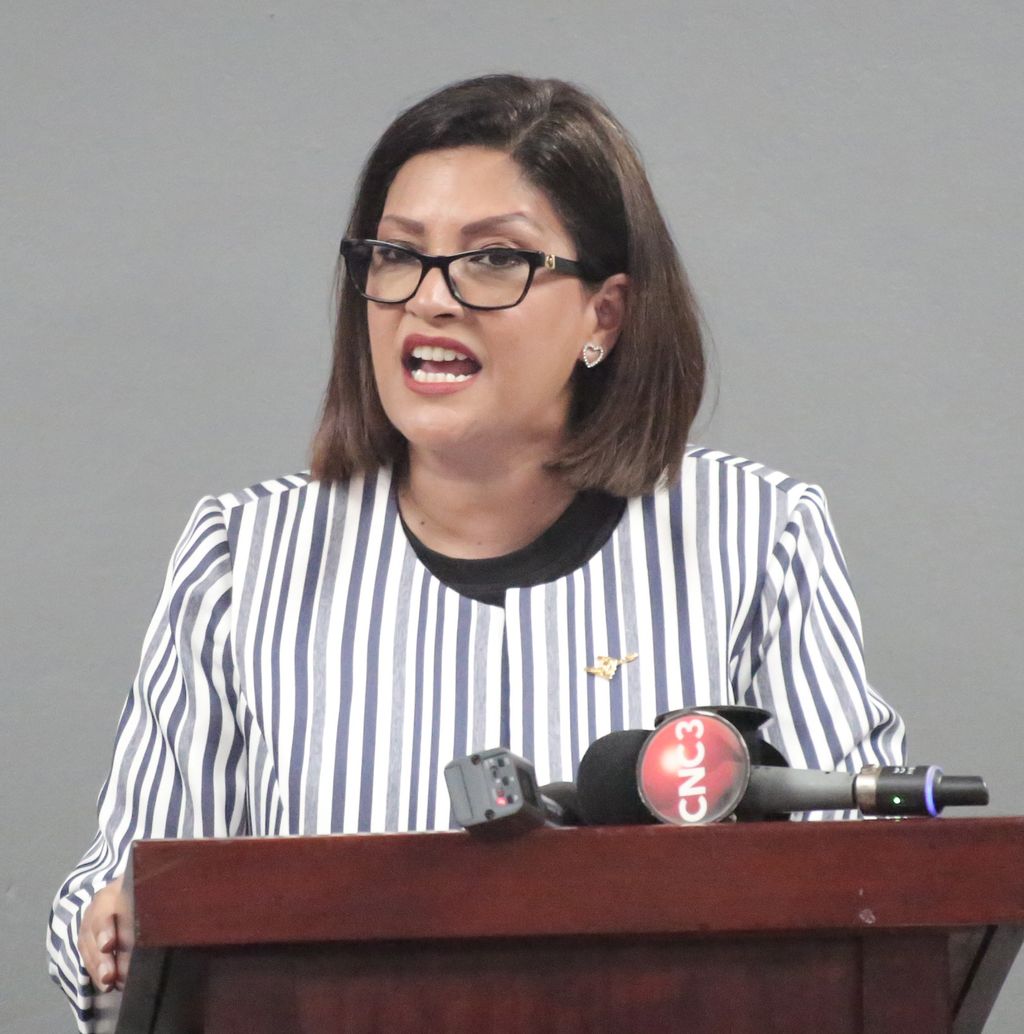

Patriotic Front leader Mickela Panday is again criticising the United National Congress (UNC) Government’s approach to crime, arguing that repeated States of Emergency do not amount to a national security plan.
In a media statement, Panday said that crime was a central issue in the 2025 general election campaign, during which time the population was promised a comprehensive anti-crime strategy. She argued that the current administration, led by Prime Minister Kamla Persad-Bissessar, has had sufficient time across multiple terms in and out of office to develop and implement a clear plan.
She pointed out that the Government previously held office from 2010 to 2015, spent nearly a decade in Opposition, and has now returned to power for a year, giving it what she described as almost 16 years to study the crime situation, consult experts and deliver solutions.
Panday said under the previous People’s National Movement (PNM) administration, various measures were introduced, including States of Emergency, joint patrols, task forces, promises of new technology and tougher legislation. Despite those efforts, she said the country ended 2024 with record levels of violence, including mass killings and an unprecedented number of murders in Tobago.
She argued that the current UNC Government is now relying on similar emergency measures, describing it as a continuation rather than a change in policy.
“A State of Emergency may give the State extraordinary powers for a limited time. It may allow the Government to claim action is being taken. But it is not, by itself, a crime plan,” Panday said.
She outlined several areas she believes require clear policy direction, including stopping the flow of illegal firearms into the country, dismantling criminal gangs, strengthening intelligence-led policing, improving witness protection and increasing the efficiency of the court system.
Panday also called for defined timelines, measurable targets and specific interventions for at-risk youth to prevent recruitment into criminal activity.
“Citizens are not unreasonable. They understand that crime cannot disappear overnight. But they also know the difference between a serious strategy and a recycled response,” Panday said.
Panday maintained that the Government cannot campaign on crime and then rely on repeated States of Emergency as its primary response, adding that there remains no clear, transparent and measurable anti-crime plan.
She said the electorate voted for change and results, warning that continued reliance on emergency powers signals that little has shifted in the national approach to crime.
T&T has now been under four SoEs between the country’s last two administrations. The former PNM government had implemented an SoE on December 30, 2024, following a surge in violent crime. That SoE was extended and ran to April 13, 2025.
Three months after taking office in April 2025, the UNC administration announced an SoE in July. That SoE was extended to January 2026. The UNC called its latest SoE in March.
SoEs called by UNC Governments
August 2011 to December 2011
July 2025 to January 2026
March 2026-present
Related News

CANPTT raises concerns over noise pollution inaction

Court injunction halts jet ski activity in Buccoo Reef and Pigeon Point
Arima Mayor urges stronger security after Corporal Eversley killing