US-based firm unveils US$750M revitalisation plan for shuttered Point Lisas steel plant
 11 August 2026

Senior Reporter
geisha.kow[email protected]
A decade after the closure of ArcelorMittal left hundreds jobless and a premier industrial asset abandoned, a million-dollar investment described as “Lazarus arising from the dead” is now bringing heavy manufacturing back to the Point Lisas Industrial Estate.
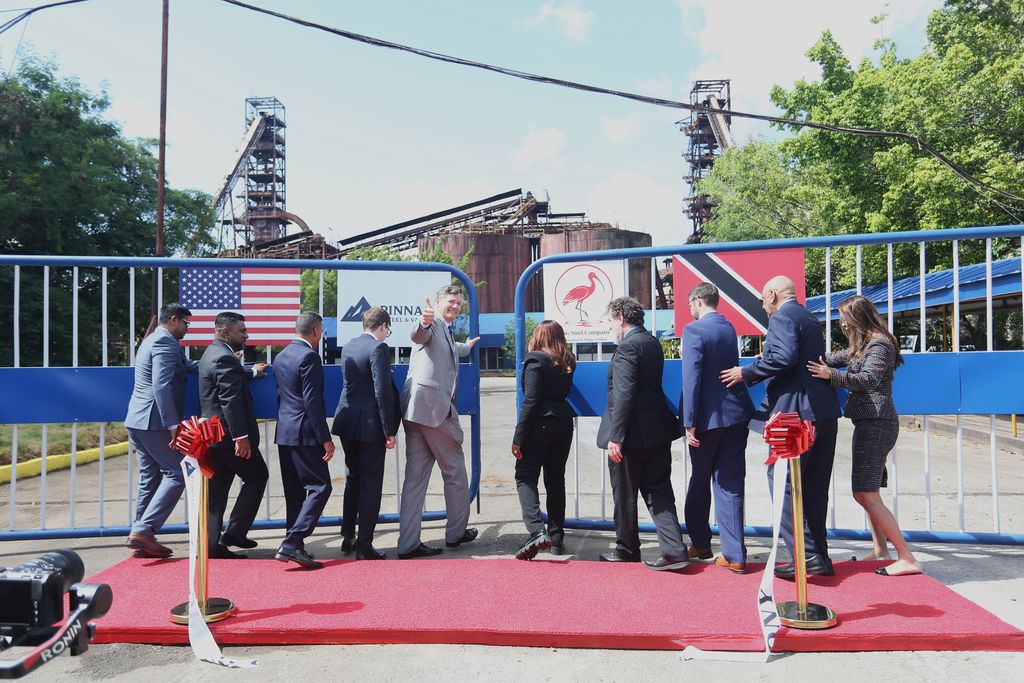
Local subsidiary Ibis Steel Company, backed by United States parent firm Pinnacle Steel and Vanadium Corporation, officially kicked off site refurbishment yesterday, with plans to pump an overall investment of US$750 million into the development, with the potential to generate up to 1,000 permanent jobs.
High-ranking diplomatic and government officials, including US Deputy Secretary of State Christopher Landau, gathered at the facility to mark what Landau called the “resurrection” of the nation’s steel industry and a key breakthrough in international mineral supply chains.
The Point Lisas steel plant, long considered the pride of Trinidad’s industrial sector, had sat idle for a decade following ArcelorMittal’s sudden closure in 2016, which left 644 workers displaced.
Liquidators Christopher Kelshall and Keith Daniel spent years navigating complex proceedings before Pinnacle acquired the site and executed key agreements with landlord Point Lisas Industrial Port Development Corporation (Plipdeco).
Speaking at a gate-opening ceremony yesterday, Landau emphasised that the reopening represents a tangible victory in turning political campaign promises into real economic progress, as he praised Prime Minister Kamla Persad-Bissessar and Minister of Foreign and Caricom Affairs Sean Sobers for driving negotiations to completion.
“I have now been in this job about a year and a half and I think this may be the most emotional ceremony that I’ve had the honour and privilege of attending ... This is the moment in which you can see words and ideas transformed into action,” Landau said.
“I think there is nothing more beautiful, frankly, than being able to see a plant like this that’s been shuttered come back to life. It’s like Lazarus arising from the dead again.”
Landau framed the joint venture as a crucial response to decades of industrial decline in both nations.
He pointed out that excessive regulation and outsourcing over past decades allowed vital processing industries and supply chains to migrate overseas, particularly to China.
“When we’re talking about the strategic imperative of ensuring our critical minerals supply chain, this is exactly what we’re talking about,” Landau noted.
“We let a lot of our critical supply chain completely fall out of our hands, so that we found that if we need certain minerals or other essentials for life, guess what? We’re dependent on a foreign country that may not have our best interests at heart.”
The event also underscored a growing convergence between public diplomatic goals and private sector execution, as Landau highlighted that while governments establish frameworks and facilitate incentives, the private sector remains the primary engine of long-term economic prosperity.
“This isn’t just a lot of talk about partnership; it’s actual, tangible results,” Landau said, pointing out that US Embassy officials worked closely with local authorities to help structure the agreement.
“It gives me great pleasure to see steel, to see vanadium, to see actual real things. Those gates are going to reopen,” the senior US official said.
Taking the podium, Pinnacle Steel and Vanadium Corporation CEO Edwin Bennett announced an initial planned investment of US$250 million to kick off the immediate refurbishment of the plant, targeted for first production by the end of 2027.
Bennett projected that the initial restart would generate 350 jobs and when in production, 500 full-time jobs.
“And after an expansion in the future, we plan to spend another $500 million and double the number of jobs, so to 1,000,” he added.
Beyond traditional steel making, the plant’s primary differentiator would be the processing and production of vanadium, a vital strategic metal heavily utilised in aerospace engineering and battery technology.
“Our vision is to produce the equivalent of 50 per cent of American consumption of vanadium—in other words, 100 per cent of the quantity of vanadium that the United States imports ... We look at this as a critical asset for Western critical mineral supply chains, putting Trinidad on the map as a key player in the Western reindustrialisation and Western creation of critical mineral supply chains outside of China,” Bennett added.
Currently, China and Russia control more than 80 per cent of global vanadium production, he said.
Meanwhile, Works and Infrastructure Minister Jearlean John stressed that she does not want a repeat of the closure of ArcelorMittal back in 2016, maintaining that investment must also mean opportunities for locals.
“Two closures 13 years apart on the same stretch of coast. But today, we are shifting that tide and proposing a third economy on this same ground,” John added.
But as the gates prepare to reopen, the Steel Workers’ Union said yesterday that it remains unaware of the specifics surrounding the project.
“People may take offence to it, but we are in the dark as a stakeholder but if someone is going to restart the facility and create sustainable employment for citizens in T&T, there is nothing other than giving support to that,” the union’s president, Timothy Bailey, told Guardian Media yesterday.
Bailey said he wrote to the PM seeking information on the development but has not received any response.