
Senior Reporter
Prime Minister Kamla Persad-Bissessar is encouraging unions to set aside their “hatred” and put their members first by seeking dialogue with the Government.
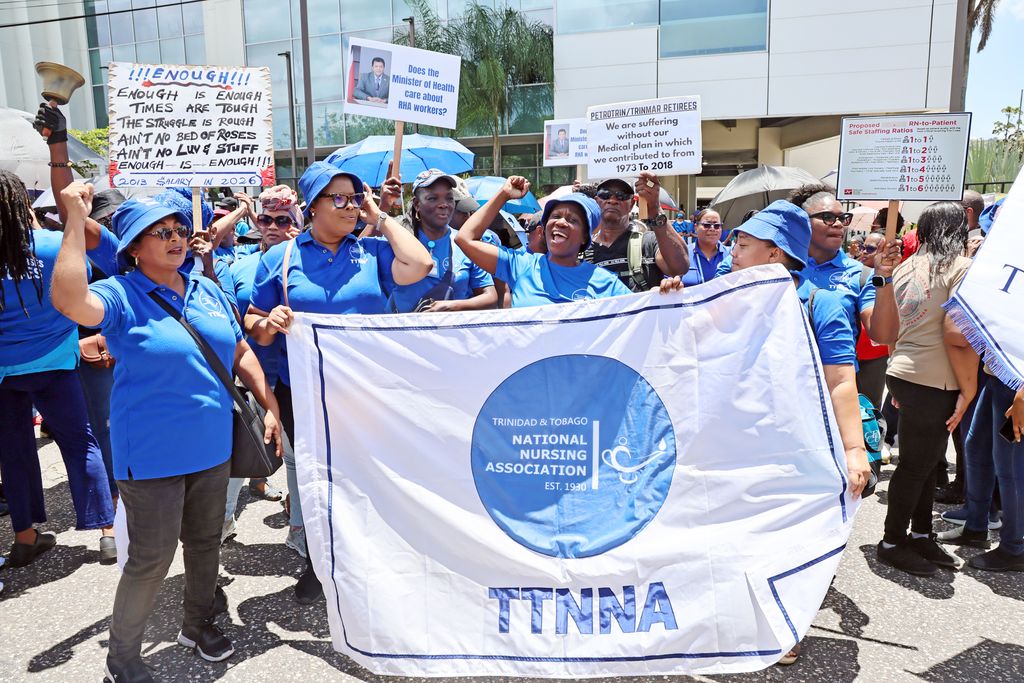
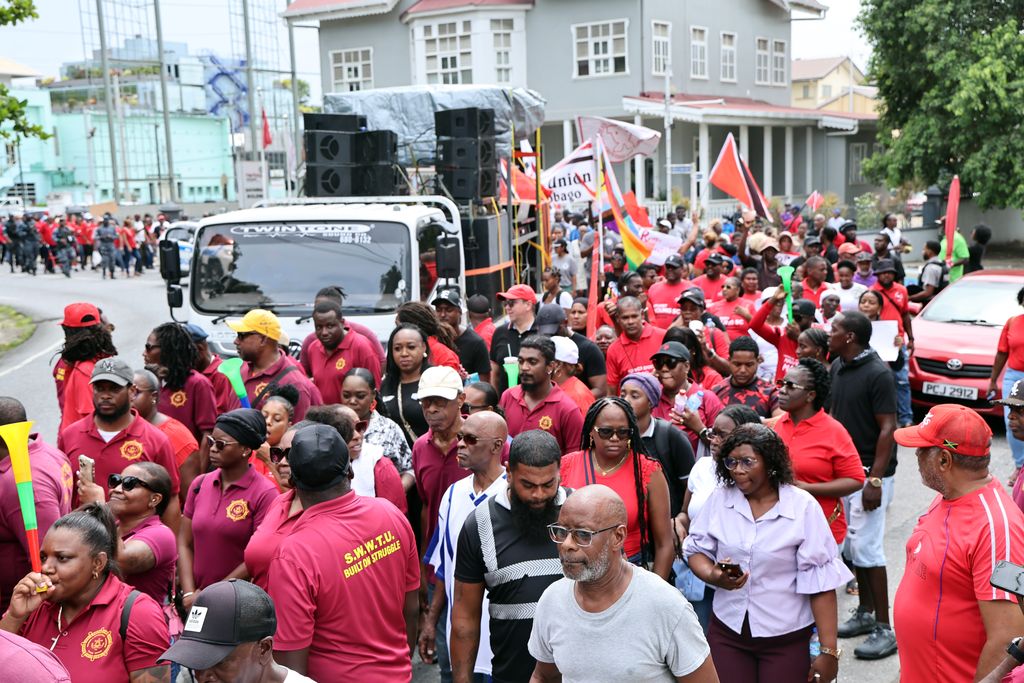
In a Facebook post yesterday, a day after several trade unions staged a march in Port-of-Spain, the Prime Minister doubled down on her assessment of the march, saying, “Following the spectacularly failed protest yesterday, which attracted at its peak about 400 people driven by political and racial hatred of the UNC, the government encourages those unions to set aside their hatred and put their members first.”
“The population has rejected their divisive rhetoric and therefore I call on them to put aside their personal interests, bias, and hatred and work with the government as other unions are doing to settle negotiations in a responsible manner,” she added.
She noted that her Government had recently settled protracted wage negotiations for PowerGen workers.
“Yesterday, while a small group of misguided people and a hundred thousand ghosts were marching against the UNC, the Minister of Public Utilities made an announcement in the Parliament of a $66.1 million settlement with the Oilfield Workers’ Trade Union (OWTU),” Persad-Bissessar said.
However, Seamen and Waterfront Workers Trade Union (SWWTU) president Michael Annisette has dismissed criticism over a perceived low turnout at a labour movement rally in Port-of-Spain on Friday.
In a telephone interview yesterday, Annisette, who also serves as general secretary of the National Trade Union Centre (NATUC), hailed the event as a success despite admitting that it attracted fewer participants than similar action in the past.
Annisette said: “Maybe they were expecting 10,000 or 15,000. No, we did not have that. I will readily admit it. But in the circumstances, one has to be satisfied with the march that came out.”
The veteran trade unionist claimed that the number of participants in the protest is not the only metric that can be used to measure its success.
“It’s not about numbers. It’s about commitment. It’s about people who are willing to come out and act,” Annisette said.
Stating that the march attracted thousands, including many who supported from vantage points along the route, Annisette claimed that detractors sought to utilise area still photographs of segments of the march in order to claim that only hundreds participated.
“They never showed the total march, the length of the march and the people that were involved from all the different unions,” he said.
Annisette also rejected criticism from Prime Minister Kamla Persad-Bissessar, who questioned the timing of the march while claiming that similar action was not taken by the trade union movement under the People’s National Movement (PNM) administration between 2015 and 2025.
He noted that NATUC held a major march in 2022.
Annisette also challenged claims that the trade unions politicised the march by allowing PNM parliamentarians and officials to participate.
He said that trade unions must engage politicians, as laws and policies that affect citizens, including their members, are shaped by them (politicians).
“It is not about politics. It is about the economic realities and the socio-economic issues that workers have to face day to day,” he added.
He noted that trade unions also have a responsibility to raise socio-economic concerns affecting citizens and are not confined to negotiating over their members’ terms and conditions of employment.
“We represent the voiceless, the disadvantaged communities, the single parents and their children, who may not get three square meals a day because of the salaries of their mother or father,” Annisette said.
Contacted yesterday, political scientist Dr Bishnu Ragoonath said that the perceived low turnout might be due to the politicisation of the event.
“What started off probably as a good thinking union protest was allowed to generate into a political march. I think that will give the United National Congress (UNC) some degree of comfort to say that this was not strictly a trade union protest against them, but rather it was a political protest,” Ragoonath said.
He claimed that the lack of demarcation over the true intent of the event may have led to some trade unions and their members staying away to avoid marching alongside former government officials who they protested against in the past.
Political analyst Dr Winford James said that he did not closely follow the rally.
James also questioned the perceived low participation of PNM members despite the attendance of senior party officials.
“The Opposition support did not seem to be something the PNM could gloat about,” James said.