
KEJAN HAYNES
Lead Editor – Newsgathering
Trinidad and Tobago is set to lead the next phase of a proposed regional ferry service, with CARICOM leaders agreeing to explore using one of the country’s existing vessels as a pilot project while a private sector-led operation is developed.
The initiative, first advanced in January 2024 under former Prime Minister Dr Keith Rowley, has gained renewed attention as regional leaders look for ways to reduce the cost of transporting goods and ease the impact of rising prices across CARICOM..
The issue resurfaced at the closing news conference of the Fifty-First Regular Meeting of the Conference of Heads of Government of CARICOM in Saint Lucia, where Barbados Prime Minister Mia Mottley said Trinidad and Tobago’s existing ferry capacity could be used as a temporary solution.
Mottley said the private sector arrangements for a permanent regional ferry service could take about a year, as operators would need to source vessels, while governments continue regulatory work.
She said Prime Minister Kamla Persad-Bissessar had agreed that Trinidad and Tobago’s experience operating ferries between Trinidad and Tobago could help launch the initiative.
"We are now about to enter discussions, Prime Minister Friday from St Vincent and the Grenadines, Prime Minister Persad-Bissessar, and myself as lead on CSME, to see how best we can utilise one of the Trinidad vessels as a proof of concept while the private sector procures," Mottley said.
She said the discussions would also address mutual recognition of licences, insurance requirements and the movement of vehicles and cargo between islands.
Mottley said the pilot project would initially focus on the Southern and Eastern Caribbean, but governments would also examine port infrastructure requirements.
The initiative was discussed in the context of rising living costs, fuel prices and freight charges, with leaders seeking regional solutions to reduce inflationary pressures.
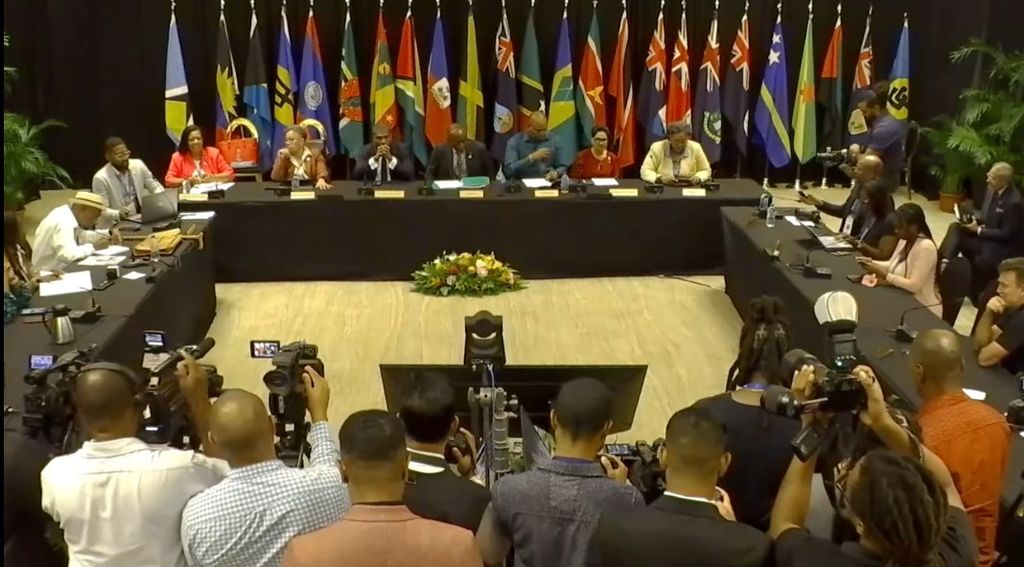
Prime Minister Kamla Persad-Bissessar (2nd from right) along with other regional leaders at the closing news conference of the Fifty-First Regular Meeting of the Conference of Heads of Government of CARICOM in Saint Lucia, on July 8, 2026. [Image courtesy CARICOM]
CARICOM
Persad-Bissessar supported the ferry proposal but also expanded on how Trinidad and Tobago could contribute to regional cooperation through healthcare services.
She said the National Prosthetic Centre, established with assistance from the Government of India, could provide affordable artificial limbs for CARICOM citizens.
"We propose that, first of all, we have had help from the Government of India to set up a national prosthetic centre. This is for the fitting of artificial limbs... the affordable price will be available to our CARICOM brothers and sisters," she said.
She said prosthetic limbs could cost between US$3,000 and US$120,000 internationally, depending on the level of mobility required.
Persad-Bissessar also offered Trinidad and Tobago’s medical personnel to assist other CARICOM countries.
"We do have many, many medical graduates at the general practice level, house officer level... We are willing to work with them to provide fully trained doctors, majority UWI-trained doctors, to the other countries," she said.
She further offered access to the Couva Children’s Hospital, saying the specialist facility could provide treatment for regional patients at affordable prices.
The discussion followed questions on how CARICOM governments intended to shield citizens from rising living costs and higher energy prices caused by global instability.
Also responding, St Kitts and Nevis PM Terrance Drew said Caribbean countries remained vulnerable because they imported much of what they consumed, particularly petroleum products.
He argued that expanding renewable energy, including solar, wind, geothermal and wave power, offered the best long-term solution to stabilise energy costs and reduce the region's exposure to global price shocks.