Marco Rubio Says America Has Taken Back Control Of The Western Hemisphere
 03 June 2026
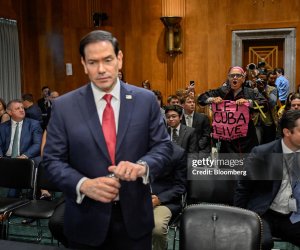


News Americas, WASHINGTON, D.C., Weds. June 3, 2026: On the second day of Caribbean American Heritage Month – a month the Trump White House has still not seen fit to formally recognize – US Secretary of State Marco Rubio told the United States Senate that the Trump administration has taken back control of the Western Hemisphere.
Those were Rubio’s words Tuesday before the Senate Foreign Relations Committee – delivered as the USS Nimitz, one of the world’s largest nuclear-powered aircraft carriers, sat docked at the Port of Kingston, Jamaica, 90 miles from Cuba, and as the United States quietly met with Guyana’s Foreign Minister to discuss oil investment and sovereignty protection in what analysts say is a deliberate strategy to reshape the Caribbean’s geopolitical alignment.
For the millions of Caribbean Americans marking Heritage Month across New York, Florida, Connecticut, and beyond – the message from Washington could not have been clearer. The Western Hemisphere belongs to the United States. The Caribbean’s role in that hemisphere is to fall in line.
Rubio’s appearance before the Senate Foreign Relations Committee produced some of the most revealing language yet about the Trump administration’s vision for the Caribbean and Latin America. Touting the January operation that removed Venezuelan President Nicolás Maduro – a key ally of Cuba’s communist government – Rubio declared that the administration had taken back control of the Western Hemisphere, as reported by NPR.
On Cuba specifically, Rubio was unambiguous about his position. “I really don’t believe this system is capable of reform, unless new people take over or a new mindset takes hold,” he told the committee, as quoted by NPR, language that analysts describe as a clear call for regime change.
But here is where the contradiction emerges – and where the Caribbean should be paying close attention. The Helms-Burton Act, which Rubio has long championed, requires credible steps toward democracy before the US embargo on Cuba can be lifted. Rubio’s vision is nothing less than the collapse of the Cuban communist system – an Eastern European-style regime change, as Christopher Sabatini of the Chatham House think tank described it to NPR.
President Trump, however, appears to have a different vision. In Venezuela, the administration toppled Maduro but left the state largely intact – opening up business deals for American companies. That kind of arrangement, analysts told NPR, might appeal to Trump in Cuba as well. But it is not what Helms-Burton requires. And it is not what Rubio has called for.
“So he’s going to have to confront his own constituency and his own conscience, if you will, in a policy that Trump is dictating in which Trump will want a victory,” Sabatini told NPR. “But it’s not the same absolute victory that Marco Rubio and many of his constituents have imagined, literally, for more than six decades now.”
The Caribbean – caught between two competing American agendas neither of which considers regional interests – is watching two powerful men pull in different directions over a crisis that will be felt from Havana to Kingston to Port of Spain regardless of who wins that internal argument.
One of the most striking details to emerge from coverage of Rubio’s testimony is a fact that Cuba’s own Foreign Minister raised last week and that Cuban history professor Lillian Guerra of the University of Florida confirmed to NPR this week: Marco Rubio has never been to Cuba.
“He is very unaware of how – what life is like in Cuba. He’s never been there,” Guerra told NPR. “And I think that he needs to be cognizant of that.”
Rubio’s parents were born in Cuba but left before the revolution. The Secretary of State is driving the most aggressive US pressure campaign against Cuba in decades, a campaign that is reshaping Caribbean geopolitics, fracturing CARICOM, and placing a nuclear aircraft carrier in Caribbean waters – has never set foot on the island whose future he is helping to determine.
Guerra also noted that a PBS genealogy program found that Rubio’s third great-grandfather owned a tobacco farm in Cuba – and slaves. “That was shocking to him,” she told NPR. “But it wasn’t to anybody who’s Cuban on the island.”
While Rubio testified on Capitol Hill, a separate and significant diplomatic meeting was taking place that received far less attention – but that tells an equally important story about Washington’s Caribbean strategy.
US Deputy Secretary Christopher Landau met Tuesday with Guyanese Foreign Minister Hugh Todd, according to a State Department readout issued June 2, 2026. The meeting focused on reaffirming the strong and expanding partnership between the United States and Guyana, expanding US private sector engagement in Guyana, and reaffirming the United States’ commitment to Guyana’s sovereignty and territorial integrity – the latter a clear reference to the ongoing dispute with Venezuela over the Essequibo region.
The timing is striking. Guyana was among the CARICOM members that reserved its position from the regional body’s statement of concern over US measures against Cuba – breaking ranks with Caribbean solidarity to maintain its alignment with Washington through the US-led Shield of the Americas security pact.
The day after the USS Nimitz docked in Jamaica – the day Caribbean American Heritage Month began without a White House proclamation – the United States was quietly consolidating its relationship with one of the Caribbean’s most strategically important nations. Oil investment. Sovereignty guarantees. Commercial partnerships.
The Caribbean is not being consulted about its future. It is being managed. And the difference matters enormously.
Perhaps the most extraordinary detail to emerge from NPR’s coverage of Tuesday’s testimony is this: even as the Department of Justice pursues a murder indictment against former Cuban President Raul Castro – and even as Rubio calls for systemic regime change – the Trump administration is simultaneously talking to Cuban officials, including Raul Castro’s own grandson.
The contradiction is breathtaking. Washington is indicting the grandfather for murder while negotiating with the grandson. It is deploying a nuclear aircraft carrier to Caribbean waters while offering $100 million in humanitarian aid. It is calling Cuba a failed state while pursuing back-channel conversations with its leadership.
For the Caribbean – which has watched this contradiction play out in real time – the message is not one of principled foreign policy. It is one of raw power, managed carefully enough to keep all options open.
Against this backdrop of geopolitical maneuvering, regime change rhetoric, and quiet diplomatic realignments, Caribbean American Heritage Month began on June 1st with no proclamation from the Trump White House – breaking with a tradition maintained by previous administrations – and with little more than social media posts from elected officials who even represent Caribbean diaspora communities.
No formal recognition. No acknowledgment of the millions of Caribbean Americans who have contributed to this country for more than 250 years. No statement addressing the communities most directly affected by the administration’s Cuba policy, its immigration enforcement operations, or its military posture in the Caribbean.
Just a warship in Kingston Harbor; silence from the White House and Rubio speaking of taking back “control” not partnerships.
Related News
Guyana – One Destiny, One Future

The Caribbean Is Now At The Center Of The Most Dangerous US-Cuba Confrontation In Decades
Cuba Maintains Socialist Path At BRICS Foreign Ministers’ Meeting Amid U.S. Pressure