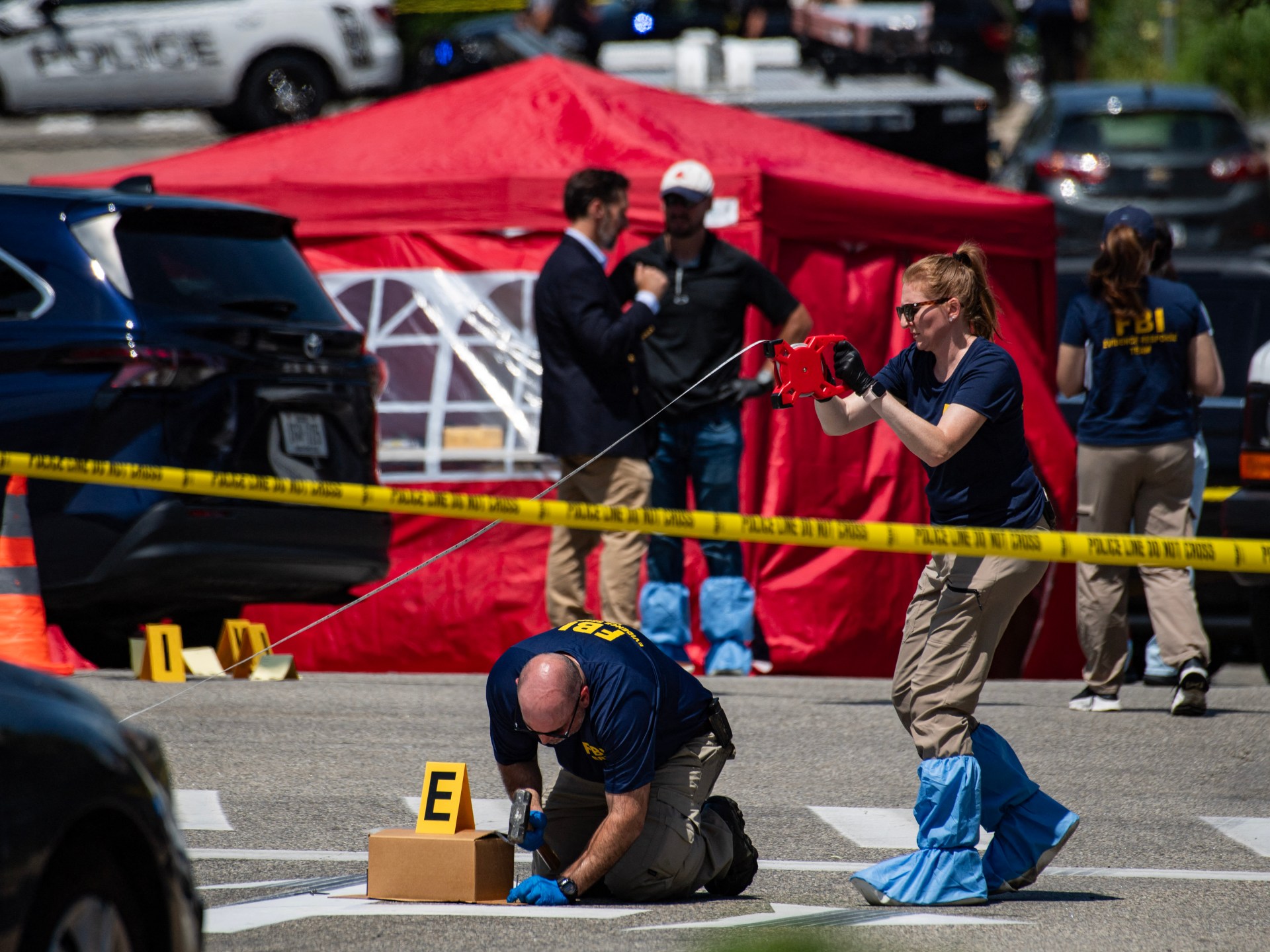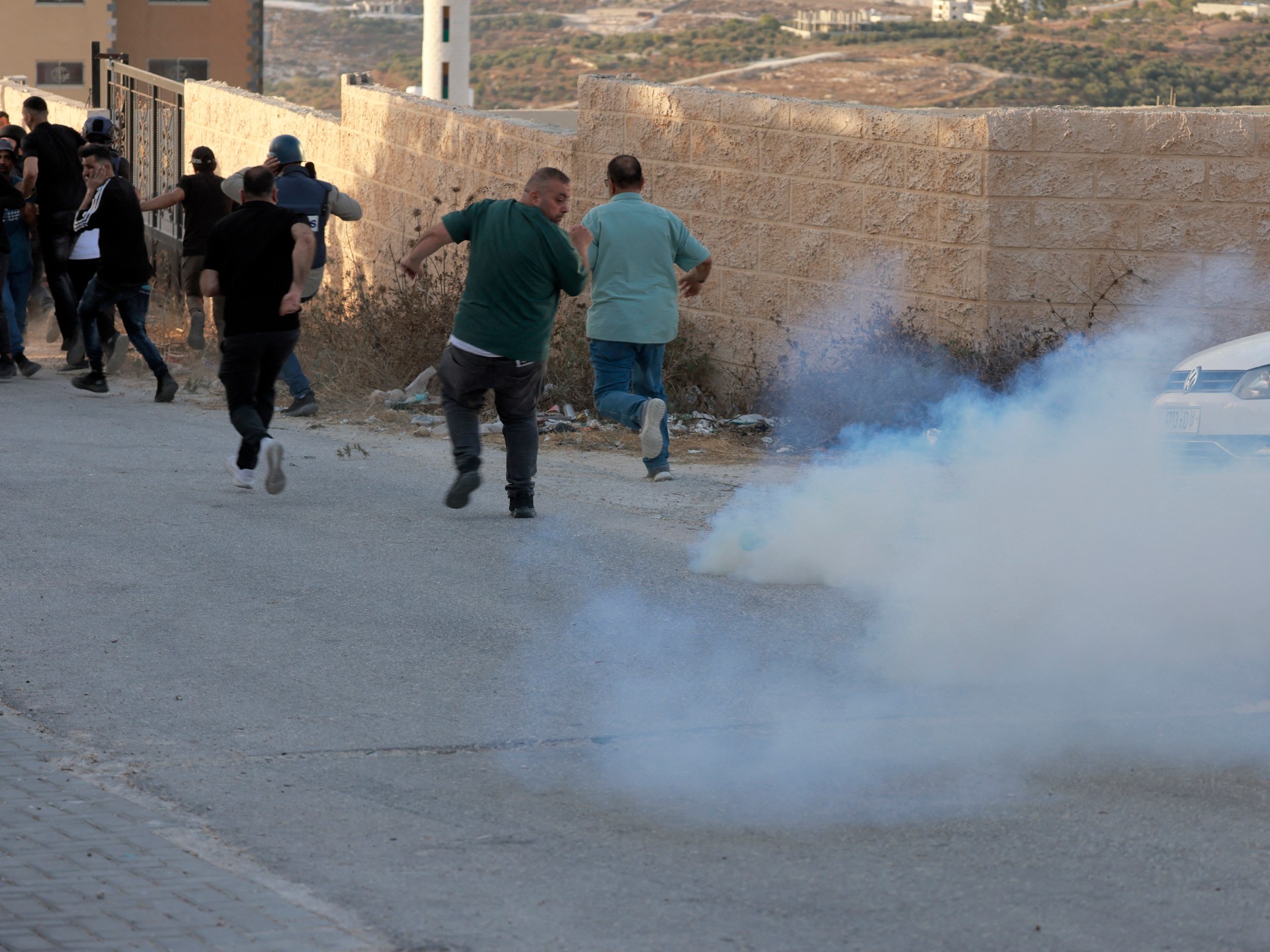

The Israeli military has launched an aggressive crackdown in the occupied West Bank, storming several towns and villages and detaining hundreds of Palestinians, amid escalating attacks by Jewish settlers, in a furious reaction to a shootout in a village near Nablus in which four Palestinians and two Israeli soldiers were killed.
The “wide-scale military operation” across the West Bank ordered by Israeli Prime Minister Benjamin Netanyahu following the deaths of the soldiers intensified on Sunday, and settlers became bolder and more violent, marauding through villages, scrawling graffiti on buildings and attacking Palestinians.
- list 1 of 3What’s behind the Israeli crackdown in the occupied West Bank?
- list 2 of 3Israel arrests nine at Tel Aviv protest against West Bank settler violence
- list 3 of 3House of Hope: New film follows a Waldorf-inspired school in the West Bank
end of list
Settlers tried to set two mosques ablaze. At one of those, the newly built Al-Rahma Mosque in the town of Qusra southeast of Nablus, settlers spray-painted slogans like “Jewish revenge” on the walls, said Abdel Azim Wadi, head of the village council in Qusra. Videos verified by Al Jazeera showed fire consuming the mosque.
The other mosque targeted in the arson attack was in the village of Kour, south of Tulkarem. Farid Jiyousi, a member of the village council, said three settlers tried to set the mosque ablaze at dawn, but worshippers put out the fire before it could reach the main area of the premises.
Reporting from Ramallah, Al Jazeera’s Nour Odeh said Israeli forces raided Rafidia near Nablus.
“They were also spotted in Huwara, in the Nablus area, assaulting a paramedic and a man. There is video circulating from witnesses about that. The Palestine Red Crescent Society also reported an assault on one of its paramedics in Masafer Yatta, to the south of Hebron,” she said.
Advertisement
“So, all across the occupied West Bank there were overnight raids.”
Separately, the Palestinian news agency Wafa reported that 30 people were arrested in the village of Tal, where the confrontation that led to the crackdown took place, as well as 14 in Ramallah, five in Jenin, eight in Hebron, three in Bethlehem and six in Tulkarem.
Wafa also reported that Israeli forces launched a large-scale raid across the city of Jenin and several towns and villages in the governorate of Jenin, including Zababdeh, Faqqua, Yabad, Burqin, Jalbun, Qabatiya, Jalqamus, Silat al-Harithiya, al-Yamoun, Kafr Dan, Deir Abu Daif and Zububa.
The national broadcaster Kan reported that Israeli forces imposed strict traffic restrictions and numerous security checkpoints on main roads and at the entrances to villages across the occupied West Bank.
The firefight that triggered the punitive and oppressive military response took place on Friday in Tal, southwest of Nablus. Each side disputes the other’s account of the events that led to the confrontation. However, video footage confirms the testimony of villagers who say a group of about 20 Israeli settlers, many of them wielding rifles, approached Tal with the intent of causing violence.
Villagers came out of their homes to confront the settlers, and as tensions rose, Israeli soldiers arrived. One of the villagers grabbed a gun from a settler, and a shootout erupted.
Lieutenant Colonel Ella Waweya, a spokesperson for the Israeli army, said on Sunday that Israeli forces were raiding houses in Tal belonging to villagers suspected of involvement in Friday’s violence. She said the homes “were raided in preparation for their temporary sealing, as a preliminary step preceding their demolition”.
Israel has a policy of demolishing the homes of Palestinians accused of carrying out lethal attacks, a practice rights groups condemn as collective punishment that violates international law.
Phyllis Bennis, a fellow at the Institute for Policy Studies, said Israeli settlers are not being held accountable for their crimes. “We’re seeing an increase in direct war crimes,” she told Al Jazeera.
Bennis said Israel’s distinction between settlers and soldiers is false.
“Some of the settlers are themselves part of the Israeli military. They serve in the reserves. They are armed by the military. Many are trained by the military. They’re all using US-provided arms. So this distinction is not a very important one. They are all supported by the Israeli state,” she said.
Advertisement
“And what we’re seeing here is a decision that they make to deliberately commit war crimes. So we’re seeing collective punishment. We’re seeing attacks on hospitals.”
Israeli forces and settlers intensified their attacks in the occupied West Bank after October 7, 2023, when the genocidal war on Gaza began. Since then, they have killed at least 1,185 Palestinians, including more than 250 children. At least 12,652 Palestinians have been wounded and more than 24,000 have been detained.
As of July 1, 2026, 9,299 Palestinians remain in Israeli jails, of whom 3,244 are held without charge.
The United Nations and rights groups have criticised Israel for a lack of accountability, saying settlers are rarely prosecuted and Israeli soldiers are seldom convicted.
The latest violence also comes just three months before general elections in Israel.
Opinion polls suggest Netanyahu could lose power. Landgrabs and accelerating the establishment of new illegal settlements sit well with his right-wing support base.
Finance Minister Bezalel Smotrich has said Israel plans to build 763 new units in the illegal Eli settlement, south of Nablus.
Meanwhile, hundreds gathered in Tel Aviv on Saturday to protest against the surge in settler violence and the military crackdown in the West Bank.
Israeli police arrested nine protesters, saying the demonstrations had gone ahead without authorisation and had begun to “disrupt public order and block the roadway”.
Related News
Will the war on Iran affect ASEAN’s efforts to tackle regional issues?
Burnham pledges devolution and discipline if he becomes UK prime minister
Iran attacks US bases in Middle East as Trump meets Netanyahu