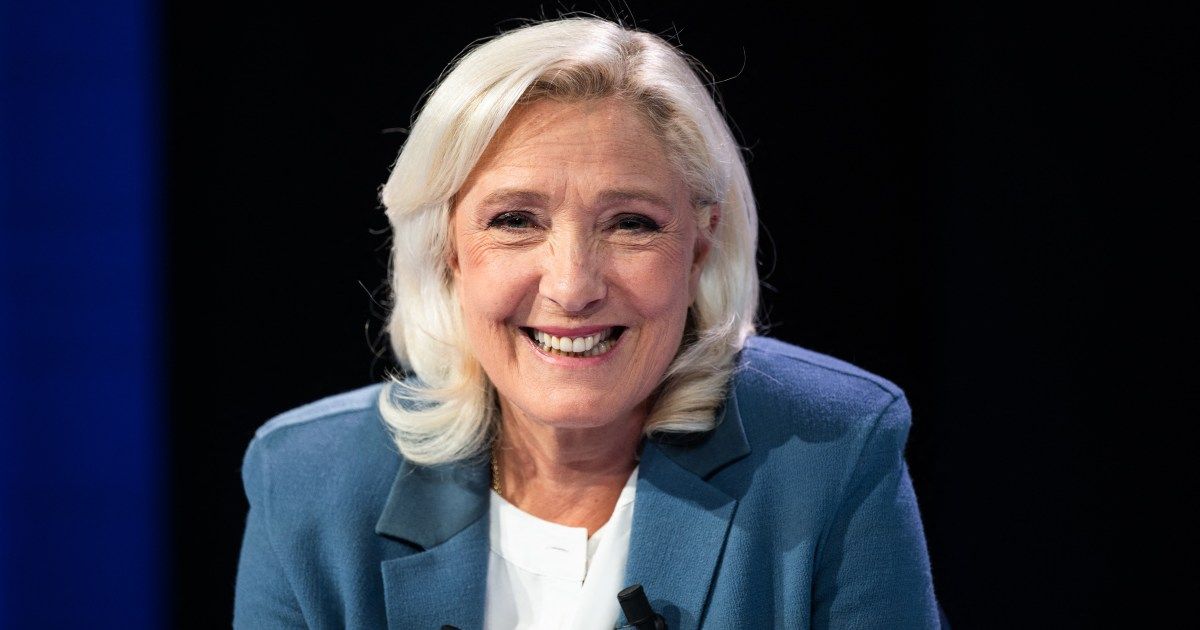

France’s appeal court is set to deliver a key verdict on whether Marine Le Pen and other members of her National Rally party misused European Parliament funds in the hiring of aides between 2004 and 2016.
If, on Tuesday, the court upholds her 2025 conviction, which saw her barred from office for five years and sentenced to house arrest, Le Pen – one of the most prominent figures of the European far right and a frontrunner in polls for France’s 2027 contest – is likely to be unable to stand in presidential elections next year.
- list 1 of 3France to increase nuclear warheads, lend nuclear aircraft to Europe allies
- list 2 of 3Europe’s hard right fractures over US-Israel war on Iran
- list 3 of 3Is the tide turning on Europe’s hard-right populists?
end of list
On Wednesday last week, Le Pen said that even if the court only upholds the order for her to wear an electronic bracelet, she will not stand. “If I can be a candidate, I will be a candidate, provided that I am able to campaign,” the 57-year-old political firebrand told LCI channel.
“Because if I’m allowed to be a candidate but am effectively prevented from campaigning freely, then you understand that wouldn’t be possible.”
What was Le Pen convicted of?
In March 2025, a Paris criminal court ruled that Le Pen was at the heart of “a fraudulent system” that her party used to siphon off EU Parliament funds worth 2.9 million euros ($3.32m).
The court also fined the National Rally party 2 million euros ($2.29m), half of which was suspended.
She had been accused of using money intended to finance the costs of parliamentary assistants to pay employees working for her political party. EU politicians are allocated funds to cover expenses, including salaries for parliamentary assistants, but are not allowed to use them for party activities.
Advertisement
Le Pen was ordered to stand trial in 2023, after a seven-year investigation, alongside more than two dozen other defendants. She and her party have denied the accusations, arguing the money had been used legitimately and that prosecutors had applied an overly narrow definition of what a parliamentary assistant does.
What were the political implications of the verdict?
As part of the initial verdict last year, Le Pen was given a five-year ban from holding elected office and sentenced to two years’ house arrest with an electronic bracelet. Since France will hold the first round of its next presidential election on April 18, 2027, with a run-off set for May 2, Le Pen will not be able to run if she loses the appeal.
The far-right leader has pledged to put up a fight if she’s barred from running. “If I cannot be a candidate, I will make use of every available avenue of appeal,” Le Pen said.
She could go, therefore, to France’s highest court, the Court of Cassation, which does not judge the facts but checks whether the courts and court of appeal have applied the law correctly. The court could take about six months to hear the case and issue a verdict.
If allowed to run, Le Pen is widely seen as a top contender to succeed centrist President Emmanuel Macron in the 2027 election. If not, her 30-year-old protege Jordan Bardella would likely run instead.
What could the Court of Appeal decide?
The appeal court could overturn Le Pen’s conviction in its ruling on July 7, leaving her free to run for president next year. Legal experts say that outcome appears unlikely, however, given the court’s findings at first instance.
The court can instead uphold Le Pen’s conviction. If it confirms the five-year ban requested by prosecutors, it will rule her out of the presidential race, paving the way for Bardella to take her place. Le Pen can then appeal to the Court of Cassation.
A third possibility is that the court upholds the conviction but softens the sentence. If the ban from public office were lifted or shortened to two years or less, the door to a presidential bid would be open.
Related News
What are the security implications of the US-Saudi nuclear deal?
NATO’s Turkiye summit live: Trump, leaders to meet in Ankara

Israel confirms death of Palestinian detainee, nearly two years late