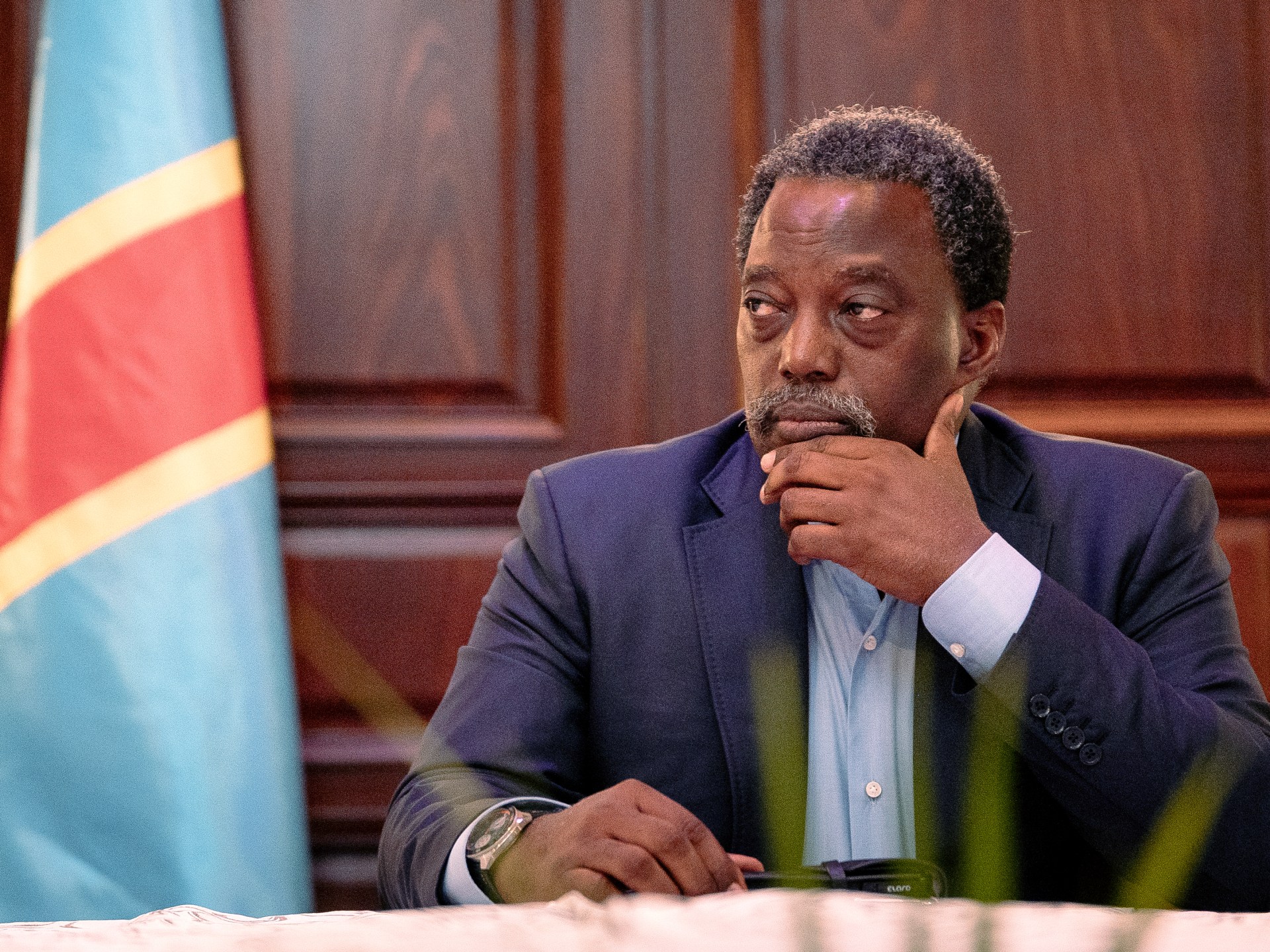

Former Congolese President Joseph Kabila has launched a new political and military coalition, including the Rwanda-backed M23 armed group, which has captured vast areas of the eastern Democratic Republic of the Congo (DRC).
Kabila introduced the Front for the Refoundation of the Nation (FRN) at a news conference on Monday at his residence in the eastern city of Goma, which the M23 has controlled since January 2025.
- list 1 of 4DR Congo, M23 rebels agree on roadmap for peace talks
- list 2 of 4Rwanda accuses DR Congo of supporting an armed group on its soil
- list 3 of 4Police crack down on protests against constitutional change in DR Congo
- list 4 of 4Hundreds protest in DR Congo against third presidential term
end of list
Kabila said he will head the FRN with rebel leaders, including Corneille Nangaa, the former leader of the Congo River Alliance (AFC) and the political wing of M23, serving as his deputies.
Claude Ibalanky, a coalition adviser, said the group aims to unite all resistance forces “to put an end to tyranny by any means necessary, including the use of force”.
There was no immediate response to the announcement from the DRC government.
Reporting from Goma, Al Jazeera’s Alain Uaykani said there were growing fears that fighting in eastern DRC could escalate.
“Kabila addressed the nation, explaining his plan. People are making comments across the country that this is another level of the conflict,” Uaykani explained.
Uaykani said rebels already hold Goma, Bukabu, the airports and key border crossings with Rwanda and Uganda, and that the government has been unable to push them back. Talks to resolve the conflict have also failed, with each side blaming the other.
“The government has shown no sign of defeating these people,” he said.
Uaykani noted that Kabila is a former army chief and said there were fears that government troops could defect.
Advertisement
“He’s still a soldier; he has led an army. People are worried that more soldiers from the government may join him as well”.
Yvon Muya, a researcher at the University of Ottawa in Canada, said the announcement increases the chances of a confrontation between Kabila and DRC President Felix Tshisekedi, and could lead to more fighting in eastern DRC.
“You don’t make an announcement like this without having prepared the actions that follow,” Muya said. “We will likely witness an escalation on the military front.”
Representatives from the DRC government and the M23 movement were expected to meet in Qatar in November for talks, but analysts warn that the new coalition could undermine the process.
Kabila led the DRC from 2001 to 2019, taking office at 29 after his father, President Laurent Kabila, was assassinated.
A DRC military court sentenced Joseph Kabila to death in absentia last year on charges of treason, war crimes and crimes against humanity, finding that he collaborated with Rwanda and M23.
Kabila has called the case politically motivated and denies the charges.
The US imposed sanctions on him earlier this year over his alleged role in funding rebel groups.
The DRC, the United States and United Nations experts accuse Rwanda of backing M23, an allegation Rwanda denies.
Tshisekedi’s second term ends in 2028, and his allies have been preparing public opinion for changes to the constitution’s two-term limit, as rebel activities intensify in the east.
Related News
Israel’s Smotrich calls for ‘war’ in West Bank: Rhetoric or real threat?
Trump praises US-China friendship at state dinner with Xi Jinping
US seeking to revive Russia-Ukraine ceasefire talks