Federal investigators probe Amazon cargo jet’s fiery runway crash that killed 5 in Miami
 07 September 2026

Federal investigators examining why an Amazon cargo jet barreled off a runway at Miami International Airport and into vehicles, killing at least five people, are likely to focus on a crucial moment in the landing: whether the plane touched down too late to stop safely.
Video of Sunday’s landing appears to show the Boeing 767 remaining airborne well down the runway before touching down. Aviation experts said investigators will seek to determine exactly where the plane landed and, if it was beyond the normal touchdown zone, why the pilots did not abandon the landing and circle back for another attempt.
Investigators will also examine the plane’s speed and braking, weather and wind conditions, the aircraft’s mechanical condition and other factors that could have contributed to the deadly overrun. The National Transportation Safety Board has sent a team led by Chairwoman Jennifer Homendy to Miami, where she is expected to give the agency’s first briefing on the investigation Monday.
The aircraft overran the runway around 2 p.m. Sunday after arriving from San Juan, Puerto Rico, and plowed across a road used by warehouse workers and other businesses that surround the airport. Five people died, three were critically injured and two others were hospitalized with less severe injuries, officials said.
The crash, which sent thick black smoke billowing into the sky, trapped the pilot and copilot in the cockpit and some occupants in cars, said Miami-Dade Fire Rescue Chief Ray Jadallah. The agency said crews also had to extricate a person who was trapped under a vehicle. It wasn’t immediately clear if the pilots were among those killed.
The typical landing zone for a plane is within the first 3,000 feet (914 meters) of a runway, experts said. If the cargo jet was beyond that area, it should have aborted the landing and gone around for another try, aviation safety expert Steve Arroyo said.
Mary Schiavo, who is a pilot and former Inspector General of the Transportation Department, said video posted online shows the Amazon plane floating above the runway for an extended period without flaring the nose upward to force the main landing gear onto the ground.
It wasn’t raining at the time, but dark storm clouds loomed and strong winds were reported. Schiavo said that if the plane had a tail wind, that could have contributed to it floating further down the runway.
“A tail wind would certainly add to your troubles if you’ve already given up a good chunk of the runway by not touching down and landing right away,” Schiavo said.
The Miami airport is not equipped with arresting systems that the FAA says have been installed at more than 120 airports nationwide to safely stop planes that do go past the end of a runway. Those beds of lightweight, crushable material at the end of a runway have been credited by the FAA with helping save at least 497 lives aboard planes that overran runways.
Miami’s airport appears to be in compliance and wasn’t required to have an arresting system because it has a 1,000-foot safety buffer at the end of its runways, said Mike O’Donnell, the FAA’s former director of airport safety and accident investigations.
The requirement was prompted by American Airlines Flight 1420 overrunning a runway at Little Rock National Airport in Arkansas in 1999, killing nine.
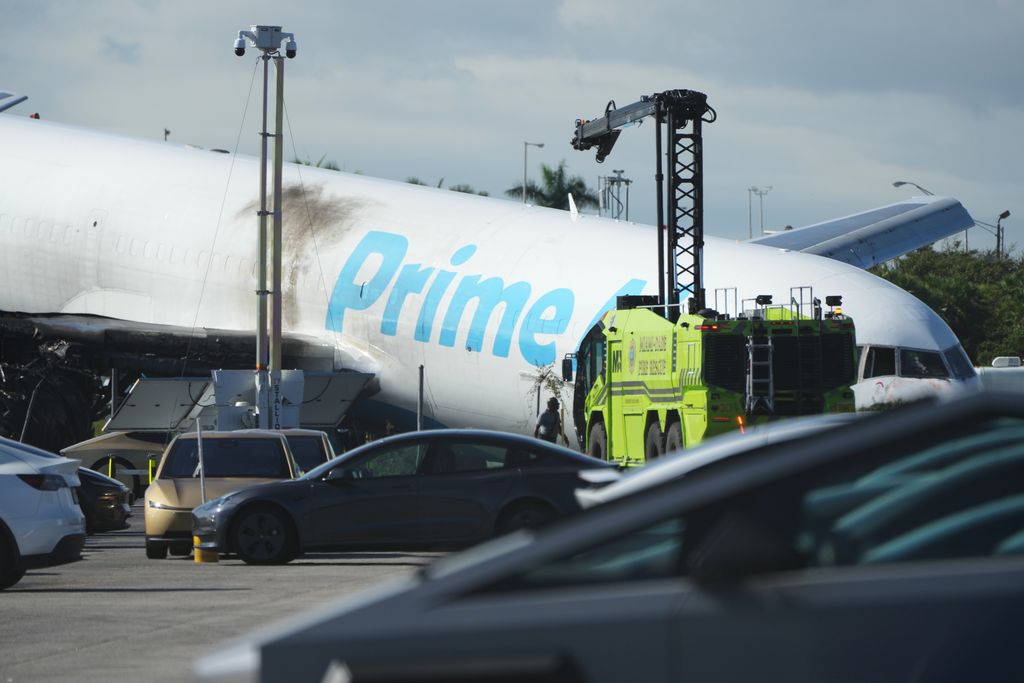
The Prime Air plane came to rest beside a roadway near two semitrucks, images showed. The aircraft appeared to be resting on its belly and was largely intact despite the fire.
The flight had been operated by 21 Air, a cargo carrier based in North Carolina. The 32-year-old Boeing 767 was originally built to carry passengers and flew for several airlines for more than two decades before being converted to a cargo plane in 2015, according to flight-tracking site Flightradar24.
Schiavo said the NTSB will also closely examine the maintenance history of this plane — particularly since it has a history of foreign ownership, including by a Russian company.
The crash halted flights at the busy travel hub for much of the afternoon.
More than 160 flights were canceled and nearly 325 delayed by late Sunday, according to FlightAware, a website that tracks flight disruptions. Officials from Orlando International Airport, more than 200 miles (320 km) north of Miami, said some flights were diverted there.
Amazon said in a statement that it would cooperate with any investigation.
“We’re heartbroken to learn that five people lost their lives in today’s incident at Miami International Airport,” the company said. “Our deepest sympathies go out to the families, loved ones, and all those affected by this devastating loss.”
Last year, a UPS plane crashed after losing its engine while accelerating down the runway at Louisville’s Muhammad Ali International Airport. The crash killed all three pilots and 12 people on the ground. Twenty-three more were injured. — MIAMI (AP)
___________
Story by DAVID FISCHER, MARC LEVY and JEFFREY COLLINS | Associated Press
Marc Levy reported from Harrisburg, Pennsylvania; and Jeffrey Collins reported from Columbia, South Carolina. Also contributing to this report was Associated Press writer Josh Funk in Omaha, Nebraska.