
Senior Reporter
elizabeth.gonza[email protected]
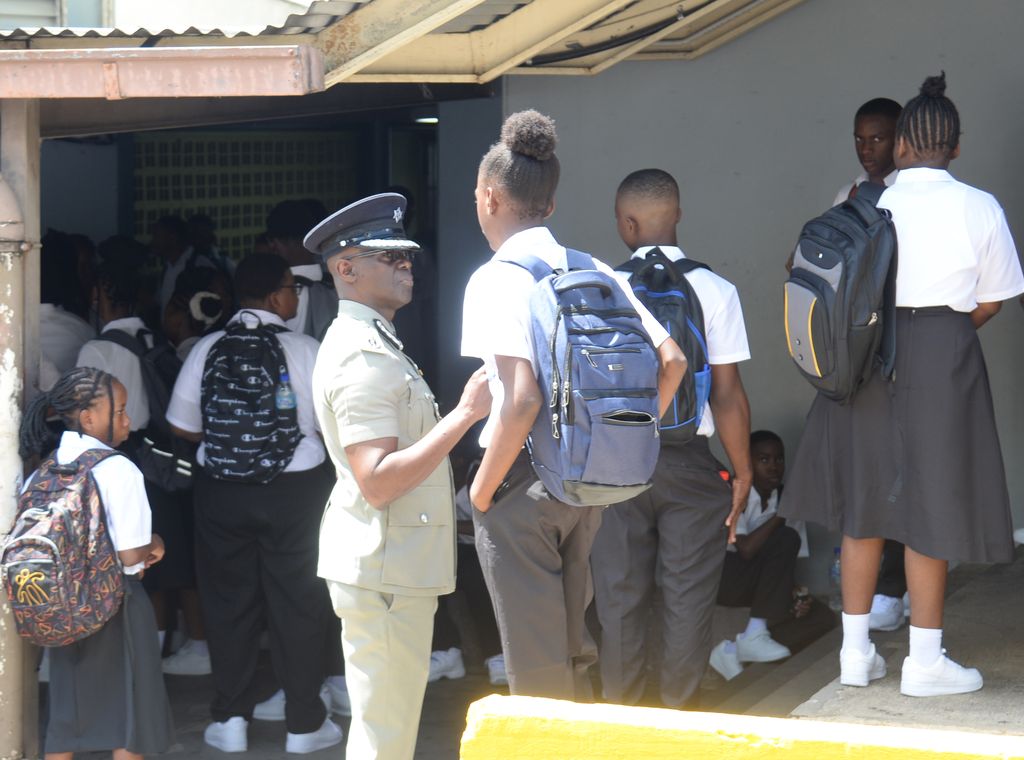
Police will use data gathered during the last academic year to target fighting, vaping and marijuana possession in schools this term, with 51 schools remaining on the School-Oriented Policing (SOP) programme for now.
Speaking with Guardian Media yesterday, Deputy Commissioner of Police Junior Benjamin said the Trinidad and Tobago Police Service (TTPS) is adopting a more proactive approach as schools reopen today, after statistics showed increases in all three areas during the 2025/2026 academic year.
“What we plan on doing this year is to really see how we can improve the level of service that we want to give to the schools by, first of all, seeking to have a more proactive response,” Benjamin said.
“Now that we have stats from last year, we’re able to look at the areas where we recognise most of the offences that are taking place. This includes, one, we saw an increase in fighting. We also saw an increase in vaping. And also, we saw an increase in possession of marijuana.”
Benjamin said police will concentrate resources on schools where those issues have been most prevalent. Community policing officers will also engage at-risk students as part of an effort to improve behaviour and reduce offending.
“The idea is to really try to ensure that, one, we create a safer environment for learning across the school environment. That’s one. Two, the next thing is to see if we can reduce the number of offences that are taking place within the schools, more particularly those that we have the police officers in,” he said.
He added that officers are being encouraged to work more closely with teachers, principals, parents and students. Police also want officers to build mentorship relationships with students and be seen as sources of support, rather than solely as enforcers of the law.
The programme will continue in the same 51 schools for the time being, although Benjamin said the list could be revised following discussions with the Ministry of Education.
He explained that the ministry makes the final decision on school selection, using both its own reports and information provided by the TTPS. Some schools may eventually be removed if incidents decline, while others could be added.
“For now, we’re going with the same schools thus far, until further notice,” he said.
Benjamin also confirmed that manpower assigned to the initiative has not changed, although he said he did not have the exact number of officers available.
The SOP programme was introduced in September 2025 as part of the Government’s response to escalating school violence.
In March, Homeland Security Minister Roger Alexander told the Senate that the initiative was designed to strengthen school safety, prevent and manage violence, and provide a visible police presence where needed.
At the start of the 2025/2026 school year, specially trained officers were assigned to 50 secondary schools, while police also provided patrol support to an additional 10 secondary and 10 primary schools.
By March, Education Minister Dr Michael Dowlath told Parliament that schools were selected based on suspension data, patterns of violent incidents, the vulnerability of surrounding communities and other risk factors.
Dowlath said 51 schools had been identified using those criteria, while 20 schools were assigned roving police patrols.
The initiative has faced scrutiny over the role of police officers in schools, the criteria used to select schools and whether sufficient attention is being paid to the underlying causes of violence and indiscipline.
Those issues were raised in Parliament in March when St Ann’s East MP and former education minister Dr Nyan Gadsby-Dolly tabled a private motion seeking more information on officers’ training, responsibilities, deployment and the programme’s performance measures.
Defending the initiative, Dowlath said 257 officers had received multidisciplinary training and 95 were selected for school deployments. Their responsibilities include maintaining safety, responding to emergencies, mediating conflicts, promoting positive behaviour, supporting vulnerable students and enforcing the law when necessary.
According to Education Ministry data cited by Dowlath, approximately 22,000 suspensions were recorded across the school system between 2022 and 2025. The figures included 3,700 fights, 458 assaults involving weapons, 879 cases of sexual misconduct, 1,100 drug-related incidents and 504 cases involving weapon possession.
Dowlath later reported that suspensions in schools with assigned school-oriented police officers declined from 1,711 to 1,555 in Term Two, while violence-related suspensions fell from 560 to 455.
Benjamin said the TTPS now intends to use lessons learned during the programme’s first year to guide deployments and interventions.
“We are hoping to, again, use that intelligence-led approach where we’re going to be looking at the schools where we’re seeing most of the offences taking place,” he said.