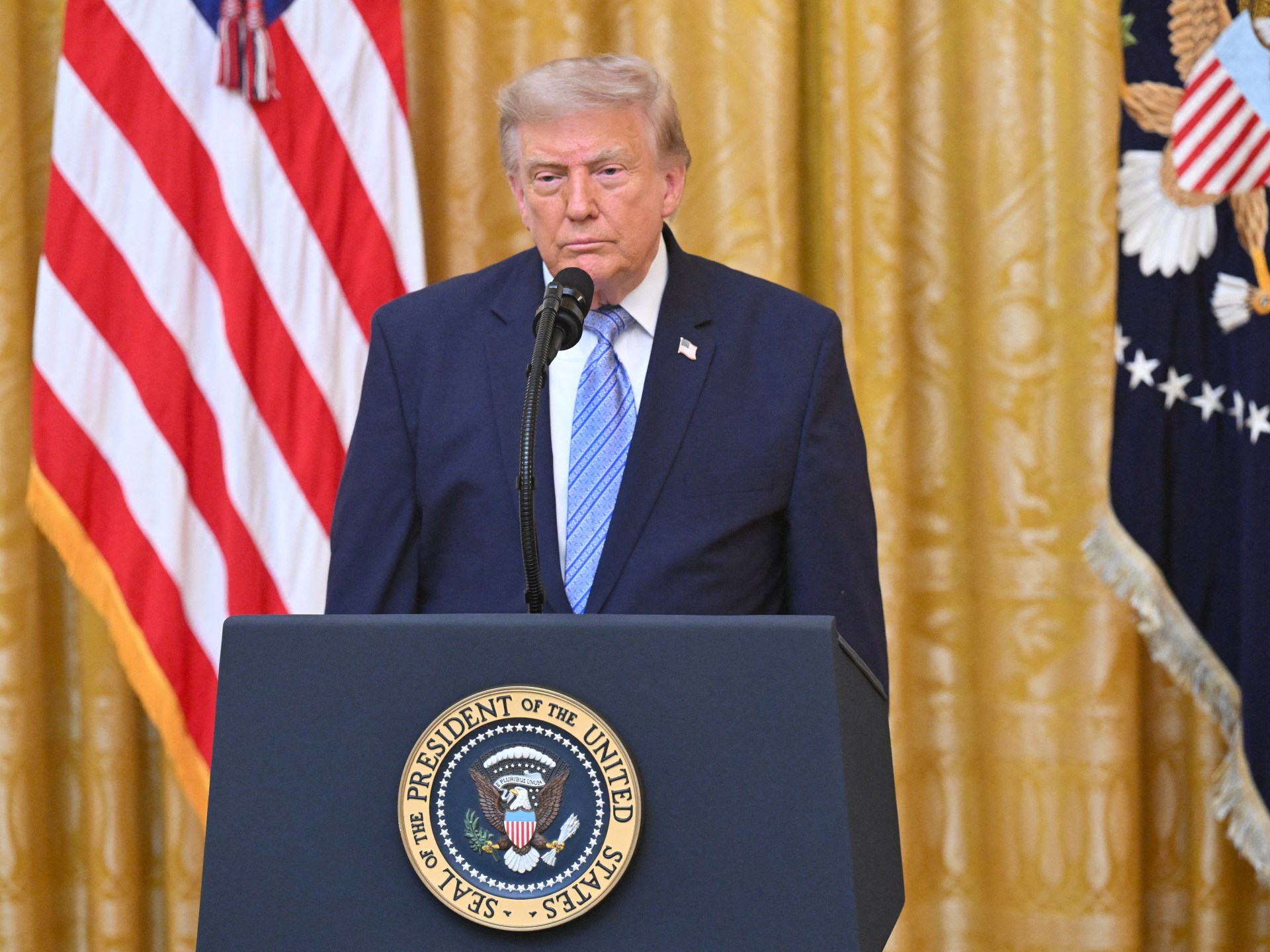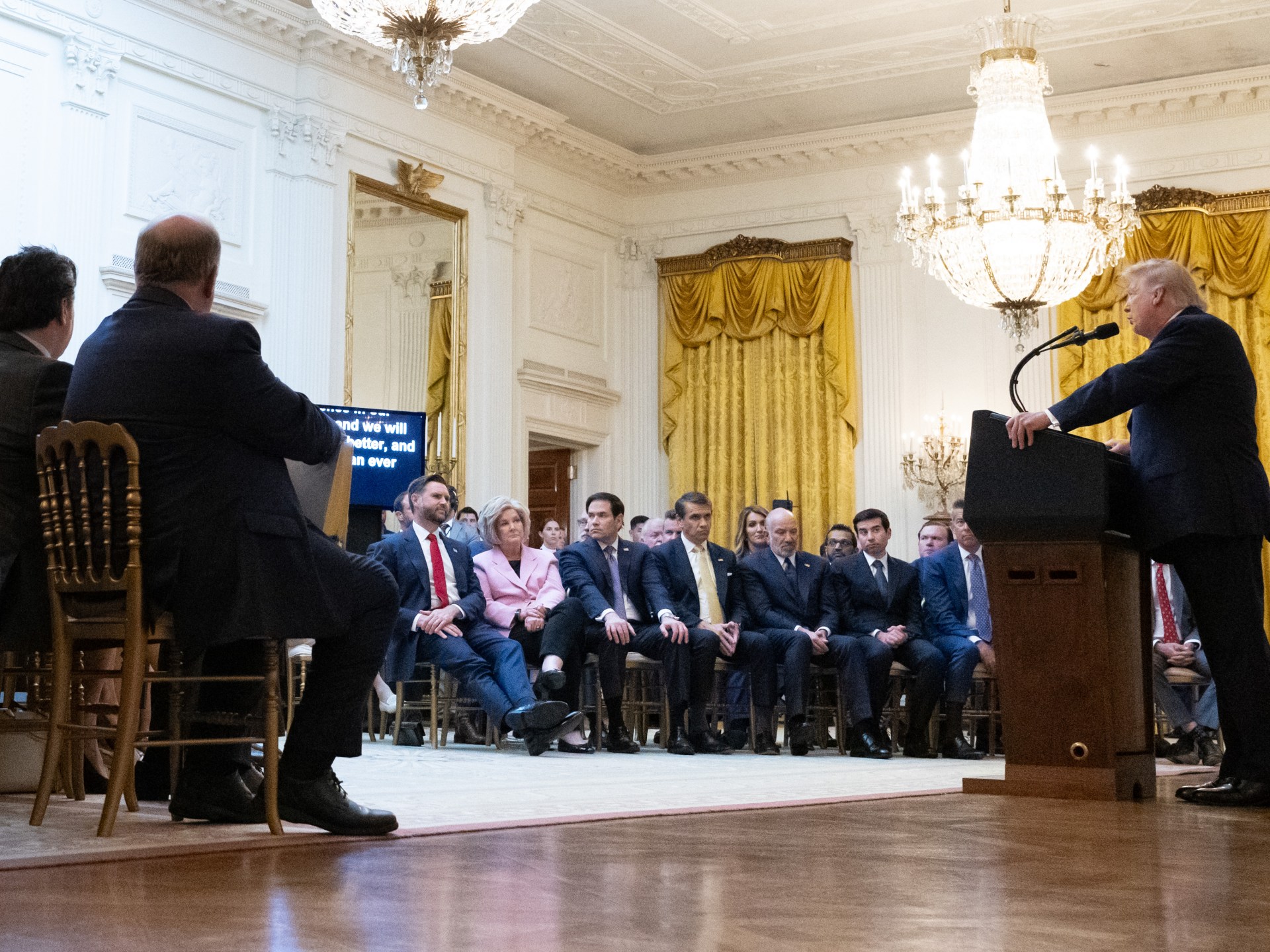

United States President Donald Trump has renewed a campaign to cast doubts on the 2020 elections that saw him lose to Joe Biden – this time painting China as a major adversary that helped “manipulate” the vote.
Speaking in a primetime address on Thursday, Trump claimed that newly declassified intelligence material exposed foreign interference in the elections, despite intelligence assessments from the US government that stated the opposite.
- list 1 of 4Key takeaways from Donald Trump’s controversial speech on election security
- list 2 of 4Trump’s intelligence chief nominee won’t say Biden won 2020 election
- list 3 of 4Epstein linked to Israeli ‘deep state’, US intel, says Vance: What we know
- list 4 of 4‘Trump Accounts’ are symbolic, not effective at closing wealth gap
end of list
The US president’s insistence on debunked stolen election theories led to one of the country’s most serious political crises when his supporters led a violent attack on Capitol Hill on January 6, 2021, in the final days of his first term.
Trump repeated in recent months that the 2020 election results were manipulated at the same time that he sought to push Congress to pass a restrictive voter identification law, which its proponents have called the SAVE America Act.
The law would impose strict ID requirements on US voters and would allow greater federal intervention in elections. While it has passed in the lower house, Democratic opposition in the Senate has stalled its progress.
The claims come as Trump is set to meet with Chinese President Xi Jinping in September following a turbulent trade war in the past year that severely strained diplomatic relations.
Here’s what we know:

What did Trump say against China?
Trump accused Beijing of stealing compromising data on US voters. He also accused China of influencing the US midterms in 2018 to harm his fellow Republicans and damage his re-election bid in 2020.
Advertisement
Beijing illicitly gathered 220 million voter files “over a period of years” and executed “the largest compromise of election data in history” in 2020, Trump claimed. The files contained voter registration data such as names and addresses.
“They wanted to just make you sound like your president was not so hot. When actually your president has done a great job,” he added.
The Trump administration on Thursday also published hundreds of previously classified documents to back the president’s claims.
However, a US intelligence report in 2021 concluded that China had considered, but ultimately had not deployed “influence efforts” to affect the 2020 election.
The assessment, which was conducted under John Ratcliffe, Trump’s then-director of national intelligence and his present CIA director, found that China attempted to collect information on US voters, public opinion and political parties going as far back as 2008. Typically, such data is publicly available and cannot be used to alter votes. It could, however, be used to predict election results.
US media reported in 2021 that within the intelligence committee at the time, a minority view from two officials theorised that China had tried to undermine Trump’s chances by using online influence campaigns and other measures because of worries about how Trump’s volatile policies would affect China’s semiconductor industry.
The partially redacted documents released on Thursday further showed that the two officials assessed China probably used “overt messaging, nascent online covert influence capabilities, diplomatic measures and the use of economic leverage”. The officials admitted that these were not China’s “most aggressive options” and that they had low to medium confidence in their own suspicions.

How has China responded?
Responding to US media ahead of Trump’s speech on Thursday, Liu Chang, a spokesperson for the Chinese embassy in the US, refuted the claims.
“China has all along adhered to the principle of non-interference in others’ internal affairs,” he said. “The US election is an internal matter of the US. Its outcome is determined by the votes of the American people. China has never and will never interfere in the presidential elections of the US.”
Several Democratic Party leaders have also reacted to the claims. Democrat Senator Mark Warner, in a series of posts on X, accused Trump of sharing misleading information in a bid to interfere with the coming November midterms.
Advertisement
“Trump’s shocking “bombshells” about China are totally bogus,” Warner wrote. “The fact is our intelligence agencies unanimously agreed that China did not even try to change a single vote in the 2020 election. A single concurring opinion suggested China may have tried to sway voters’ opinions … but that’s been public knowledge since 2021.”
Trump, as in recent months, cast doubts on mail-in balloting ahead of the midterms, saying that absentee voting was “inherently corrupt”.
Analysis by conservative think tank the Heritage Foundation inadvertently found there were only 300 cases of fraudulent absentee votes between 1982 and 2025. The Brookings Institution calculates that fraud in mail-in ballots accounts for four out of 10 million votes.
The president on Thursday also pointed to CIA findings on Venezuela to suggest that US voting machines are susceptible to digital manipulation.
The intelligence document from last month, which summarises reporting between 2004 and 2020, found that Venezuela’s government was capable of digitally manipulating electronic voting systems – in Venezuela, not the US. Trump’s supporters have long spread theories that the government of abducted former President Nicolas Maduro hacked US voter machines in 2020.
The president also claimed that about 278,000 non-citizens were illegally registered to vote in federal elections, and cited a review by the Department of Homeland Security.
The claim comes as his administration has sought to compel states, largely Democrat-led ones, to hand over private voter data for review. A study from the Bipartisan Policy Center found that past state reviews found 0.04 percent of voters were non-citizens.
Separately, Trump said the FBI would reopen an election fraud case in Michigan, a Democratic stronghold. The 2020 case involved a voter-registration company that had collected some fraudulent or error-filled data, which was discovered before the election. Authorities at the time said the registrations were voided.
Which countries actually interfered in the US elections?
Extensive investigations by US intelligence agencies in 2021 found that Russia’s President Vladimir Putin authorised several Russian government agencies to conduct influence operations that sought to undermine the Biden campaign and pull support for Trump’s. The campaigns also aimed to puncture public confidence in the electoral process and further heighten political divisions.
The intelligence report determined that Iran attempted to covertly undercut Trump’s prospects, while Cuba, Venezuela and Hezbollah in Lebanon conducted “smaller-scale” efforts to influence the elections.
Although Brazil, under former President Jair Bolsonaro, was not flagged by US intelligence, analysis by the investigative journalist organisation Agencia Publica found thousands of tweets trending in the country around the 2020 elections that spread conspiracy theories about election fraud and shared online hashtags supporting Trump, such as #GoTrumpReeleito or “let’s go, Trump re-elected”.
Advertisement
The agency found that bots and supporters of Bolsonaro, a strong Trump ally, largely drove the campaign.
Related News
Ukraine’s Zelenskyy set to meet Trump as Iran and Ukraine wars converge

Ukraine says it attacked two Russian oil refineries

Gaza holds mass funeral for 112 people killed in Israel’s 2023 Sabra attack