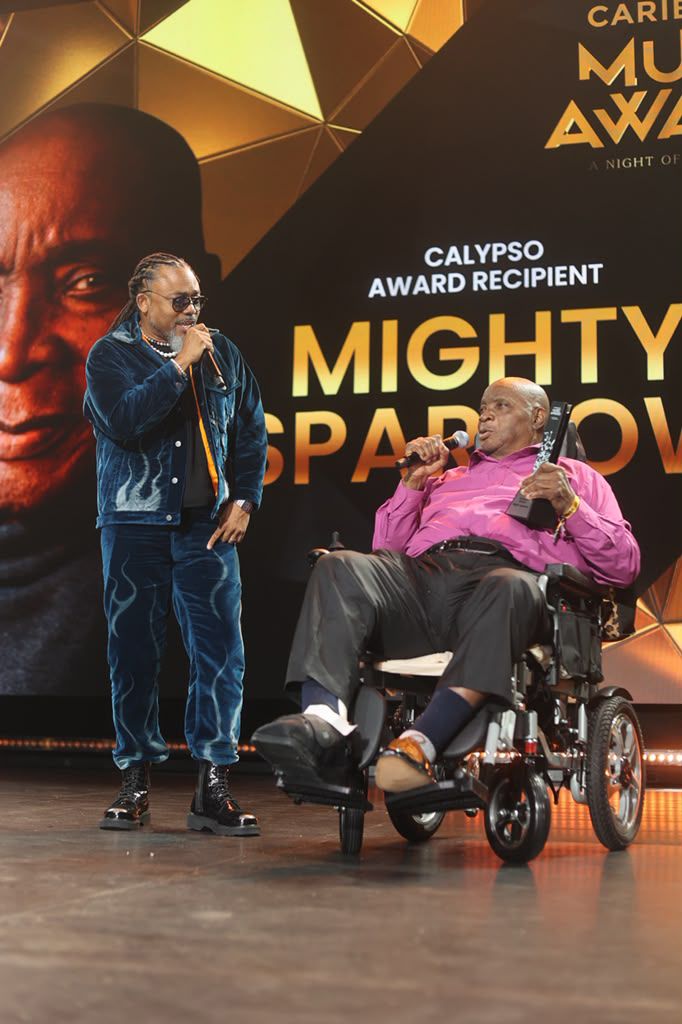

Slinger Francisco, the legendary calypsonian known across the Caribbean and around the world as The Mighty Sparrow, has died at the age of 91.
Francisco died peacefully in New York surrounded by loved ones following a brief illness, according to a statement issued by his family yesterday.
Widely regarded as one of the greatest calypsonians in history, Sparrow was celebrated for his extraordinary talent as a singer, songwriter, performer and mentor. For more than seven decades, his music entertained, challenged and inspired audiences, cementing his place as one of the most influential figures in Caribbean culture.
Beyond the stage, his family remembered him as a devoted husband, father, grandfather, great-grandfather, life partner and friend.
The family also said they took comfort in knowing that before his passing, Francisco had given his life to Jesus Christ and was baptised in the Seventh-day Adventist faith.
Plans are being made for a public celebration of his life. Fans and well-wishers have been encouraged to honour the calypso icon on social media by tagging @therealmightysparrow.
The family thanked the public for its outpouring of support and requested privacy as they mourn.
Born in the fishing village of Grand Roy, Grenada, Francisco moved to Trinidad and Tobago with his mother when he was one year old. He grew up in Port-of-Spain, where the city’s rich cultural landscape helped shape the artistry that would later define his career.
Music played an important role in his childhood. As a member of the choir at St Patrick’s Catholic Church, he developed the vocal discipline and musical foundation that became hallmarks of his success.
His fascination with calypso grew in the tents of Port-of-Spain, where he discovered a medium that allowed him to blend humour, melody and performance with powerful social and political commentary.
Francisco began his professional career in the early 1950s as “Little Sparrow” before adopting the name that would become synonymous with calypso excellence: The Mighty Sparrow.
His breakthrough came in 1956 with Jean and Dinah, a witty and provocative calypso examining the social impact of the departure of American servicemen from Trinidad and Tobago after World War II.
The song captured both the Calypso Monarch and Road March titles, launching Sparrow to national prominence and signalling a new era for calypso. His sharp lyrics, contemporary style and fearless commentary helped transform the art form and expand its appeal.
Over the next several decades, Sparrow dominated the calypso landscape, recording dozens of albums and composing hundreds of songs that explored politics, economics, love, religion, family and Caribbean identity.
Classics such as Capitalism Gone Mad, Federation and No Money No Love showcased his ability to dissect political and social realities, while hits including Congo Man, Saltfish, Obeah Wedding, Melda and Mother-in-Law highlighted his trademark wit and storytelling prowess.
Though often provocative, Sparrow’s work was marked by intelligence, humour and a masterful command of language. He elevated calypso beyond seasonal entertainment, establishing it as a powerful vehicle for social commentary and cultural expression.
An electrifying performer, Sparrow’s stage presence carried him from local calypso tents to major venues across the Caribbean, North America and Europe, including appearances at Madison Square Garden in New York and London’s Royal Albert Hall.
Throughout a career spanning more than 70 years, he won multiple Calypso Monarch and Road March titles and received Trinidad and Tobago’s Chaconia Gold Medal for his outstanding contribution to music and culture.
His influence transcended generations and genres. Even in his later years, Sparrow remained active in music, continuing to perform and record despite periods of serious illness.
Tributes and concerts celebrating his work introduced new audiences to his music, while his songs remained fixtures of Carnival celebrations, cultural festivals and Caribbean gatherings around the world.
Sparrow spent much of his later life between Trinidad and Tobago and New York, where he maintained strong ties with Caribbean communities and remained a beloved cultural figure.
For generations, The Mighty Sparrow was more than a calypsonian. He was a chronicler of Caribbean life, a fearless commentator, a master storyteller and one of the defining voices of the region.
With his passing, Trinidad and Tobago, Grenada and the wider Caribbean have lost one of their most enduring cultural giants.
The Mighty Sparrow received numerous major honours and competitive titles during his lifetime. The most significant major national and regional honours include:
Related News
Homeland Security Minister defends PM's ”UNC only” security policy
395 SOE detainees released after revocation orders

Caribbean strengthens preparedness for African Swine Fever