
SEIGONIE MOHAMMED
GML Climate Change Editor
—reporting from Castries, Saint Lucia
There may soon be virtually no safe zone from overlapping climate threats for children across parts of the Eastern Caribbean, with new research warning that more than nine in ten could be exposed to at least three climate hazards by mid-century.
The UNICEF-commissioned analysis covers approximately 176,000 children in Barbados, Dominica, Grenada, Saint Kitts and Nevis, Saint Lucia, and Saint Vincent and the Grenadines.
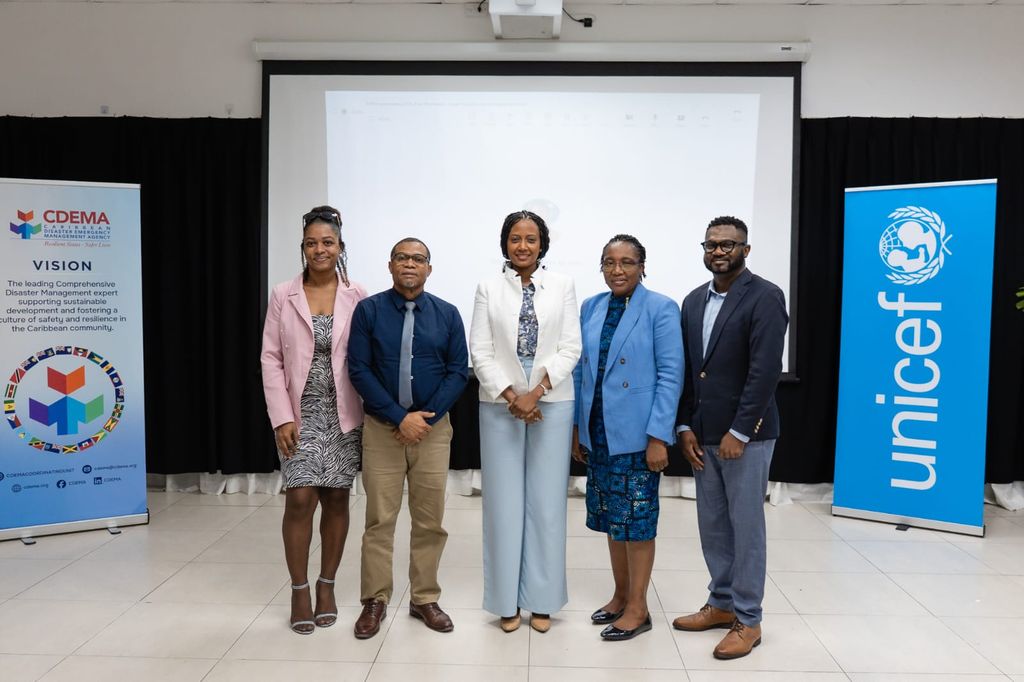
Presenting the findings in Saint Lucia Wednesday, Meru Labs climate and data analyst Irina Bird Reddiar said more than a third of children are already living in areas exposed to at least three climate hazards.
“By mid-century, under the high emission scenarios, this could rise to more than nine in 10,” Reddiar said. “That means there is no safe zone in the region. And the question is not whether children will be affected, but how severely and how often.”
The warning goes beyond hurricanes.
Under a high-emissions scenario, the study projects the Eastern Caribbean could be about 1.4 degrees Celsius warmer by mid-century, bringing more than 80 additional days above 30 degrees annually. Moderate to severe drought could occur for three to four months each year on average, while a major hurricane passes through regional waters roughly every six years.
Researchers say the consequences could follow children throughout their lives, from learning loss and illness to malnutrition, psychological distress, reduced educational attainment and lower lifetime earnings.
“GDP-based accounting cannot see the cost that accumulates silently in children's bodies, their minds, and their futures,” Reddiar warned.
The study also exposes a significant policy gap. While national climate plans across the six countries identify sectors critical to children, including health, education, water and agriculture, Reddiar said none currently contains child-specific indicators, measurable outcome targets or adaptation commitments tied to child outcomes.
“And without this, it's impossible to track whether climate investments are reaching children or to demonstrate their returns to climate finance providers,” she said.
UNICEF Eastern Caribbean representative Maryam Abdu said governments must now translate the evidence into budgets and policy.
“Reports should not be on the shelf, it should influence what we're going to do as a government, as a people, and including development partners,” Abdu said.
Saint Lucia is already using the research.
NDC in-country facilitator Onika Benn announced that officials are finalising a project designed to provide at least five days of water for 20 schools in the country's most water-stressed areas. Support has been pledged for water tanks and solar-powered water pumps.
The country is also developing a climate investment proposal addressing water security, technical and vocational education and psychosocial support for children, teachers and counsellors.
Saint Lucia’s Sustainable Development Minister Lisa Jawahir said the test will be whether the research produces measurable change.
“We must move from evidence to policy, from policy to investment, and from investment to measurable improvements in the lives of our people,” she said