
Lead Editor-Politics
akash.sama[email protected]
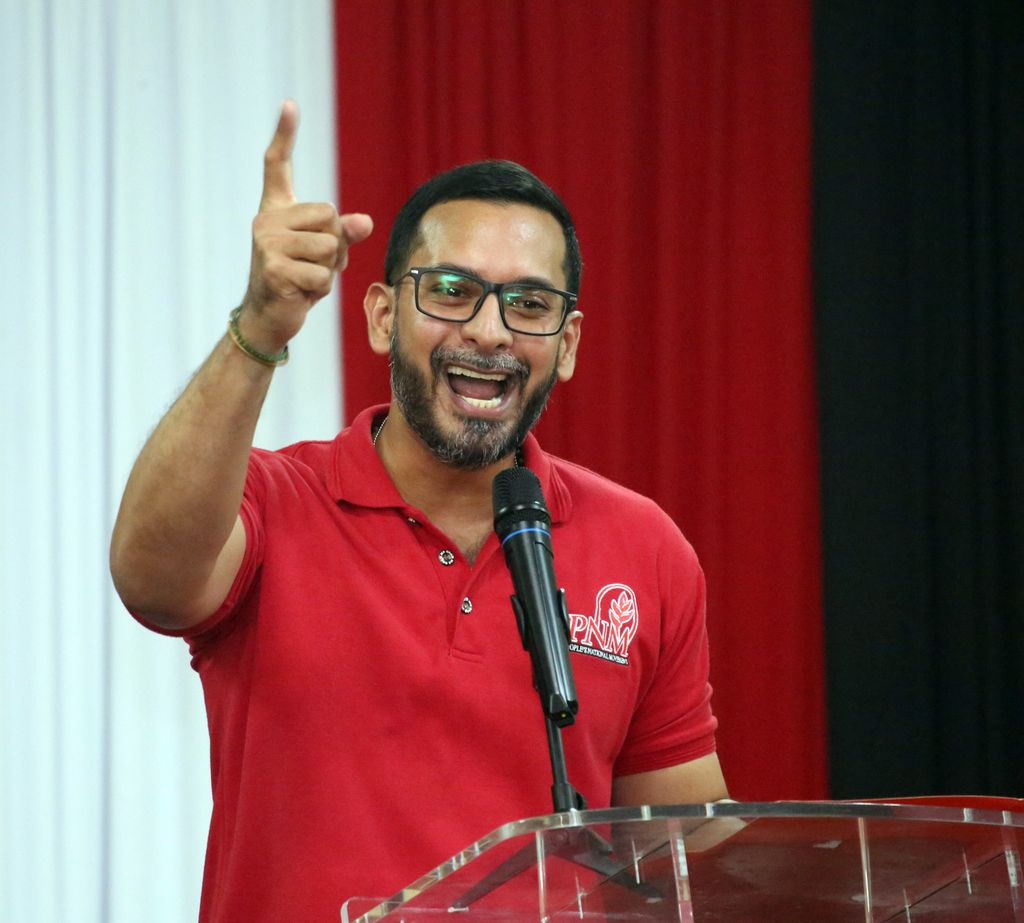
People’s National Movement (PNM) deputy leader Sanjiv Boodhu has rubbished Homeland Security Minister Roger Alexander’s insistence that there is no political interference in the issuance of Preventive Detention Orders (PDOs), accusing him of misunderstanding the very regulations that govern the current State of Emergency (SoE).
Boodhu’s criticism came a day after Alexander rejected claims that politicians influence the detention process, maintaining that PDOs originate with the T&T Police Service (TTPS) and are not politically directed.
The debate comes following the detention of businessman Dominic Hadeed and his wife Genevieve under the emergency regulations. Neither has been charged with any offence.
But Boodhu yesterday said Alexander’s explanation was fundamentally wrong.
“The Minister of Homeland Security is obviously, but alarmingly, a stranger to the SoE Regulations,” he said.
He pointed to a legal interpretation issued by Assembly of Southern Lawyers president Saira Lakhan, which said the regulations make it “clear and plain” that the Minister of Homeland Security, not the police, is the only official authorised to issue a PDO.
“The regulations confirm in clear and plain language that the Minister of Homeland Security is the only person authorised to issue a PDO. The PDO is then enforced in terms of an arrest by the TTPS,” he said.
Boodhu argued that Alexander’s own role in approving detention orders undermines his insistence that there is no political involvement. He went further, accusing Cabinet of granting itself extraordinary powers that ordinarily belong to the courts or the police.
“The fact, not conjecture, fact, is that the Cabinet has empowered themselves continuously with executive power of arrest, a power otherwise reserved for the police or the court by way of warrant or judicial order.”
According to Boodhu, the Constitution was deliberately designed to prevent governments from directing police operations, but the emergency regulations now permit ministers to authorise the detention of citizens without charge.
“During this State of Emergency, this Government not only has given themselves powers of arrest by the stroke of a pen held by the Minister of Homeland Security, they continue to use that power on a daily basis to detain hundreds of citizens without charge, without due process, without bail.”
Boodhu questioned why individuals are being held for months if investigators already possess evidence linking them to criminal activity.
“The purpose of a PDO is described in the regulations as being a tool to immediately apprehend persons who are suspected or found to be a threat to public safety or order.
“If, however, the state has information or evidence or intelligence that a person detained by a PDO has acted in such a manner that is inconsistent with the law, what is the reason for holding them for months on end without a charge being laid?”
He pointed to the previous SoE, where numerous detainees were eventually released without being charged, arguing that the system failed to produce meaningful results while violent crime persisted.
“Consider the hundreds of persons released without charge at the end of the last SoE who spent months incarcerated. Murders, extortion, violent robberies, kidnapping, shootings all continue unabated.”
Boodhu said citizens were therefore justified in questioning the Government’s motives.
“So, why should the public draw any conclusion other than the SoE is used as a political tool to circumvent the constitutional safeguards that protect us, the citizens, from the abuse of executive power, which we no doubt are experiencing daily.”
He said although public attention has centred on Hadeeds’ detentions, the issue extends well beyond them.
“Many think this is about Hadeed and his family but it really is not. The Hadeed matter has opened the eyes of some members of the public who otherwise may not have realised that they too could be subject to the unrestricted power of the sitting Government, who can lock you up for months, based on whatever allegation they feel to throw at you.”
Boodhu claimed uncertainty was spreading throughout the business sector, from small businesses to large corporations.
“The prevailing feeling in the business community from SME to large industry is, ‘Who is next?’”
He called on citizens to speak out against what he described as an abuse of executive authority.
“This is no time for silence. This is time for the public to stand up and say enough is enough.”
He also appealed to rank-and-file police officers, saying public confidence in the TTPS was being eroded.
“It is time for the men and women of the TTPS rank and file to recognise that their reputation and the trust of the people are being flushed away by the ineptitude and irresponsibility of this Government. We are living in a time of constitutional crisis and it is intolerable.”
PNM chairman Marvin Gonzales also took aim at Alexander, although he said he was reluctant to comment extensively while police investigations remain ongoing.
“I am trying my best not to comment on this matter at this time given the fact that investigations appear to be at a sensitive stage and prudence will dictate that one should await the outcome of the police work before commenting,” Gonzales said.
However, he suggested Alexander should refrain from making definitive public pronouncements.
“But having regard to the previous utterances of key Government spokespersons, including the AG and the PM, the Minister of Homeland Security would be advised to ‘drink his tea cool’ and not embarrass himself as he is prone to do.”
Former United National Congress (UNC) MP Ramona Ramdial partly agrees with Alexander’s explanation of the detention process.
“I really don’t think it’s political,” she said on CNC3’s The Morning Brew yesterday, noting allegations circulating publicly that Hadeed’s wife is closely related to a sitting Government minister.
She also said while the minister must approve a PDO, the request originates with the police.
“It is really the PDOs given on the request of the police. So, it has to be approved by the minister, but the request comes from the police. So, he is right when he talks about the process with respect to that.”
Meanwhile, Patriotic Front leader Mickela Panday adopted a more cautious position, saying she was not prepared to either conclude there had been political interference or accept Government assurances that there had been none.
“At this stage, I am not prepared to conclude that there was political interference, nor am I prepared to simply accept assurances that there was none,” Panday said.
“The facts must be allowed to emerge and the authorities must ultimately account for their actions.”
She added that investigators should be allowed to complete their work and that any conclusions should ultimately be guided by evidence and due process.
Related News

Two Trinidadians named to Guyana ferry disaster probe
First Citizens CEO resigns effective August 31
Scotiabank Foundation donates steelpans to Mt D’Or school