Blue Wave Harmony’s troubled journey to T&T: Vessel once detained, concerns raised over safety lapses
 07 February 2026
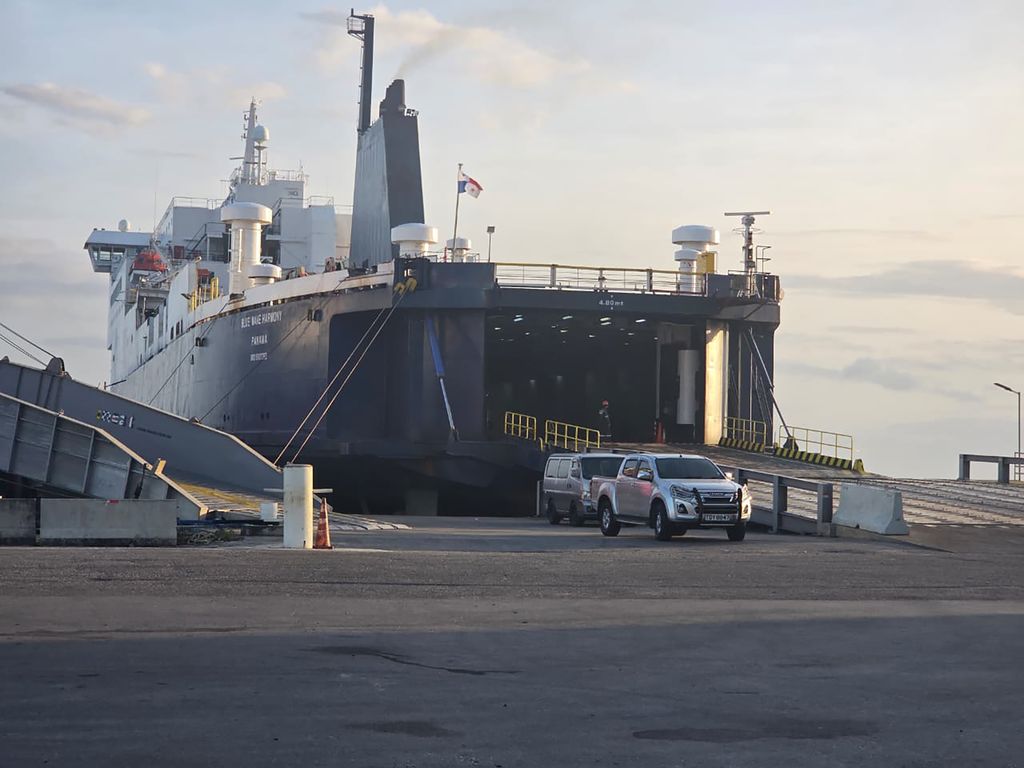

On January 30, just days after it reached T&T and while on sea trials, the vessel brought to service the inter-island seabridge—Blue Wave Harmony—was damaged during berthing manoeuvres in Tobago.
According to reports obtained by Guardian Media Investigations Desk, the vessel was flagged in 2024 for safety concerns.
With the State having to pay US$25,500 a day, Guardian Media takes a look at what happened at the Port of Scarborough during berthing that damaged the ship’s hull, and what the vessel’s documented history showed about safety oversight before it ever arrived in T&T on January 22.
Senior Reporter
elizabeth.gonza[email protected]
In April 2024, a vessel history report from S&P Global’s maritime database showed that the Blue Wave Harmony was detained by the United States Coast Guard (USCG) under Port State Control in San Juan, Puerto Rico, for 17 days.
Additional documentation on the detention lists categories of deficiencies tied to ship maintenance and equipment, fire-fighting readiness, cargo-related safety, and a load line issue connected to the ship’s International Load Line Certificate (ILLC).
The vessel’s S&P history also showed that the ship continued to receive Port State Control inspections afterwards, including in 2025. (See Table 1.)
Vessel detentions happen from time to time, but last week’s berthing incident in Tobago raised concerns about the vessel’s operability and safety concerns and the impact on Tobago, given that the cargo service is the lifeline of Tobago.
10 Apr 2024 San Juan, Puerto Rico US Coast Guard Detained – 17 days Load Line certificate (detainable);
Fire protection systems operation
27 Apr 2024 San Juan, Puerto Rico US Coast Guard Initial inspection Load Line certificate;
Fire protection systems operation
22 Jun 2024 San Juan, Puerto Rico US Coast Guard Follow-up inspection Defects not itemised in report
07 Jul 2023 Vigo, Spain Paris MOU Initial inspection Cargo Ship Safety Equipment certificate;
Freeboard marks; Weathertight doors;ISM
Pre-Jul 2023 Port not specified Paris MOU Inspection Load Lines (detainable);
Cargo securing (detainable); Firefighting equipment availability (detainable); MARPOL Annex I; Ballast Water Management;
ISM maintenance
05 May 2025 Haifa, Israel Med MOU Detailed inspection Ship certificate (other); Machinery controls alarm; Sickbay; Gas instruments; Gyro compass; ISM
21 Oct 2025 Iskenderun, Turkey Med MOU More detailed inspection Crew certificate endorsement; Stability/loading information; Public address system;
Emergency lighting/batteries; Cargo Securing Manual; Radar; ECDIS; VDR
21 Dec 2025 Piraeus, Greece Paris MO More detailed inspection Ship certificate (other);
Bridge operation
Last week, Guardian Media’s Investigations Desk raised the issue of the vessel’s history and detention with Works Minister Jearlean John, who explained that “situations of this nature are not uncommon in vessel operations.”
She said a detention is only lifted once the deficiencies identified have been fully rectified to the satisfaction of the inspecting authority, and once all required reports and verifications have been duly completed and accepted.
She pointed out that public Port State Control (PSC) databases typically list the deficiencies identified at the time of inspection, but do not reflect the corrective actions implemented, the resolutions achieved, nor the preventive measures subsequently adopted, which can sometimes create concern if taken out of context.
“In this case, the vessel manager is preparing the corresponding clarification, confirming that: All deficiencies identified during the April 2024 inspection were properly rectified, the detention was cleared in accordance with USCG requirements, the vessel is currently in compliance with Load Line, Class and statutory requirements, and ongoing compliance is being monitored under the supervision of the Classification Society and Flag State, as applicable,” she said.
Minister John said that after completion of class renewal, the vessel has been inspected by several port states without any finding structural matters.
“The vessel also passed a very strict PSC inspection in Piraeus/Greece in 12/2025 (December, 2025) without findings regarding vessel structure or load line. Finally, the vessel just passed the annual class inspection in 12/2025 without deficiency and is managed in compliance with class and statutory regulations and under close supervision of class and flag. The deficiency regarding the load line at the time of the detention in 04/2024 (April, 2024) has been the wrong application of the LL marks at the hull, which have been found not to be following the LL certificate. The marks have been renewed at that time, and the deficiency has been closed,” she said.
Specialist maritime and commercial Attorney-at-Law Nyree Alfonso, after reviewing the vessel history report, said the vessel was showing current compliance with all of the international certification requirements.
On the USCG detention, she said, “In the ordinary course of things, the US Coast Guard is not going to release you if it is you have not fixed the deficiencies that they have identified when they board you.”
She later stated, “The chances of you escaping the US Coast Guard with a deficiency not addressed or not rectified, I think, nil, nil, and nil.”
On the public fear that a past detention alone means a vessel is unsafe now, Alfonso argued that the stronger evidence is what the ship is certified to do at present, and what recent inspections show. She pointed to the existence of valid certificates and recent inspections as indicators of compliance.
She also addressed the “casualty” entry in the vessel history—including a record of a fire/explosion incident listed as non-serious—and said, “We call any kind of incident that happens… a marine casualty.”
“Marine casualties could be a ship to ship striking, collision, a pier to ship, a fire of some form,” she said, adding that the term does not automatically mean the vessel was catastrophically damaged or unfit,” she said.
But while Alfonso focused on certification and current compliance, she also acknowledged that the level of detail the public wants is not usually contained in a synopsis-style history record: “When you read through these synopsis-type reports, it’s just a bunch of dates and information. It’s not telling you how it was resolved, when it was resolved. You don’t get that kind of detail or flavour.”
The Port Authority of Trinidad and Tobago (PATT) said it did not procure the Blue Wave Harmony and had no role in selecting the vessel.
When contacted, PATT chairman Dr Rodney Ramroop said, “Well, first of all, the Port Authority had nothing to do with the procurement of the Blue Wave. That was done under NIDCO (National Infrastructure Development Company Limited). We only do the operating side of it. So NIDCO is in charge of that. NIDCO and the ministry. So those people will be the appropriate people. Yeah, we were not involved in the procurement of the Blue Wave Harmony, not the Port Authority.”
PATT’s own Request for Proposal notice showed the authority invited bids for “The Provision of a Cargo Vessel for the Inter-Island Seabridge” under RFP folio: PATT06/2025, dated July 10, 2025. The notice stated interested companies could signal their interest between Friday, July 11, 2025 and Friday, July 25, 2025, and that sealed bids were to be received by 10 am on Wednesday, September 10, 2025.
Questions were sent to NIDCO chairman Neil Dookie via email. He acknowledged receipt and promised to respond. There was no response before publication.
However, a NIDCO official familiar with the procurement process, who asked not to be named, said the decision on which agency sends out tenders depends on what the government wants procured and which entity is best placed to run the process.
The official said ministries and state agencies can choose to use NIDCO because “NIDCO is doing so much procuring for the government… they have used NIDCO in the past to do the procuring programme,” but the Port Authority can also be approached, “depending on the expertise required.”
The official said neither agency typically acts alone on technical matters and that NIDCO, even when it does not have all the expertise “resident at NIDCO,” would “approach other agencies” for inputs, including information on port facilities and would consult external technical resources such as marine engineering expertise from UTT.
The official said specifications are usually guided by end-user needs and stakeholder consultations, including meetings with business interests and that once specifications are agreed, an agency can “issue a call” based on those specs to lease or procure a vessel.
A Port source provided information on earlier figures submitted to Cabinet in 2025, stating the daily charter rate proposed at that time was US$18,600 and that it would increase to US$19,000 per day up to January 2026.
The Port source, who did not want to be identified, said an offer under consideration at that time included a substitution for the Cabo Star with the MV Sailor at US$19,000 per day, with a guaranteed period covering 2026–2028. The Port source said MV Sailor was described as larger, with a passenger capacity of 120, compared with Cabo Star’s 100. But concerns included the length of the guarantee period and positioning/repositioning costs.
In the Blue Wave Harmony record, the vessel is shown as Panama-flagged.
The record lists corporate names connected to the ship’s operation, including Blue Wave Corp and a ship management entity. But it does not, on its face, answer who the ultimate person is behind the company.
The Blue Wave Harmony was not in full commercial service when it was damaged in Tobago. It was on sea trials, a normal step for commissioning and familiarisation.
PATT said the vessel completed its first sea trial on January 27 and on January 30 departed Port-of-Spain for a second sea trial to Scarborough. Then came the incident.
In its release at the time, PATT stated: “During berthing manoeuvres at the Port of Scarborough this morning, an incident occurred, resulting in damage to the vessel’s hull.” PATT said “preliminary information indicates that weather conditions, including strong winds, were contributing factors,” and that a marine pilot was assisting the captain.
An update on February 3 said the vessel left Scarborough around 7.15 am, headed to Trinidad for repairs that will be inspected and certified, with the ship expected to enter service “in the coming days.”
Photos and video from the scene showed visible physical damage consistent with a hard impact near the berth area, including damaged infrastructure.
But an industry expert had sharply different views on how the incident may have happened.
A ship buyer, seller and operator with 36 years of experience in the maritime industry, who spoke on anonymity, claimed the vessel “actually rammed into the wharf” and argued that the public explanation focusing on rough seas did not square with the basic layout of the port.
He said: “Your jetty is about 300 or 400 feet in a U-shape, so he would have already entered that U-shape, so he would have been in some level of protected water. So, if there was wind, if there was wind and he was already in the jetty, he was already inside, so the wind and the rough seas couldn’t really vary him that much.”
He questioned whether the vessel approached too fast, lost power or whether standard berthing controls were used properly, and said: “He coming to moor up, he knew he had to be coming in dead slow.”
On whether the operation should have been abandoned if conditions were unsafe, he said: “If the condition wasn’t right for rough seas (as the minister said), then abort the boating. If he has a master, the master does not ask (take control or guide) the pilot. He does not assume control of the vessel. He gets to give guidance. But if the master of the vessel tells the pilot he’s not comfortable, then he says ‘abandon, abandon the boating and take the vessel back to anchorage.’”
He also challenged early talk that a simple welding job could be enough, saying the repair depends on what is found once damaged plating is removed: “It’s only when you remove the plate, then you will see. I wouldn’t doubt any, some frame may have shifted, bent or buckled.”
He said that if frames were damaged, the vessel may need a dry dock and cited the cost of docking as a major factor.
The industry insider called for a proper investigation into what did and did not happen during berthing of the Blue Wave Harmony.