Andy Burnham becomes the UK’s seventh prime minister in a decade after Starmer resigns
 20 July 2026
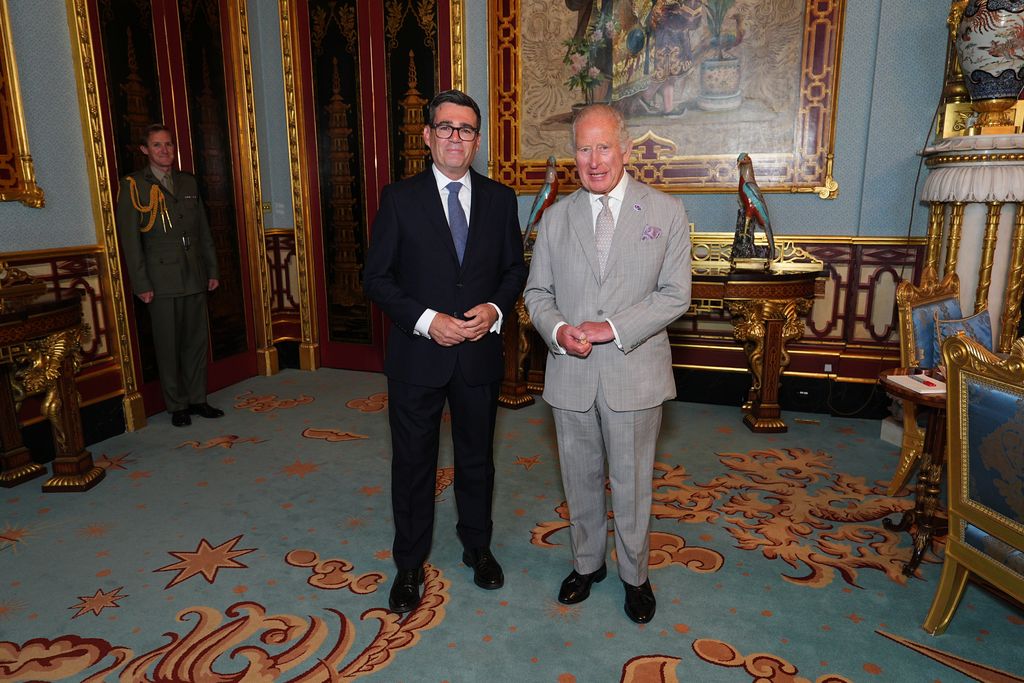

The moment for Andy Burnham has finally come.
After weeks as leader-in-waiting, Burnham officially became prime minister on Monday during a meeting with King Charles III at Buckingham Palace.
He succeeded Keir Starmer, on a day when Britain’s political turbulence gave way, at least temporarily, to smooth choreography.
Buckingham Palace has released a photo of the two men shaking hands. The ceremony known as “kissing hands” marks the transfer of power.
The palace said in a statement that the king “received in audience the Rt. Hon. Andrew Burnham MP and requested him to form a new Administration. The Rt. Hon Andrew Burnham MP accepted The King’s offer and kissed hands upon his appointment as Prime Minister and First Lord of the Treasury.”
Burnham is the seventh U.K. prime minister since 2016 in a now well-rehearsed handover after replacing Starmer as leader of the centre-left governing Labour Party on Friday.
Starmer made a short farewell speech outside the prime minister’s 10 Downing Street residence, saying “my work is done.”
The outgoing leader, forced to resign by his own party, said Britain is now “stronger and fairer than it was two years ago,” when he took office.
“I go with good grace, I go with a smile, and I go proud of everything that we have achieved,” Starmer said before heading to Buckingham Palace to offer his resignation to the king. It was an offer “His Majesty was graciously pleased to accept,” the palace said in a statement.
The king will ask Burnham to take charge
Burnham then went to the palace in his turn and Charles will ask him to form a government. That’s when he officially becomes prime minister, a moment known as “kissing hands.”
The king’s role harkens back to a time when the monarch exercised supreme power and chose a prime minister to run the government. Today, the king has no political power, but the monarch still officially offers the job to the leader of the party that can command a majority in the House of Commons. No hand-kissing is involved.
Britain’s parliamentary democracy allows governing parties to change leaders, and thus prime ministers, without the need for a general election. The next national poll doesn’t have to be held until 2029, though Burnham can call one sooner if he wants.
From the palace, Burnham will go to Downing Street, where he will make his first speech as prime minister.
A spokesperson said Burnham will say that he’s “acutely aware” of how many changes of leader the country has been through in the past decade and will pledge to restore stability.
Starmer said much the same when he took office two years ago. Last month he announced he would resign after missteps and judgment errors that eroded his standing with his party and the public.
Burnham was the only candidate in a contest to become the party’s new leader, securing nominations from 379 of the 403 Labour lawmakers in the House of Commons.
The new leader pledges a new style of politics
The former mayor of Greater Manchester has pledged to make politics “less toxic,” improve living standards across the country and “bring back the hope we have all been missing.”
“I will work to build a new politics,” he said after becoming Labour leader on Friday. “The country is crying out for it.”
Critics and supporters alike will soon be clamouring for details of how Burnham plans to fulfil his pledges.
“Fundamentally, it only will work if you can generate significant economic growth, because it’s the lack of growth that’s really holding the country back,” said Joshi Herrmann, who has followed Burnham’s career as founder of Manchester news site The Mill.
Attention will quickly turn to who Burnham will appoint to his Cabinet. He’s expected to make changes to Starmer’s top team, especially to the biggest jobs of Treasury chief, foreign secretary and home secretary.
In his first speech as Labour leader, Burnham praised Starmer’s achievements, saying he would “build on the foundation laid” by his predecessor.
Starmer became Labour leader in 2020 after one of the party’s worst elections defeats and led it to a landslide victory four years later. But he was soon defeated by the challenges of governing.
At his final Prime Minister’s Questions session in Parliament on Wednesday, Starmer defended his government’s record on the international stage — especially its support for Ukraine — and its domestic policy achievements. He mentioned stronger protections for working people, a reduction in child poverty, a law designed to stop official cover-ups after tragedies, and higher defence spending.
“In six and a half years, I took our party from a historic defeat in 2019, changed it so it was fit to face the country and won a landslide general election victory in 2024,” Starmer said in his final remarks before leaving Downing St, hand-in-hand with his wife Victoria.
“Since then, it has been the privilege of my life to serve you and this great country as prime minister. I am confident that Britain is now stronger and fairer than it was two years ago.” —LONDON (AP)
_________
Story by JILL LAWLESS | Associated Press