After a year in office: Guevarro defends protest restrictions, cites intelligence
 21 June 2026


Anna-Lisa Paul
Senior Reporter
As he moves seamlessly into his second year as Commissioner of Police (CoP), Allister Guevarro is firmly focused on making T&T a safer place for all.
Indicating this during an interview at the Police Administration Building, Port-of-Spain, last Friday, Guevarro addressed some of the recognised highs and controversial lows that defined his first year in office.
Welcoming the criticism, which he said he uses to build himself and improve the general operations of the T&T Police Service (TTPS), the top cop wasted no time in responding to a number of issues that continue to attract widespread public attention – all whilst denying he was the “blue-eyed boy.”
While the question of accountability and transparency arises every time there is a fatal police shooting, with renewed calls for body cameras for all police officers, Guevarro briefly revisited what he said was an inherited debt and alleged purchase of sub-standard equipment, and revealed what steps he had taken to rectify the matter.
While he has previously disclosed the challenges he encountered in this area since assuming office, he said a review of prior policies found the TTPS had been locked in to million-dollar contracts that were not benefitting the service, government or the public.
And as technological upgrades continue constantly, he went on, “These cameras were not suitable at this point in time.”
In order to save a few dollars, the Commissioner said he opted against injecting any more money into preserving and maintaining the system.
“I took that decision to have removed the incurring debt and to move forward with this new procurement.
“We are currently probably mid-stage, so the public will soon be happy to hear that the Expression of Interest will be completed and then we can go on to the evaluation and examination of all the bids and we can go forward with procurement.”
Looking back at the year past and the major milestones that defined his term from the assumption of office on June 17, 2025, Guevarro reflected, “I can safely say that we’ve had some major successes in the reduction of crime.”
Following a recent assessment of what the authorities refer to as SoE 1, SoE 2 and SoE 3, he said an analysis of the data collected and collated during the three SoEs found, “SoE 2 was determined to be the one that had the greatest benefit in terms of reduction in homicides out of the three.”
“And SoE 3, which is the current one, is deemed to be the one with the greatest overall impact on serious reported violent crimes.”
Confirming this data had been presented to the National Security Council (NSC), Guevarro claimed, “So there is a balancing of the scales.”
He pointed to an emergence out of a high in 2024, which he labelled “historical” in terms of the number of homicides.
In 2024, T&T recorded a total of 615 murders, marking it as the deadliest year in the country’s history, with this figure surpassing the previous record of 605 murders set in 2022.
The TTPS was able to get the murder rate down to 369 at the end of 2025.
The CoP declared, “We had a historical drop and we are actually maintaining that position.”
“We are actually a little lower than it was, even for last year, so knock on wood, we shall continue to work towards maintaining that and even getting that figure even lower.”
Pointing to the reduction in the number of serious reported crimes, he acknowledged, “We may want to say the public is not feeling safe and the public is not seeing that reduction in crime, but the statistics speak for themselves.”
With these trends being tracked by the Crime and Problem Analysis (CAPA) bureau, the Commissioner questioned, “Why doesn’t the public want to believe that in 2026, we are on a downward trajectory?”
He reasoned that hidden agendas had a role to play in this regard.
“I can posit that persons with personal or other agendas in the social media, that want to keep a particular narrative alive.”
“Crime is high. The country, Rome, is burning. You must run for the hills, that sort of thing.”
He said PDOs also played a role in this decline.
“The introduction of Preventive Detention Orders was able to take persons who would normally be out in the public, committing crimes, and place them behind bars.”
Referring to this as “state-sponsored accommodation” where these men and women were provided with three square meals per day, Guevarro claimed, “We saw a commensurate drop in the homicide and serious crime rates.”
He added, “A small number of the population have crime high and have us living in fear.”
This, he said, had spurred the authorities even more to focus on “Removing them in a lawful way, from inconveniencing the fair-minded citizens of T&T, and keeping them safely tucked away where they can do no harm to the public.”
Defending the optics of SoE 1 and SoE 2, as well as the statistics arising out of both periods where the majority of detainees would have been released without being charged, Guevarro said investigators were continuing to work on building their cases as the evidence threshold had not been met up to the time of their release.
Insisting the TTPS was constantly rolling out new operational plans – some of which could not be made public – he assured their efforts were geared towards ensuring that when the country is no longer under an SoE, “We’re able to continue to provide that level of safety and security to the members of the public.”
Rubbishing claims that the SoEs were being used as a crime-fighting tool, he argued, “I want to assure the public that the TTPS has a strategic plan.”
He admitted that the SoEs had provided law enforcement with additional strategies, including
Preventive Detention Orders (PDOs) and warrant-less entry, he said, “This has maintained a particular amount of control over crime for the TTPS.”
Pressed to say how the TTPS intended to preserve the gains they had so far secured, the CoP said this was where legislative amendments came into play.
“We need to get changes done so as to give the police a little more authority to get things done,” he said.
Regarding the reported record-low levels of public trust and confidence in the TTPS and several calls for him to step down, Guevarro said this did not accurately reflect the whole of society.
Rather, he said, “It reflects the views of certain persons in society who feel aggrieved by certain decisions.”
“No matter what decision I make sitting in this chair, I will not be able to please everyone.”
Aware that the overwhelming call for his removal arose from the decision he made not to immediately suspend the officers involved in the Joshua Samaroo/Kaia Sealy shooting in January, the Commissioner again defended his stance as he said, “The general public did not have sight of the evidence that I had.”
“They didn’t know what I knew, and thus, I took a decision to remove the officers from the front line.”
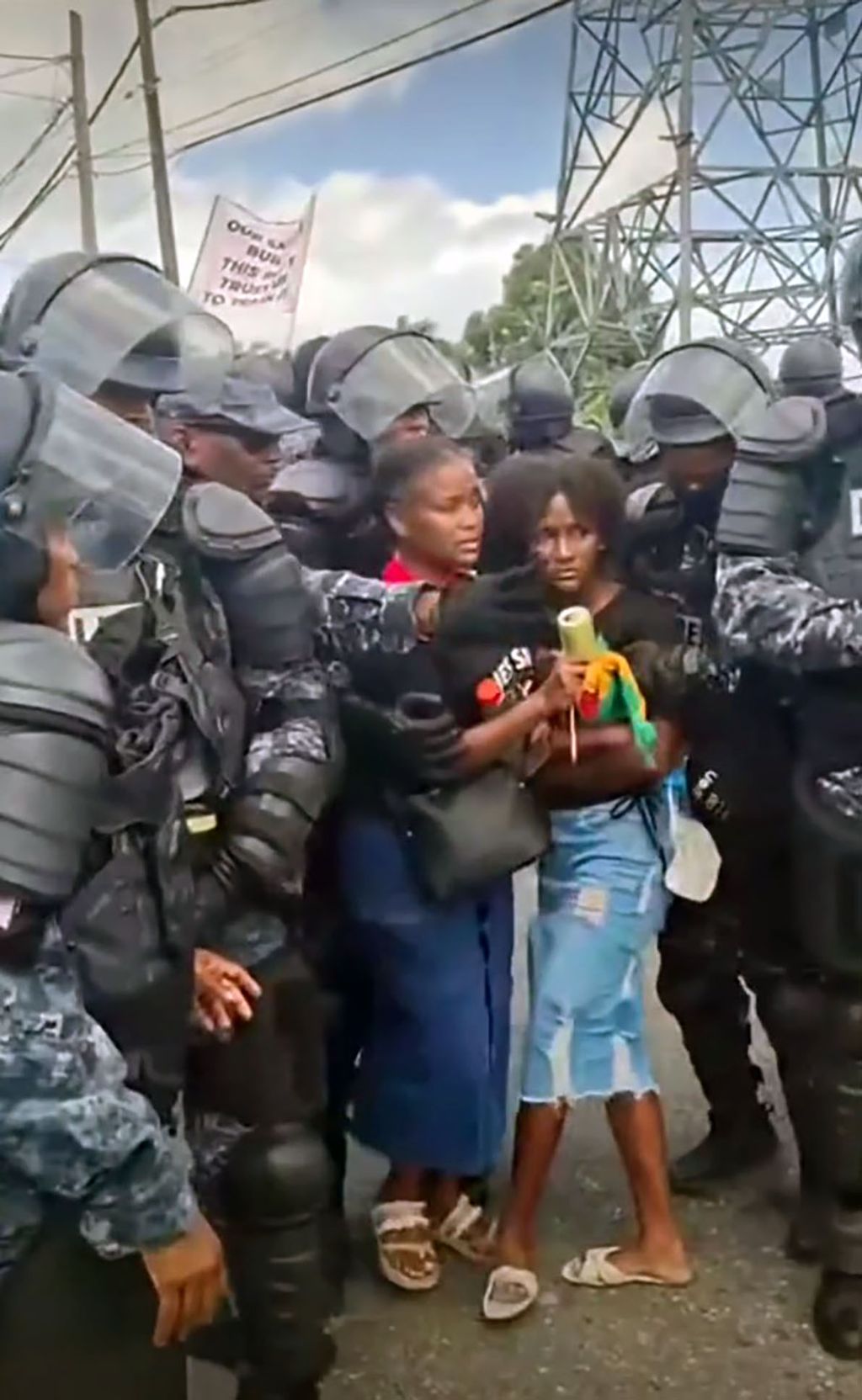
Aware that the public’s ire had been ignited with the move to allow the officers to continue working as normal, the CoP said aggrieved persons had the option to exercise their constitutional rights by protesting, as had been seen with the 19 Bullets, 19 Protests Campaign led by Alyssa Phillip.
“I had no problem with them protesting. In fact, they protested in front of the Red House on the first day. They protested in front Police Headquarters the second day. They protested in front several police stations along the East-West Corridor, and they did peacefully, but at some point in time, intelligence suggested to us that persons who were not like-minded in terms of peaceful protests, infiltrated that little protest group and it became somewhat adversarial to the public interest and thus, at the 16 to 17 protests, the police had to act.”
Guevarro sought to justify his actions, arguing, “We just can’t continue looking at them carrying on and seeing that it was going on a particular trajectory and not stop it, so we decided to act, and I utilised the authority given to me under the various legislation to have a legal notice placed so as to protect particular places in T&T from particular actions.”
Declining to disclose what intelligence had been gleaned to inform this action, he continued, “If you look at the particular places, and I am one who will support the person’s right to freedom of expression and what we are saying is you can come and express yourself freely, just do it within the limit.”
Guevarro reiterated, “In terms of persons being free to protest in T&T, that freedom still exists and it is not being curtailed in any way whatsoever, just do it within what the law represents.”
To those arguing that the TTPS was hiding behind the refrain that “intelligence-led policing” was now being trotted out as the defence for a lot of what was taking place during the SoE, Guevarro responded, “It is unfortunate that the psyche of the citizenry in this country has become one that they tend to disbelieve everything.”
The top cop reminded the public of the old saying, “believe half of what you hear and none of what you see”, he claimed, “I can tell you from where I sit, that there are several things that come to the attention of not only the CoP, but other persons who are in receipt of intelligence data such as the director of the SSA and the Chief of Defense Staff...all these bits of information intelligence comes to us and on a daily basis, we must now assess this information to see what is verifiable and what is not verifiable.”
Without divulging the sensitive inner workings of the national security apparatus, he moved to assure the population that all decisions were taken in their best interest as it pertained to existing and potential threats.
“I would urge the public to place the belief that we are doing so with your interest, to protect you.”
As the leader of the TTPS, Geuvarro explained, “It is for me to take decisions and operate in a particular way with integrity and everything else that comes with the office, to ensure that the perception of the leader also filters down to the general members of the staff.”
“And how do we go about this? We try to root out the negative elements within the society, and within the police service itself.”
Revealing there were currently 290 officers on suspension at the moment, Guevarro said this was transparency and accountability at work in that, “The police service will investigate, arrest, and charge our own.”
Citing the Police Complaints Authority (PCA) as well as the Professional Standards Bureau (PSB) as two oversight bodies to deal with complaints of internal discipline, the Commissioner said, “We have systems that are working to weed out the negative elements.”
Pressed on the fact that police killings are up, he repeated the call for people to lay down their guns.
“When my officers are being asked to respond, place themselves in operational mode or heightened operational mode, and I have to constantly come to the public and beg them and ask them, put down your firearms, call the police, tell them where it is. It’s better to find the firearm than try to engage my officers with the firearm. Yet still, persons find it very difficult to do so.”
He added, “At the end of the day, I again will make a plea to the members of the public who are engaged or feel that this is the only way that they can go through life with criminality, turn your lives away from a life of crime. Give your life to Jesus, Allah, Krishna. Get some religious teachings. Put them into your life.”
Related News
Teachers reject backpay relief delay; nurses welcome timeline clarity
Marcelle accuses government of using ”PNM” as slur
Tobago MPs back SoE extension as Thomas says TPP is part of Government