A push to identify bodies as deaths multiply in Venezuela after twin earthquakes
 03 July 2026
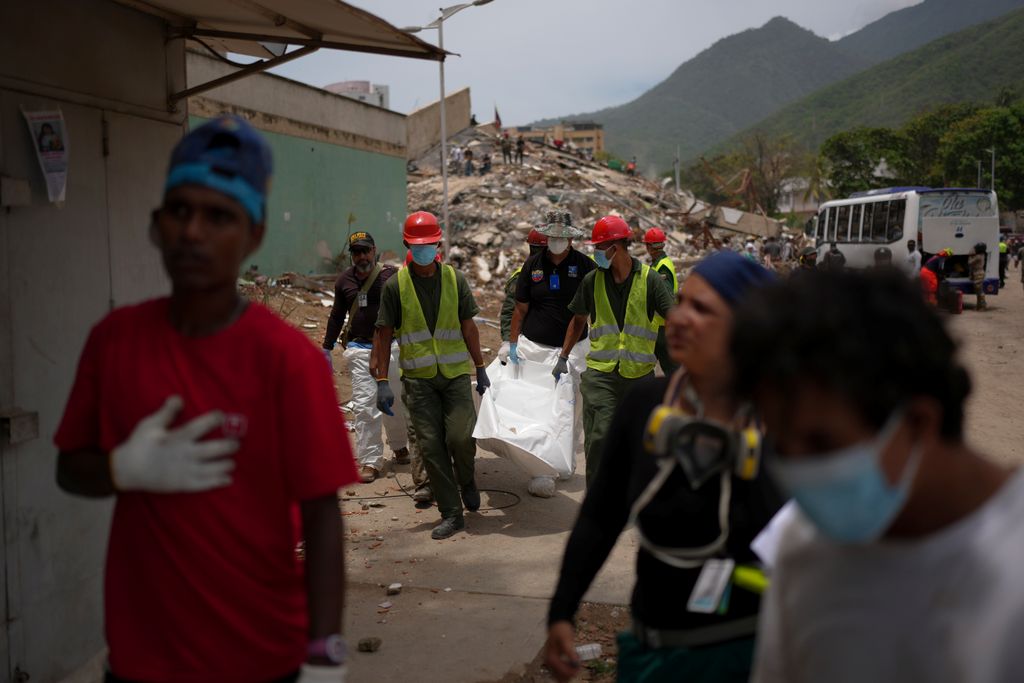

Speaking in a hushed voice, Rosa López recalled how she had to sidestep the rows of bodies lying under a harsh sun as she helped her daughter search for her missing husband. Even her years working as a nurse did not prepare her for the sight of the dozens of dead wrapped in sheets or blankets.
“We saw a lot of bodies that had not yet been identified,” López said.
The rush is on across La Guaira, the state on Venezuela’s northern coast hardest hit by the powerful back-to-back June 24 earthquakes, to identify loved ones before it’s too late. With at least 2,295 people killed, Venezuela is overwhelmed with bodies that officials are struggling to collect, identify and preserve for loved ones to claim. Thousands are still missing.
José Antonio Toledo, López’s 25-year-old son-in-law, was found under the building where he was working as a security guard when the quakes struck. Crews took his body to a local hospital, where staff turned them away because there was no space. The body was sent to another facility and eventually transferred to an open parking lot.
A forensic doctor helped the family find him days later, on Saturday. But once they identified his body, they didn’t know what to do with it because they couldn’t afford the $450 that a funeral home was charging.
At almost midnight on Saturday, López got word that the mayor’s office was offering them a free space at a local cemetery, but they had to move quickly to not lose the spot. An hour later, López and her daughter trudged up a hill leading to the cemetery and buried Toledo.
“He was an exemplary person, a boy who liked helping people,” López said.
They saved him from a mass grave that many fear is coming as they search for the bodies of their loved ones.
The number of bodies found is expected to soar
Forensic technician Joel Mirabal has worked for seven days straight since the 7.2 and 7.5 magnitude earthquakes struck.
The 45-year-old estimates that in 60% to 70% of cases, there’s a relative or neighbor available to identify a body when he comes to pick it up. Even so, it’s a struggle, he said, with many relying on tattoos, scars or familiar clothing.
“They don’t look even 10% like what they were in real life,” he said of the victims.
If a body cannot be identified, it goes to forensic specialists working at La Guaira seaport. Private companies have donated large cooling containers to help preserve the bodies, but the number of dead keeps growing.
“Obviously, mass graves will have to be created,” Mirabal said. “The collapse is massive, and the bodies are buried under many layers of debris.”
Mirabal said he and other forensic technicians anticipate spending up to three months collecting bodies.
They drive around the affected areas every day, led by rescue crews and civilians who have recovered or spotted bodies.
“Many of the rescues are carried out by the people,” he said of the thousands of ordinary Venezuelans who have pitched in for the recovery effort.
A dog trainer by profession who once helped the government locate drugs and missing people, Mirabal finds solace in the 12 dogs waiting for him at home, not counting the puppies. One of his favorites is Mila, a young black Dutch Shepherd who lay by his side on Thursday as he rested.
“It’s not easy at all to witness the suffering and tragedy of your fellow human beings,” he said.
Venezuelans wait in line to try to identify loved ones
Over the weekend, crews took dozens of bodies recovered from flattened buildings to a government-run health care facility in the city of La Guaira. They were left on a sweltering parking lot until families identified them, with funeral home workers estimating that more than 200 bodies were kept there at one point.
On Thursday, those who lost loved ones waited outside La Guaira seaport to identify bodies that authorities continue to pick up across the coastal state. Cars, including trucks and vans from funeral homes, formed a line outside a makeshift morgue.
Among those waiting was Robert Rodríguez. He sat on a concrete block, crestfallen, his legs dangling, waiting for his daughter to identify the body of his son-in-law. Rafael Alvarado died trapped inside a grocery store where he worked at the deli counter.
Rodríguez said the family found Alvarado in the rubble on Wednesday, his body freed and transported to the port on Thursday.
“I saw his shoes and knew it was him,” Rodríguez said, adding that he warned his daughter. “I told her, ‘Prepare yourself.’”
He said the family plans to cremate Alvarado and scatter his ashes on Isla de Margarita, the Venezuelan island that was his home. —LA GUAIRA, Venezuela (AP)
_________
Story by REGINA GARCIA CANO and DÁNICA COTO | Associated Press
Danica Coto reported from San Juan, Puerto Rico.