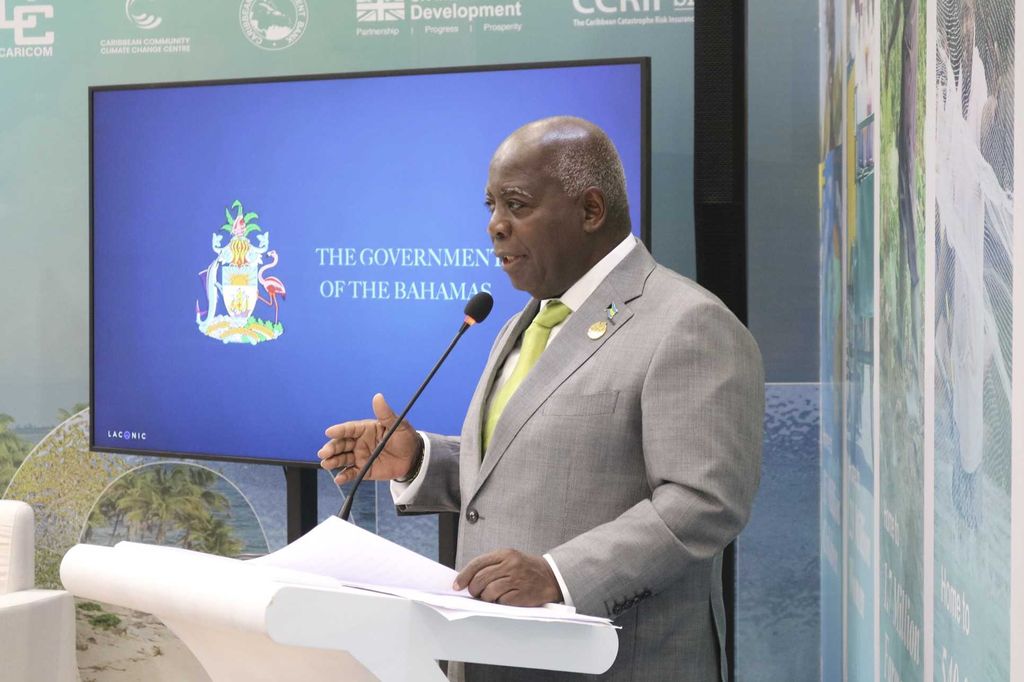

The Bahamas Prime Minister Philip Davis says changes in government and shifting national priorities are undermining efforts to tackle the climate crisis, warning that small island developing states cannot afford to keep inheriting promises that are never fulfilled.
Speaking to the Guardian Media on the sidelines of COP31 in Antalya, Türkiye, Davis said the international climate negotiations must move beyond dialogue, declarations and communiqués towards concrete action that countries can rely on, regardless of changes in political leadership.
He argued that while there has been political will among countries to address climate change, changes in administrations have repeatedly disrupted progress made through the United Nations climate process, which has been running for almost three decades.
“The challenge with COP over the last 29-plus years is the fact that we inherited promises made by others and, depending on the goodwill of individuals, we carried those promises and we have not been able to deliver,” Davis said.
“Whereas there is the political will, I think it’s just that political change has been the enemy of progress in this space that we have been fighting for, particularly small and developing states like ours.”
The Prime Minister said his expectation for COP31 was that countries would continue pressing for implementation rather than allowing negotiations to become another exercise in making commitments without meaningful follow-through.
“This COP, I trust that we will continue to press for action as opposed to continue dialogue. We want concrete outcomes, quite apart from communiqués and declarations,” he said.
Davis called for mechanisms to be established that would protect climate commitments from being reversed whenever a new government takes office.
He said incoming administrations often introduce their own priorities, challenges and approaches to climate change, resulting in delays or the abandonment of initiatives pursued by their predecessors.
“We need to find a mechanism where we could entrench gains that could not be reversed because of a political change,” he said.
Despite his concerns about the pace of international climate action, Davis maintained confidence in the COP process, describing its shortcomings as structural challenges that must be addressed rather than reasons to abandon the negotiations.
On the increasingly difficult prospect of limiting global warming to 1.5 degrees Celsius above pre-industrial levels, Davis acknowledged that the world had moved beyond the threshold, describing this year as particularly challenging.
“I’ve been warning that we’re not going to meet this threshold from 2021,” he said.
However, he cautioned against surrendering to the prospect of missing the target, arguing that there could still be an opportunity to reverse the trajectory if countries follow through on their commitments.
“We’re not to lose hope. There may be an opportunity to reverse it if we go and do what we say we’re going to do,” he said.
For The Bahamas, a low-lying island nation particularly exposed to climate-related threats, the question of implementation carries significant implications for its long-term resilience and development.
Davis also pointed to the importance of regional cooperation, welcoming The Bahamas’ formal accession to the agreement establishing the Five Seas initiative.
The move, formalised during a recent COP-related engagement in Miami, strengthens the country’s participation in a regional arrangement that Davis said it had supported for some time.
He described the development as consistent with his longstanding commitment to Caribbean integration, arguing that participation in regional institutions was an important step towards strengthening cooperation among Caribbean countries.
“Caribbean integration has always been part of my agenda, and every step towards that, by becoming part of institutions and becoming a part of whatever Caribbean is, is always something that I embrace,” he said.
His remarks come as Caribbean countries continue to push for greater international accountability on climate commitments, particularly on financing, adaptation and support for vulnerable states.
For Davis, however, the central challenge remains ensuring that agreements reached at international climate negotiations survive beyond the governments that sign them.