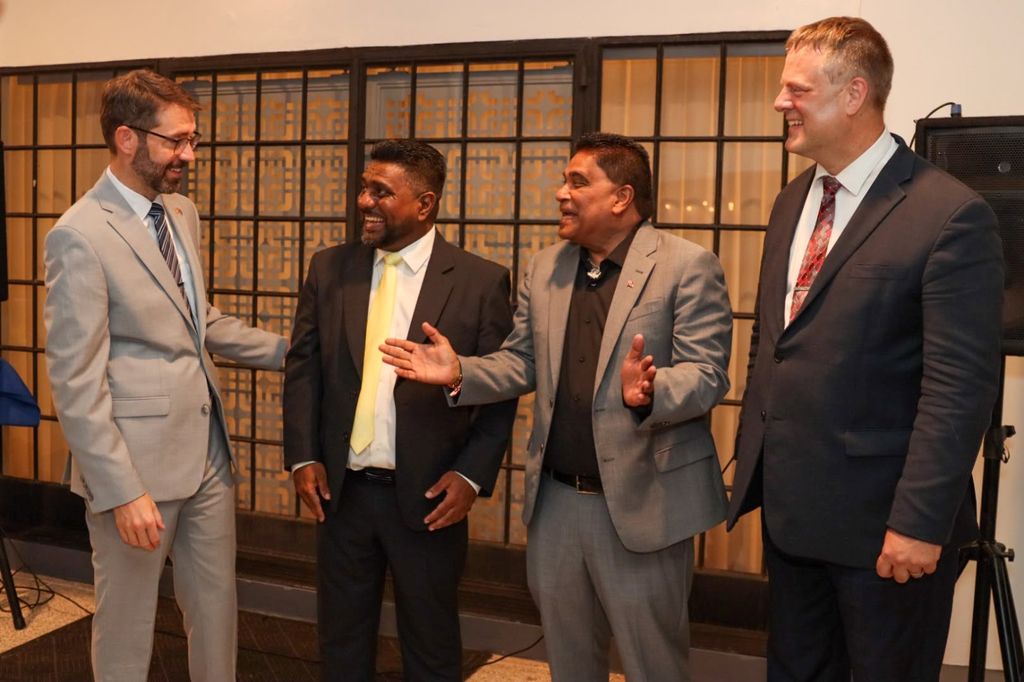

US Chargé d’Affaires Philip Kern says Trinidad and Tobago’s downstream energy sector remains important to both countries, particularly as the country works to secure additional natural gas supplies.
Kern was speaking at a Downstream Energy Industry Reception at the US Chief of Mission Residence in Port of Spain on Tuesday night.
He said the reception was organised to provide an opportunity for the National Gas Company of Trinidad and Tobago (NGC), downstream companies and other stakeholders to meet outside of their usual negotiations.
“It also gives us a chance to hear directly from Gerald about where he sees the industry going, and for the Embassy to say thank you to all of you for the work you do here,” Kern said.
Addressing NGC Chairman Gerald Ramdeen, Kern said he took over the company at a difficult time.
“You took over NGC at a difficult time. Gas supply was tight. The company was under pressure to improve its commercial position. And the downstream companies in this room were trying to make investment decisions without much certainty about how much gas would be available, at what price, or for how long,” he said.
Kern said the last round of negotiations had been difficult and several of the resulting contracts were shorter than the companies would have preferred.
“The last round of negotiations was hard. I know the producers here felt that. Several of the resulting contracts were shorter than they would have preferred. I suspect Gerald would agree that nobody wants to negotiate the future of an industrial plant a year or two at a time,” he said.
He said NGC was also working on the supply side of the problem.
“Over the past year, Gerald and his team have renewed important relationships with upstream producers, pushed forward new sources of domestic supply, and put serious effort into the cross-border resources that could eventually bring more gas into Trinidad and Tobago,” Kern said.
“That work does not solve the shortage overnight. Gas projects take years. But the only way to have more gas available three or five years from now is to do that work today.”
Kern said if that upstream work delivers as planned, the next round of downstream negotiations should take place against a better supply picture.
“I hope that gives NGC and the companies here room to think further ahead. These plants are capital-intensive businesses. They need enough certainty to maintain equipment, plan turnarounds, invest, and decide what comes next,” he said.
Kern said the United States had a particular reason to care about the health of the industry.
“Trinidad and Tobago is an important fertilizer supplier to the United States. Ammonia and urea produced here eventually reach American agriculture. So, when I say we like the downstream, part of the reason is very practical. It helps feed people in our country,” he said.
He also outlined the economic importance of the downstream sector to Trinidad and Tobago.
“But there is also a strong economic case for the downstream here in Trinidad and Tobago,” Kern said.
“Gas that goes into an ammonia or methanol plant earns revenue for NGC. The plant pays taxes. Its employees pay income taxes. It supports the contractors who maintain the equipment, the trucking firms, the caterers, the insurers, the port, and a much larger industrial economy around Point Lisas.”
Kern said there was “a credible argument” that, over a full price cycle, a molecule of gas used in the downstream could return as much value to Trinidad and Tobago as a molecule sold as LNG.
“That argument is harder to make today with LNG prices where they are. But today’s LNG price will not last forever, and neither will today’s ammonia or methanol price,” he said.
“That is why keeping a viable downstream matters.”
Kern said the downstream sector also strengthened the case for upstream investment.
“An investor considering a new gas project needs somewhere to land that gas. Trinidad and Tobago already has a large industrial market, built over fifty years, ready to take it,” he said.
“That existing industrial base is an advantage when Trinidad and Tobago competes for upstream investment.”
Kern said the US Embassy would continue to support American companies interested in Trinidad and Tobago.
“The Embassy will continue to support American companies that want to invest in Trinidad and Tobago, supply equipment and technology, develop resources, and build commercial partnerships,” he said.
“We want the United States to be the partner Trinidad and Tobago turns to as it develops its energy resources, and we want the investments made here to support prosperity in both our countries.”
Related News

Illegal immigrants and sheep intercepted in Chaguaramas

CIA releases dozens of presidential daily briefs on bin Laden and al-Qaida before Sept. 11
Independent Senators happy with changes in new bill